IT staff augmentation in Switzerland: a customer-data access checklist

Your internal team owns a customer-data platform but needs more engineering capacity to maintain it. An external engineer may need access to repositories, support records or production-adjacent systems. For you as a CTO or business leader, the first decision is not simply who is available: it is who will direct the work, what information they can see and how you will retain control.
IT staff augmentation in Switzerland can suit a team that already has technical leadership. A dedicated development team may suit a defined stream of work, while a staffing agency serves a different sourcing need. This article shows how to choose between them and agree access, IP, onboarding and day-to-day steering before work begins.
Choose the operating model before you buy capacity
Start with the work you need covered. If your tech lead can prioritise tickets, review output and make platform decisions, team extension gives you additional engineers within that structure. If a substantial workstream needs its own delivery rhythm, consider a dedicated squad, potentially with a tech lead. If your primary need is for an agency to source people under a staffing or hiring arrangement, assess that route separately: the contractual and supervisory arrangements vary by provider.

- Team extension: your team owns priorities, architecture decisions, approvals and the definition of done; external engineers contribute within those boundaries.
- Dedicated team: agree the squad’s scope, lead, dependencies and decision rights, while keeping a named owner on your side for customer-data risk and acceptance.
- Staffing agency: establish whether it supplies personnel, supports a hiring process or proposes another arrangement. Do not assume its contract, oversight or access responsibilities match a B2B engineering service.
Remoteplatz offers vetted senior engineers and dedicated squads as a direct B2B service, not permanent placement or client employment contracts. Its senior software engineering service describes the available capacity; its engagement models provide a starting point for discussing scope. A B2B invoice does not, by itself, settle every question about a particular arrangement.
Note: Have qualified advisers review the applicable staffing, employment, tax and data-protection requirements, including any cross-border access or processing arrangements; this does not replace legal or tax advice.
IT staff augmentation in Switzerland: compare providers
Ask each provider to explain how its proposed people will fit your platform, not just how quickly they can start. For a customer-data system, evidence of production experience, sound review habits and the ability to work with your existing team matter more than a long list of technologies. Remoteplatz says its senior engineers have at least seven years of proven production experience and that every profile has passed a technical selection process. You should still interview the people who would join your team.
- Fit: describe your stack, operational constraints, team culture and the decisions the engineer may make independently. Use a technical interview with your own team to test the match.
- Coverage: confirm working-hour overlap, who handles urgent issues and whether a proposed squad includes a tech lead. Overlap is not the same as an agreed support commitment.
- Continuity: ask how handovers, absence and a poor fit will be handled. Remoteplatz offers a replacement profile if the fit is not right; agree how unfinished work and access will transfer.
- Evidence: request relevant examples of collaboration without treating a reference as proof of suitability for your data environment. You can review Remoteplatz’s published client references, then assess the proposed engineers on your own requirements.
Keep this assessment specific to customer-data maintenance. If your immediate concern is evaluating an individual’s judgement on an existing system, the senior engineer assessment checklist offers a related approach; it does not replace your platform-specific interview.
Agree data access and IP before onboarding
Assume, for illustration, that your Swiss SME brings in external engineers to maintain its customer-data platform while its internal team handles other priorities. This is not a Remoteplatz client example. Before anyone receives an account, map the tasks to the information and systems they genuinely need. An engineer investigating a test failure may not need the same access as someone resolving a production incident.
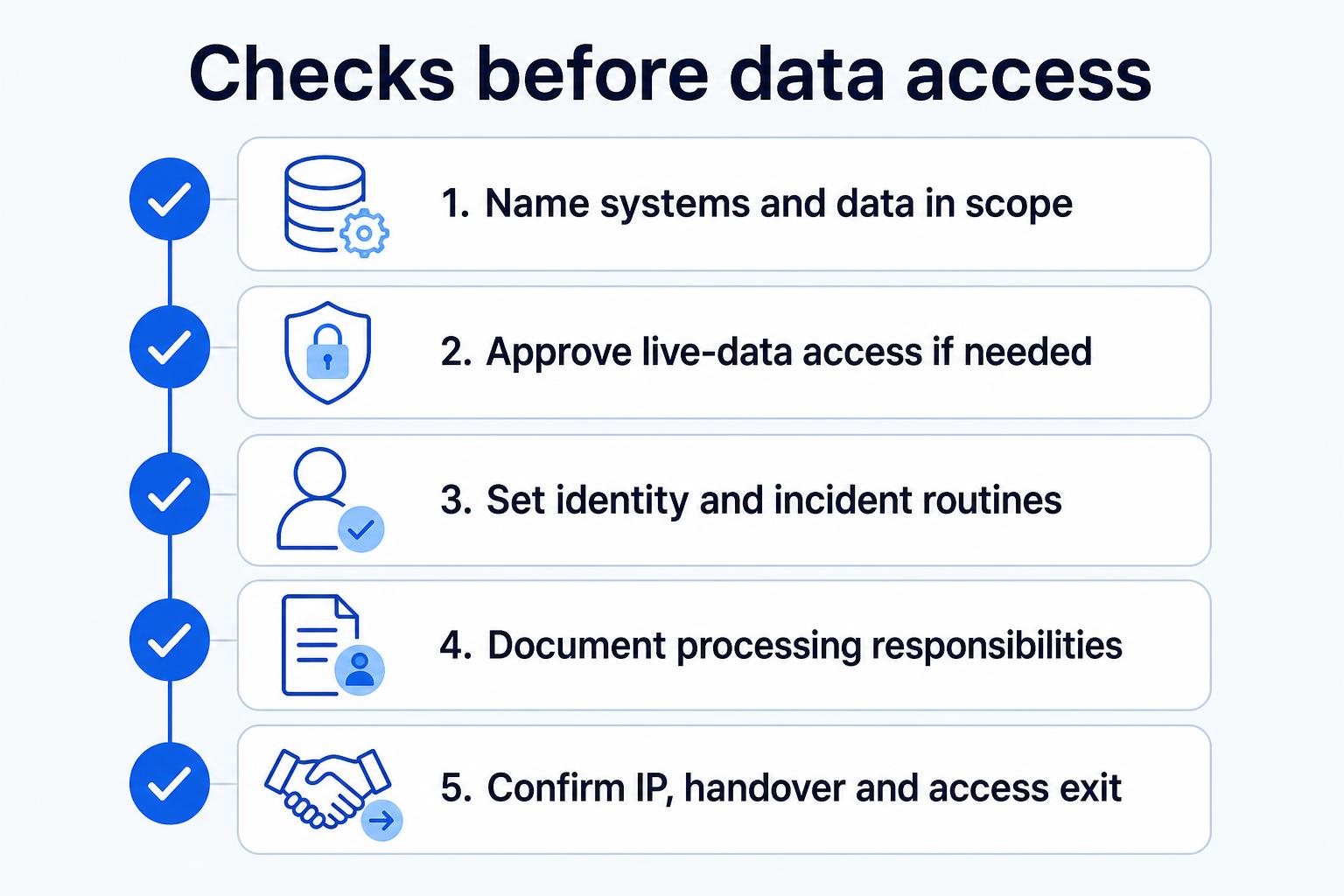
- Access boundary: name the repositories, environments, tickets and data categories in scope. Decide who approves elevated access and when it expires.
- Customer information: establish whether work can use appropriately prepared test data. If access to live customer data is necessary, specify the purpose, permitted actions and oversight.
- Security routine: agree identity management, logging, device requirements and the route for reporting a suspected incident. Assign an internal owner for granting and removing access.
- Data terms: document the relevant confidentiality and processing responsibilities, including any subcontracting or access from another location. Check the arrangements against your obligations under the Swiss FADP and, where applicable, the EU GDPR.
- IP and exit: confirm who owns work results, how code and documentation are handed over, and how access ends. Remoteplatz states that rights to work results, code and IP are contractually assigned to the client; verify that the signed terms cover your engagement.
Make these items conditions for access rather than tasks to tidy up after the first sprint. Ask your security and legal owners to review the proposed access model together, particularly if the existing platform has customers or integrations with different contractual requirements.
Onboard engineers with an accountable steering rhythm
Remoteplatz’s process begins with requirements covering stack, seniority, team culture and goals under NDA. After a scoping call, it says it provides a shortlist within 48–72 hours, followed by a technical interview with your team and onboarding into your tools and rituals. Work usually starts after 5–10 working days. Treat those timings as planning inputs, not a reason to skip your access checks.
Before the first day, designate an internal platform owner and a person authorised to approve access. Give the engineer a bounded initial task, the relevant system context, a review contact and a clear escalation route. Your tech lead should decide how changes are reviewed and released; your business owner should decide which customer-data risks require separate approval.
- Daily work: maintain one prioritised backlog and identify who can change priorities. A dedicated squad still needs a client-side decision-maker.
- Acceptance: define what must be reviewed, tested and documented before you accept work or grant wider access.
- Escalation: agree who responds to blocked work, access requests and incidents, and which decisions cannot be made by the external team alone.
- Review point: check after the initial work whether access remains appropriate, handovers are usable and your internal team still has enough knowledge to operate the platform.
If you lack a technical owner who can make these calls, adding engineers alone may not solve the constraint. Consider whether you first need temporary technology leadership; the agency-exit leadership checklist illustrates the ownership questions to resolve when an external party holds too much system knowledge.
Compare total scope and agree an exit
Ask for an offer that identifies the proposed capacity, role boundaries, expected collaboration and how you can scale up or down. Compare options on more than the service charge: your own leadership time, onboarding effort, access administration, review capacity and handover work all affect the decision. Remoteplatz does not publish concrete prices or day rates; currency and VAT are clarified in its individual offer after scoping.
Agree what happens when priorities change. Can an individual engineer move to a different task? When would a dedicated team need a revised scope? What notice, handover materials and access-removal steps apply when work ends? A good exit is not merely a contract date: your team should be able to locate decisions, operate the platform and account for who still has access.
Keep this customer-data decision distinct from a general launch plan. If you are organising a broader first engagement across an industrial business, the industrial SME launch checklist addresses that wider starting point.
Frequently asked questions
When should we choose a dedicated team over one external engineer?
Choose a dedicated team when you have a coherent stream of work that needs coordinated capacity and an agreed delivery lead. If your existing tech lead can direct and review a narrower set of tasks, one engineer may be simpler to steer.
Can we let an engineer see live customer data during onboarding?
Only if the task requires it and your organisation has approved the relevant access and data arrangements. Start with the narrowest workable scope, a named approver and a removal plan.
Does a B2B service remove our responsibility for the platform?
No. You still need an internal owner for priorities, risk decisions, access approvals and acceptance of work, even when an external squad manages its own delivery rhythm.
Conclusion
Choose the model according to who can steer the work, then make access, IP, review and exit terms explicit before an engineer joins your customer-data platform. If you want to assess Remoteplatz’s senior engineers or dedicated squads against those requirements, book a technical briefing with your platform owner and decision-makers.