How to assess a pre-vetted senior engineer for a legacy-system migration
Technically reviewed by Karl Zakhary, Software Engineer at RaiseNow

Assume your Swiss industrial SME needs temporary senior engineering capacity to migrate a system that operations still depend on. A provider can introduce pre-vetted IT professionals quickly, but general technical screening cannot establish whether one engineer is right for your particular migration.
Your decision should rest on demonstrated production judgement, a technical interview built around your constraints, clear ownership and a workable onboarding plan. This article shows how to make that assessment without treating a shortlist as a substitute for due diligence.
What should pre-vetted IT professionals already have demonstrated?
Start by separating the provider’s selection process from the evidence your project needs. Remoteplatz says its senior engineers have at least seven years of proven production experience and have passed a technical selection process. Its stated baseline also covers distributed systems, modern CI/CD, testing and review practice, fluent English and working hours overlapping with CET. Ask how the proposed engineer’s experience applies to your migration rather than assuming that every screened engineer has migrated a comparable industrial system. The senior software engineers service describes the external capacity available; your team must still assess the individual fit.
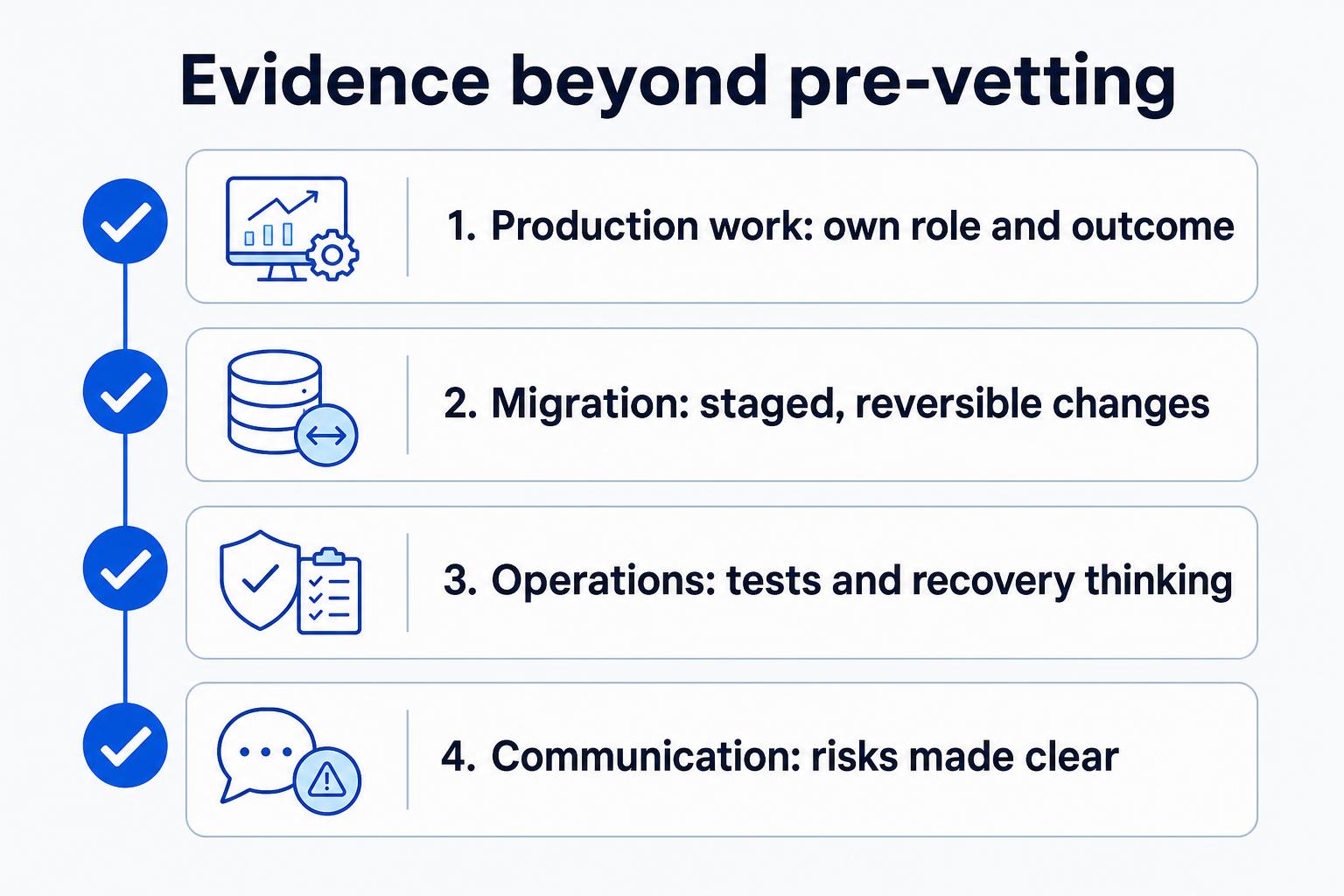
- Relevant production work: Ask for a specific account of changes made to a live, business-critical system, the engineer’s own responsibility and how operational continuity was protected.
- Migration judgement: Look for evidence that they can identify dependencies, plan reversible stages and recognise when a cutover is unsafe. Do not require an identical past project if they can explain sound decisions under comparable constraints.
- Working practices: Establish how they use tests, reviews, deployment controls and incident learning with an existing team.
- Communication: Check whether they can make risks, unknowns and decisions understandable to your technical lead and operations owner.
A remote developer vetting service can narrow the field. It cannot validate undocumented interfaces, plant-specific operating windows or the quality of your internal records; your team must supply that context.
How do you run the technical interview?
Give the proposed engineer a short, confidential account of the current system, the intended change, known dependencies and what must not fail. Keep the discussion at decision level: the purpose is to observe their reasoning, not to request unpaid design work or a coding demonstration. If your architecture is poorly documented, first establish what is known and uncertain; the architecture due-diligence guide offers a useful lens for identifying gaps, although its funding context differs from a migration.
- Map the critical path: Ask what they would need to learn before proposing migration stages. Listen for questions about integrations, data dependencies, users and operational deadlines.
- Test a failure scenario: Describe a plausible interruption during transition. Ask what signals would prompt a pause, who would decide and how service would continue or be restored.
- Explore the first increment: Ask how they would choose a limited initial change and establish that it worked before expanding the migration.
- Probe collaboration: Have your tech lead and operations owner ask how the engineer would record decisions, raise blockers and handle disagreement over risk.
Use the same scenario and evaluation criteria for everyone on the shortlist. Record evidence and unresolved questions immediately afterwards; confidence in a polished presentation is not the same as confidence in an operating plan.
Which red flags should stop an assignment?
A strong candidate need not know your system on day one. Concern is warranted when they cannot explain how they would find out, or when they dismiss the people who keep it running. Public client references can help you understand a provider’s wider experience, but they do not establish that a particular engineer has delivered your kind of migration.
- Premature certainty: They promise a cutover plan before seeing dependencies, data quality or operational constraints.
- No recovery thinking: They discuss the target system but cannot describe decision points for pausing, reverting or maintaining service.
- Unclear ownership: Their account of previous work obscures which decisions they made and which belonged to the wider team.
- Weak handovers: They regard documentation, review and operational knowledge transfer as work to leave until the end.
- Unresolved fit: Required working-hour overlap, communication with your team or access to essential expertise remains uncertain.
Resolve material gaps before granting critical access. If the concern is about the assignment’s design rather than the person, revise the scope and reassess instead of relying on a different profile to fix it.
What scope and ownership should you agree before work starts?
Decide whether you need one senior engineer to deliver a bounded part of the migration, a dedicated squad to cover several workstreams, or technology leadership to set direction and arbitrate trade-offs. Remoteplatz offers individual engineers and dedicated squads, optionally with a tech lead. Its engagement models are a starting point for discussing scope and commercial terms; costs will depend on the capacity and responsibilities you request, duration, coordination needs and the uncertainty still to be investigated. Request an individual offer rather than assuming a published rate.
Assign a named internal owner for business priorities, acceptable disruption and final go/no-go decisions. Specify the engineer’s deliverables and decision authority, who approves changes, who supports operations and what evidence will be required before each stage proceeds. If no one in your organisation can own the technical direction, assess whether fractional CTO support would provide the missing oversight. If you need someone to take temporary hands-on leadership through a transition, consider the distinct interim CTO role rather than expecting an individual engineer to fill it implicitly.
Before access is granted, agree confidentiality, system and data access, and how work results and rights to code will be documented. Remoteplatz states that these rights are contractually assigned to the client; check that the proposed agreement reflects your project’s needs.
Note: Have qualified advisers review contractual rights, confidentiality and data-access arrangements where necessary; this does not replace legal or tax advice.
How should you onboard the engineer into the migration?
Treat onboarding as the first operating test of the assignment. Remoteplatz’s stated process moves from requirements under NDA to a shortlist within 48–72 hours, a technical interview with your team and onboarding into tools and rituals. That shortlist is a selection milestone, not proof that the system is ready for migration. Work usually starts after 5–10 working days; confirm timing for your particular scope.
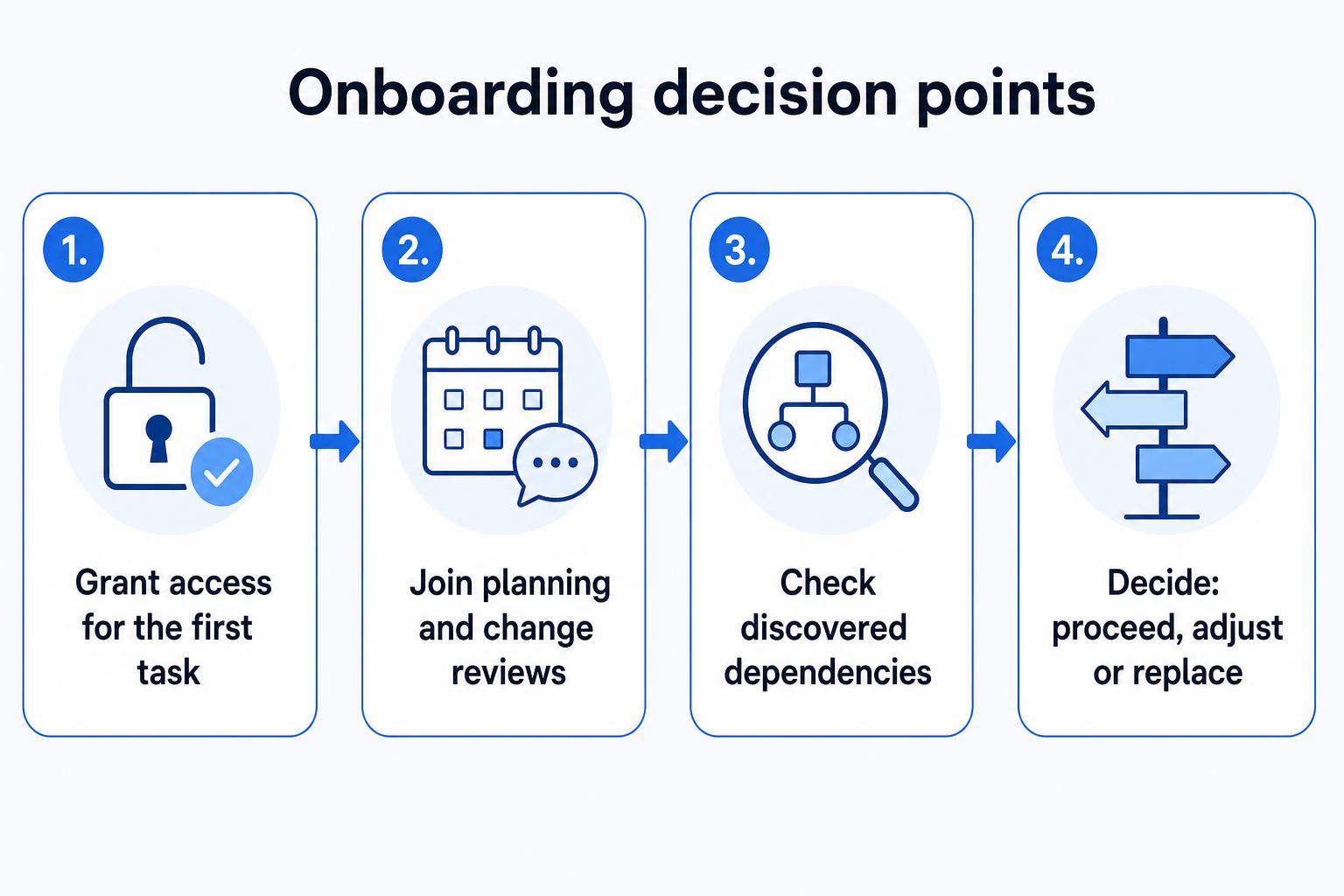
- Give controlled access: Provide the systems, documentation and contacts needed for the agreed first task, with an internal owner coordinating access.
- Join existing rituals: Include the engineer in planning, review, change approval and operational check-ins instead of creating a separate reporting track.
- Validate assumptions: Set an early checkpoint to review dependencies discovered, the proposed first increment and the conditions that would stop it.
- Plan continuity: Require decisions and system knowledge to be recorded as work proceeds, so your team can operate the result and a replacement can take over if fit is not right.
At that checkpoint, decide explicitly whether to proceed, narrow the task, add support or reconsider the fit. Remoteplatz offers a replacement profile if the fit is not right, but a replacement still needs an effective handover.
Frequently asked questions
Does pre-vetting replace our own technical interview?
No. It establishes a provider’s baseline selection, while your interview tests migration judgement against your system, team and operational constraints.
When is one senior engineer insufficient?
Consider broader capacity or a separate technical lead when multiple workstreams must move together, operational support would be stretched or no one owns architecture and cross-team decisions.
What should we decide before requesting a shortlist?
Define the migration goal, critical systems, required skills, internal decision owner, first deliverable and constraints on access or disruption. Mark unknowns openly so they can be tested in the interview.
Conclusion
Choose the engineer whose evidence and interview answers make the migration’s risks clearer, then give them a bounded assignment with an accountable internal owner and an early review point. If you are assessing external senior software engineering capacity for that work, book a technical briefing to discuss the scope and the evidence your team needs from a shortlist.