IT staff augmentation in Switzerland: a launch checklist for industrial SMEs
Your customer portal is due to launch in six months. Your internal engineers know the products and systems, but the launch plan asks them to build new features, maintain existing integrations and prepare for support at the same time. As CTO and CFO, you need to decide whether to hire, use a staffing agency or buy external engineering capacity.
For this illustrative Swiss industrial SME, IT staff augmentation in Switzerland is worth considering if the gap is time-bound and your team can direct the work. It is not a substitute for an owner of the portal, a realistic scope or a decision about long-term capacity. This article shows how to choose a route and what to check before an external team joins the launch.
Choose the route for a six-month capacity gap
Start with the work, not the sourcing label. Identify what must be delivered before launch, what must remain with your internal team and what support will still be needed afterwards. Then compare the three routes against the same criteria: speed of access, control of priorities, total engagement effort and the likely need beyond six months.
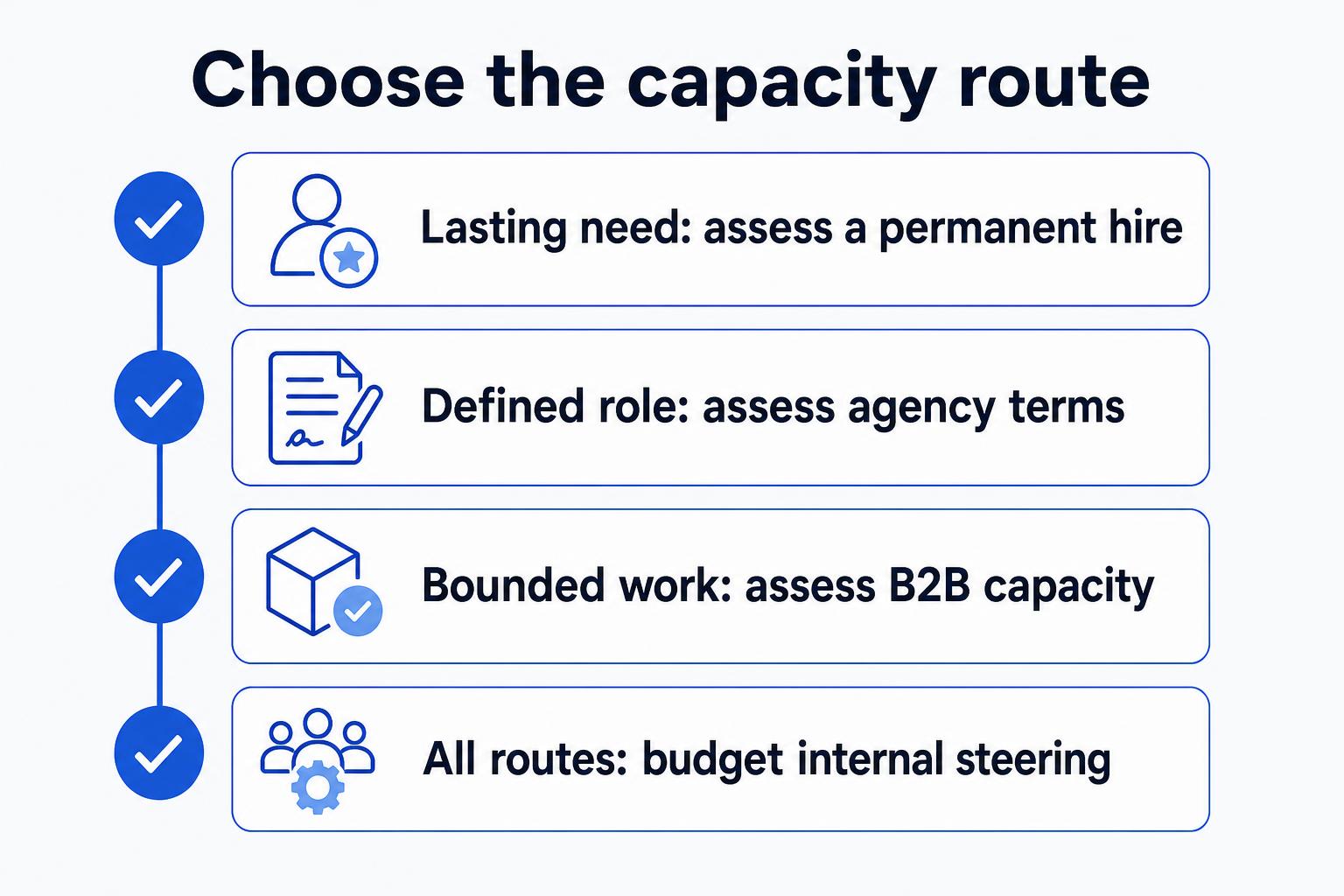
- Hire for an enduring need: A permanent hire makes more sense if portal development and support will remain a core role after launch. Recruitment and the time needed for a new colleague to learn your systems may make it a poor sole answer to an immediate gap.
- Assess a staffing agency for a specified role: If you need a person to fill a defined position under your day-to-day direction, ask the agency to explain its contractual model, who employs or contracts the worker, and who handles administration. Do not assume every agency arrangement works the same way.
- Assess a B2B engineering service for bounded delivery capacity: If your CTO can own the roadmap and reviews but needs experienced engineers for the launch period, a team extension or dedicated development team may fit. You still need to budget for internal product decisions, access, reviews and handover.
The CFO should compare more than the supplier invoice: include internal management time, onboarding, coordination, procurement and the consequences of work remaining unfinished at launch. The engagement models and costs page provides context for discussing the commercial structure; request an offer for the actual scope rather than treating one model as automatically cheaper.
Where IT staff augmentation in Switzerland fits
Remoteplatz provides vetted senior software engineers and dedicated squads directly B2B, rather than permanent placement or an employment contract between the engineer and your company. You can scope an individual engineer or a squad, optionally with a tech lead. Remoteplatz invoices the client monthly for the service; currency and VAT are clarified in the offer. Your CTO should still decide whether the work can be divided into outcomes that external engineers can take on without fragmenting ownership of the portal.
For this scenario, one possible division is for your internal team to retain product priorities, decisions about existing industrial systems and release approval, while external engineers take responsibility for agreed portal work under shared review and testing practices. That is a proposed operating model, not a claim that every portal can be split this way. If the scope resembles an existing release backlog rather than a new industrial portal, the SaaS release-backlog example offers a useful comparison. If an older integration is the principal risk, use the legacy-migration assessment to frame your technical interview.
The approved Remoteplatz process begins with requirements covering stack, seniority, team culture and goals under an NDA. A shortlist follows within 48–72 hours of scoping, then your team conducts a technical interview and the selected engineers join your tools and rituals. Work usually starts after 5–10 working days. Treat those timings as planning inputs, not a reason to delay access approvals or assume a launch date is secured.
Assign steering, IP and data responsibilities
Before selecting a supplier, name the internal owner for product trade-offs and the technical owner for integration, review and release decisions. If your CTO cannot provide that direction during the launch period, adding engineers alone may increase coordination rather than throughput. You may need to establish leadership capacity first; CTO as a Service describes a separate leadership option.
Record who may approve changes to scope, who accepts completed work and who decides whether a release is ready. Set a meeting rhythm that works for your team and external engineers, including escalation when an integration dependency blocks progress. Remoteplatz engineers work in English with hours overlapping CET, but you still need an agreed point of contact on your side.
For IP, confirm that the signed terms assign work results and rights to code and intellectual property to your company; this is part of Remoteplatz’s stated service model. For data protection, map which customer, employee or machine-related data external engineers might access, where access is needed and who approves it. Limit production access to what the work requires, and agree how credentials, test data and access removal will be handled. Remoteplatz states that its collaboration is compliant with the Swiss FADP and EU GDPR; assess the specific data flows and contractual documents for your engagement rather than relying on a general statement.
Note: Staffing arrangements, data protection, IP terms, VAT and any social-security implications depend on the actual contract and working practices. Ask qualified Swiss legal or tax advisers to review the arrangement where relevant; this does not replace legal or tax advice.
Before onboarding: clear the control gates
Use a short joint checklist before granting access. It should produce named owners and evidence of readiness, not just a supplier start date.
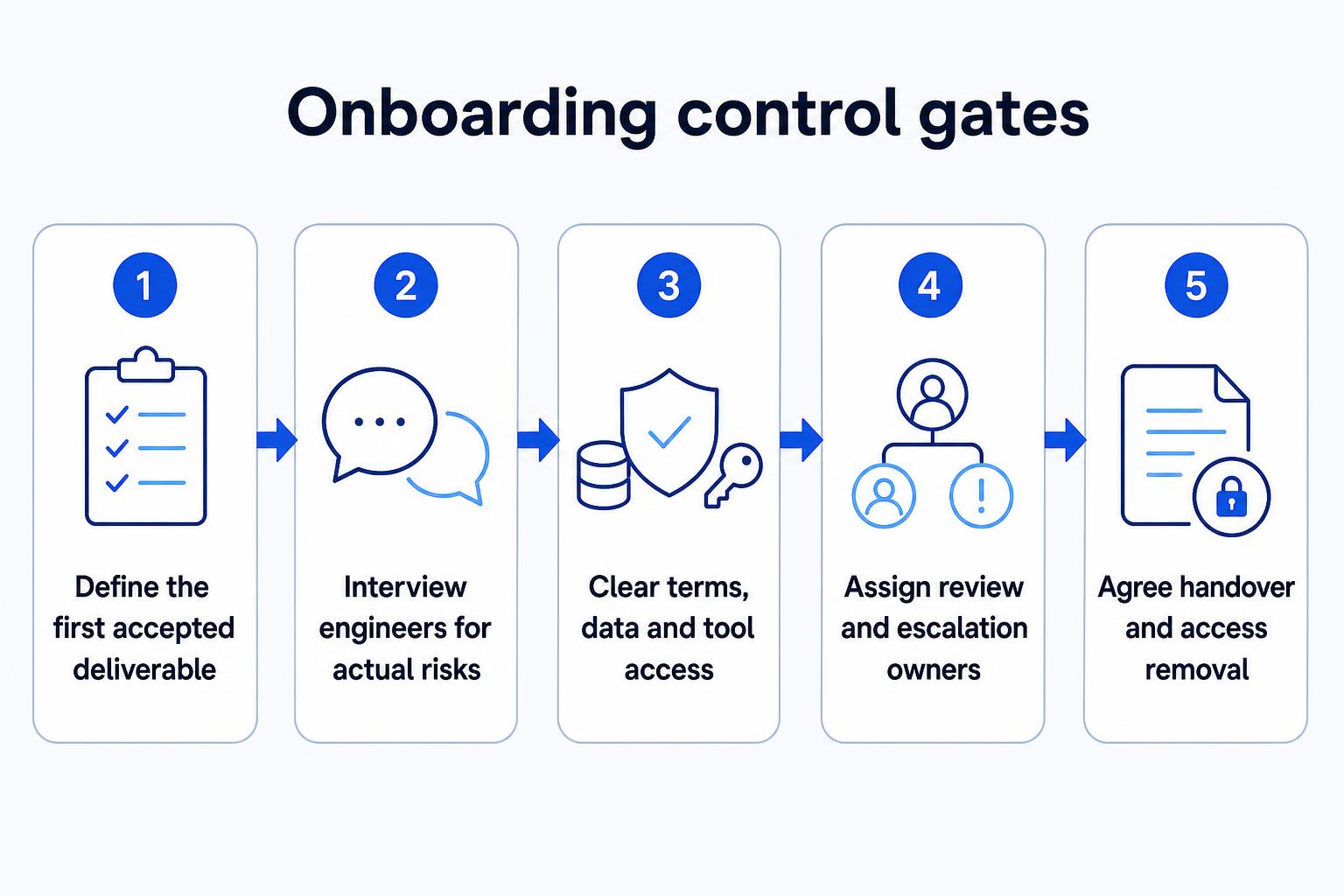
- Define the first deliverable: Give candidates a bounded piece of portal work, its acceptance criteria and the relevant constraints. Distinguish launch-critical work from improvements that can wait.
- Test the fit: Have your engineers interview the proposed people against the actual stack, integration risks, testing practice and ways of working. Ask how they would surface a blocked dependency, not merely whether they have used a particular tool.
- Check agreements and access: Confirm the scope, confidentiality, IP assignment, data-handling arrangements, authorised tools and access approvers before onboarding. Use staged permissions where possible.
- Agree the working rhythm: Identify who sets priorities, reviews changes, resolves questions from other departments and approves completed work. Make time in your internal team’s calendar for those duties.
- Plan the exit: Decide what documentation, demonstrations, access removal and operational handover you will require if capacity scales down after launch.
Remoteplatz offers replacement profiles if the fit is not right, and squads can scale up or down. Those options are useful only if you notice a mismatch early. Put a review point into the plan after the first deliverable rather than waiting until the launch window is nearly over.
Make a launch decision you can revisit
Write down the decision as a conditional plan. For example: proceed with external capacity only if the internal team can reserve review time, the supplier can show a suitable engineer or squad in a technical interview, and security and commercial checks clear before access is granted. If those conditions fail, reduce launch scope or change the timetable rather than assuming more people will absorb the risk.
Set a review at the first accepted deliverable and another before launch preparation begins. At each point, compare completed work with the agreed scope, unresolved integration issues and the internal time spent steering. Decide whether to continue, change the team shape or stop adding capacity. If you want to check the supplier’s public experience before a briefing, Remoteplatz lists its client references; assess any proposed team against your portal’s requirements rather than treating a reference as proof of fit.
Frequently asked questions
When is a permanent hire the better choice?
Choose hiring when you expect the capacity and system ownership to remain necessary well beyond the launch. For an urgent six-month gap, assess whether a hire could realistically contribute in time and what covers the work meanwhile.
Does a dedicated squad take over our portal launch?
Not by default. A squad can deliver agreed engineering work, optionally with a tech lead, but your company should retain clear ownership of priorities, business acceptance and release decisions unless a different arrangement is explicitly scoped.
What should the CFO ask for before approving onboarding?
Ask for a scope and offer that identify the service model, billing terms, internal time commitment, IP and data provisions, review points and handover expectations. Have the appropriate advisers review contractual or regulatory questions.
Conclusion
For a six-month customer-portal gap, choose the route that matches the duration of the need and your ability to direct the work. If you can retain product and release ownership while adding senior engineering capacity, review Remoteplatz’s IT staff augmentation service and book a technical briefing to test the scope, team fit and onboarding conditions before committing.