Fractional CTO in Switzerland: Choosing a Bridge After Your Build Agency Exits

Assume your Swiss start-up’s first product was built by an external agency. Its engagement ends before you onboard your first customer. You need someone who can answer questions about the product, make decisions when problems arise and direct whoever works on it next. The issue is not simply whether the agency delivers a handover document; it is who takes technical ownership afterwards.
A fractional CTO Switzerland mandate may be the right bridge if software is now business-critical but you do not yet need a full-time CTO. A one-off consultant may be enough if you only need a bounded assessment and already have someone who can act on it. This article shows how to make that choice, define the handover mandate and test whether a provider can deliver it.
Fractional CTO Switzerland: leadership or one-off advice?
Start with the decisions that will still exist after the agency’s final day. Who will accept or reject its handover? Who can prioritise a defect against a customer commitment, instruct an engineer and explain the trade-off to you? If those questions have no owner, another report will not close the gap.
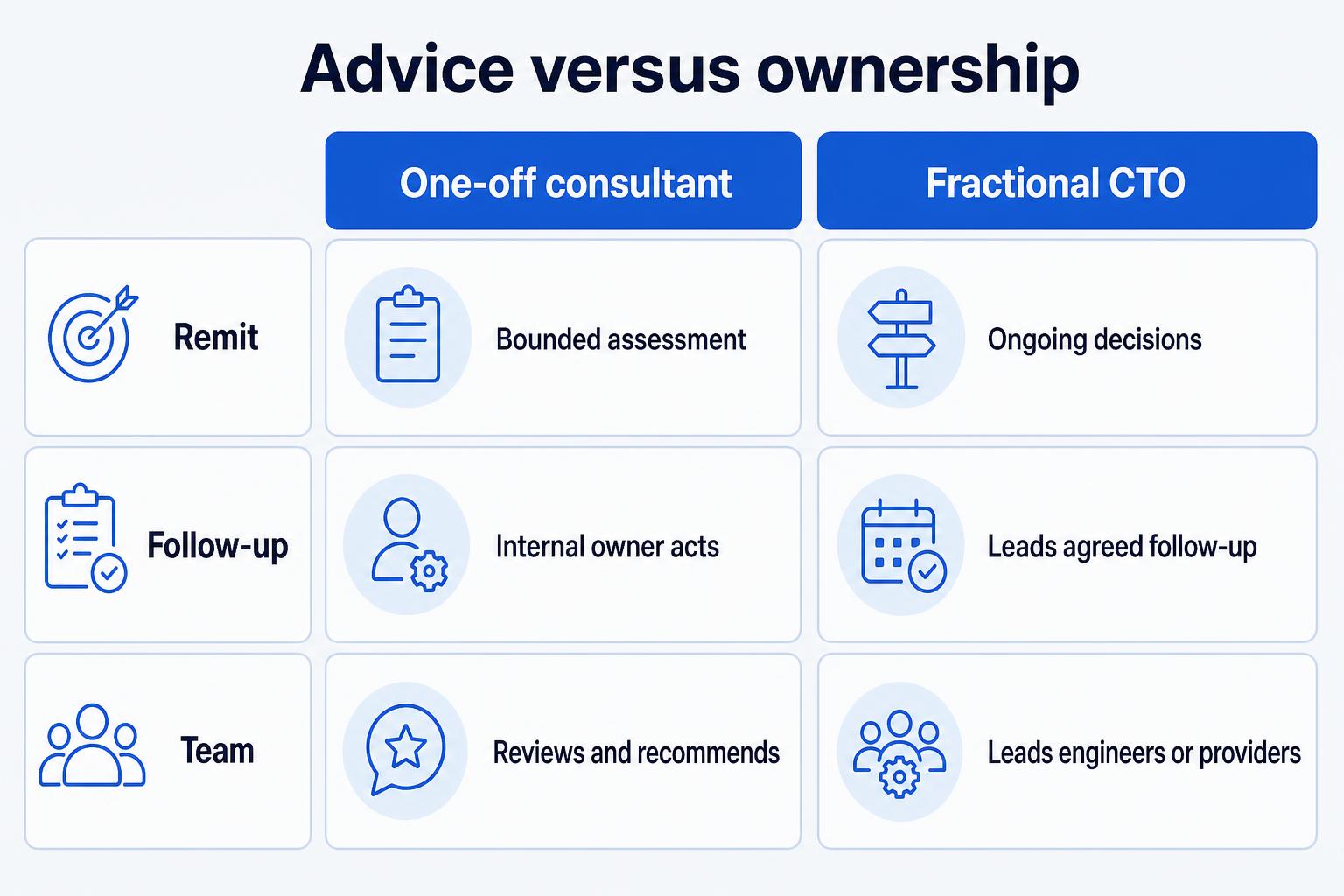
A one-off IT consultant can review architecture, identify risks and recommend next steps. A fractional CTO has an ongoing leadership remit: making technology decisions, leading engineers or providers, and representing technology to leadership. You remain accountable for business priorities and spending approval; the CTO owns the agreed technical decision process and escalates matters that require your choice. The CTO as a Service offering describes that reduced-commitment leadership model.
- Choose a defined consulting project: You have an internal technical owner who can commission the review, challenge its findings and direct the follow-up work.
- Choose fractional leadership: You need continuing ownership across handover, onboarding and the first cycle of product decisions, but cannot yet fully utilise a full-time CTO.
- Consider a more intensive bridge: The exit creates a near-daily leadership gap or an urgent transition that a limited weekly allocation cannot cover. Compare an interim CTO mandate rather than assuming every fractional arrangement provides immediate availability.
If you expect the need to persist beyond the initial handover, the fractional versus full-time CTO comparison can help you frame the longer-term decision. Do not use the absence of a permanent role as a reason to leave current decision rights undefined.
What must the agency hand over before customer onboarding?
Ask the incoming technology lead to turn the agency’s exit into an acceptance exercise, not a document collection exercise. Set a joint handover meeting while the agency is still available. The output should be a short risk register with owners, deadlines and decisions you can understand, alongside access to the materials needed to run and change the product.
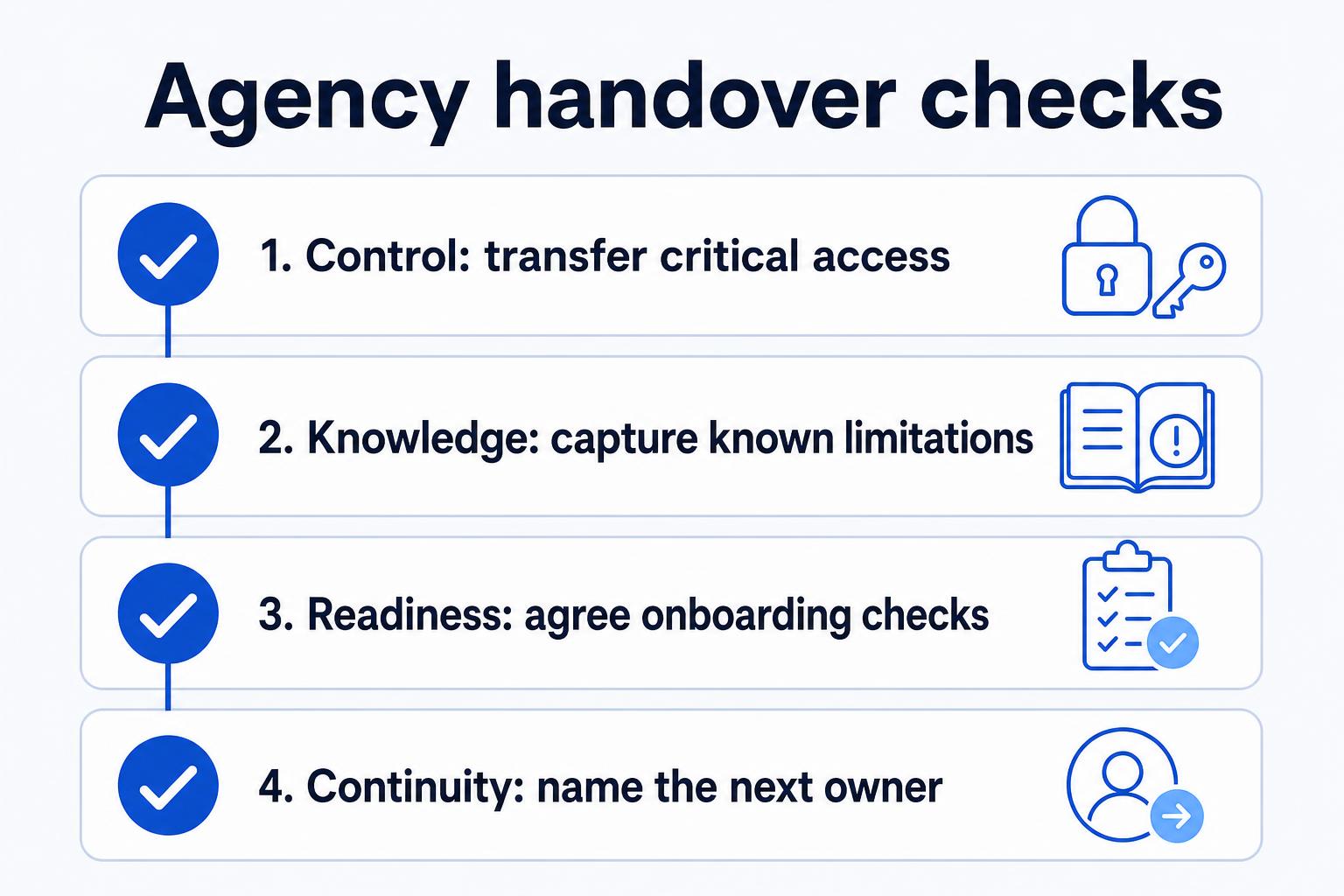
- Control: Identify who controls repositories, cloud accounts, domains, third-party services and production access. Record what still sits with the agency and who will transfer or revoke access.
- Product knowledge: Obtain architecture and integration overviews, known limitations, outstanding work, deployment and recovery procedures, and the route for investigating incidents.
- Readiness: Agree what must be demonstrated before onboarding, who checks it, and who decides whether an unresolved issue is acceptable or blocks the first customer.
- Continuity: Name the person or provider who handles defects, changes and customer-related questions after the agency leaves, including an escalation route when the fractional CTO is unavailable.
Do not treat an agency’s statement that the product is finished as independent acceptance. Ask the CTO to separate matters the agency must close under its existing engagement from work your next team must plan. Have the relevant agreements and access reviewed for code and intellectual-property rights, confidentiality and data handling; these should not be inferred from possession of a repository.
Note: Confirm contractual rights, data-protection duties and any tax or invoicing treatment with qualified advisers for your circumstances; this does not replace legal or tax advice.
How should you scope the time commitment and authority?
Write a mandate around decisions and outputs, not a vague request to “oversee the tech”. Remoteplatz describes its fractional CTO service as typically one to two days a week, with retainers lasting at least three months. That is a planning reference, not a guarantee that the allocation will cover your onboarding. Estimate the cadence you need by listing expected meetings, handover work, engineering leadership and likely decision points; ask what happens between scheduled days.
- First phase: Review the agency’s materials, establish access and decision rights, assess onboarding risks and give you a prioritised handover plan.
- Operating phase: Chair a regular engineering or provider meeting, maintain a technology roadmap, make agreed architecture and vendor decisions, and report material risks to you.
- Boundaries: State who approves spend, signs off customer commitments, directs the agency while its contract remains active and accepts the product for onboarding.
- Availability: Agree meeting cadence, response and escalation expectations, cover during absence, and which urgent work would require a separate arrangement.
- Exit: Define what the CTO must leave behind: decision records, an owned risk register, current access information and a recommended longer-term leadership model.
Cost will depend on the agreed time commitment, the depth of the handover review, whether engineers or multiple vendors need leadership, and how much support onboarding requires. There are no published day rates here: ask for a scoped offer, including what falls outside the retainer. The engagement models page provides context for discussing the arrangement. If the workload changes materially, a fractional retainer can become an interim mandate, and vice versa.
Which provider checks matter before you commit?
Test how the proposed CTO will work with your agency, leadership and next delivery team. A CV alone will not show whether they can challenge an incomplete handover without delaying decisions unnecessarily. Ask the provider to explain its proposed approach using your actual contract end date and onboarding plan.
- Named ownership: Who will perform the work, attend the handover and remain accountable during the mandate? Who handles an escalation if that person is away?
- Comparable judgement: Ask how they would distinguish a launch blocker from manageable follow-up work, and what evidence they would need before advising you to proceed.
- Working relationships: Confirm how they will lead existing engineers, communicate with the departing agency, and present risks and options to non-technical leadership.
- Commercial clarity: Check minimum term, included time, work outside scope, reporting, termination arrangements and responsibility for any separate engineering delivery.
- Control and confidentiality: Check how access, confidential information and work results will be handled and documented in the agreement.
Remoteplatz works directly B2B rather than placing someone into an employment contract with you. Its stated process is a shortlist within 48–72 hours after a scoping call, with work usually starting after 5–10 working days; these are not reasons to postpone planning if your agency leaves sooner. Ask any provider to confirm actual availability against your dates. If a funding event or investor review also shapes the remit, keep that distinct from onboarding: the Series A architecture due-diligence guide addresses a different evidence requirement.
What should you decide at the first briefing?
Bring the agency end date, onboarding target, current team structure, contracts, known risks and a list of decisions nobody currently owns. Ask for a proposed first-month sequence: joint handover, risk assessment, leadership cadence and a decision on readiness. Identify which materials the agency can still explain live, rather than assuming a later reviewer can reconstruct its choices.
End the briefing with an explicit choice: a bounded review if you already have a capable owner; a fractional mandate if ongoing leadership is missing and the agreed allocation can cover it; or a more intensive interim arrangement if the gap is too immediate. Set a date to reassess after onboarding. The separate enterprise-rollout checklist is more relevant if your next decision concerns a first enterprise deployment rather than the agency exit itself.
Frequently asked questions
Can a fractional CTO replace the departing build agency?
Not automatically. The CTO can assess the handover, lead decisions and coordinate engineers or providers, but you must separately identify who will perform ongoing development and support.
Is one or two days a week enough before the first customer starts?
It depends on the outstanding handover work, the team available to execute it and the response your onboarding needs. Agree the allocation and escalation cover against a dated work plan; consider a more intensive mandate if they do not fit.
Should we commission an audit before choosing a CTO?
Only if someone in your organisation can own the findings and direct the next steps. If that owner is missing, include a time-boxed initial assessment within a leadership mandate rather than buying an unactioned report.
Conclusion
Choose the smallest arrangement that leaves a named person able to accept the handover, direct the team and make onboarding decisions after the agency exits. Define that person’s authority, availability and exit outputs before signing; then compare the proposed remit with Remoteplatz’s fractional CTO service and book a technical briefing to test it against your dates and risks.
Discuss your agency exit date, handover gaps and onboarding plan. Book a technical briefing