Technical Due Diligence in Switzerland: A SaaS Sale Checklist
Technically reviewed by Karl Zakhary, Software Engineer at RaiseNow

Your Swiss SaaS company has received a strategic buyer’s first technical information request. The CFO needs to coordinate a response, but the engineering team holds much of the evidence. Before anyone opens a data room or grants system access, you need to know what exists, who can verify it and which issues require a decision.
For technical due diligence Switzerland is not a reason to produce a polished architecture deck while leaving ownership or security questions unanswered. In a strategic sale, you also need to consider what commercially sensitive information the buyer should see, when and under what conditions. This article shows how to organise the review, identify material gaps and prepare a controlled response before formal diligence begins.
Start with the buyer’s request, not the data room
In this illustrative scenario, a Swiss B2B SaaS company has received an initial request from a prospective buyer. The leadership team’s first task is to turn that request into an evidence register. This is an example, not a Remoteplatz client case.
For each request, record the evidence sought, its owner, whether it is current, who can verify it and whether sharing it needs approval. The CFO can coordinate the register and transaction advisers; the CTO or technology lead should validate technical claims. Legal counsel should advise on disclosure terms and rights. The board or transaction lead should decide how to handle material risks and especially sensitive requests.
- Confirm scope: Distinguish documents the buyer needs now from questions better answered in a supervised discussion or later diligence stage.
- Assign owners: Give each response one accountable owner, even where engineering, finance and legal teams contribute evidence.
- Control access: Decide which recipients may see each item and whether a summary, redacted document or demonstration is more appropriate than direct access.
- Record gaps: Mark missing, outdated and unverified evidence explicitly rather than treating an empty folder as a completed response.
A strategic buyer may also ask how your product would fit its systems. Keep that separate from a claim that an integration is already proven. If you are preparing for fundraising rather than a sale, the priorities may differ; our Series A architecture diligence guide addresses that setting.
Technical due diligence Switzerland: what should you inspect?
Your internal technical due diligence checklist should test whether the product can be understood, operated and changed without relying on unsupported assurances. Ask the technology lead to provide concise evidence and an explanation of what it demonstrates; a document’s existence alone does not prove the underlying control works.
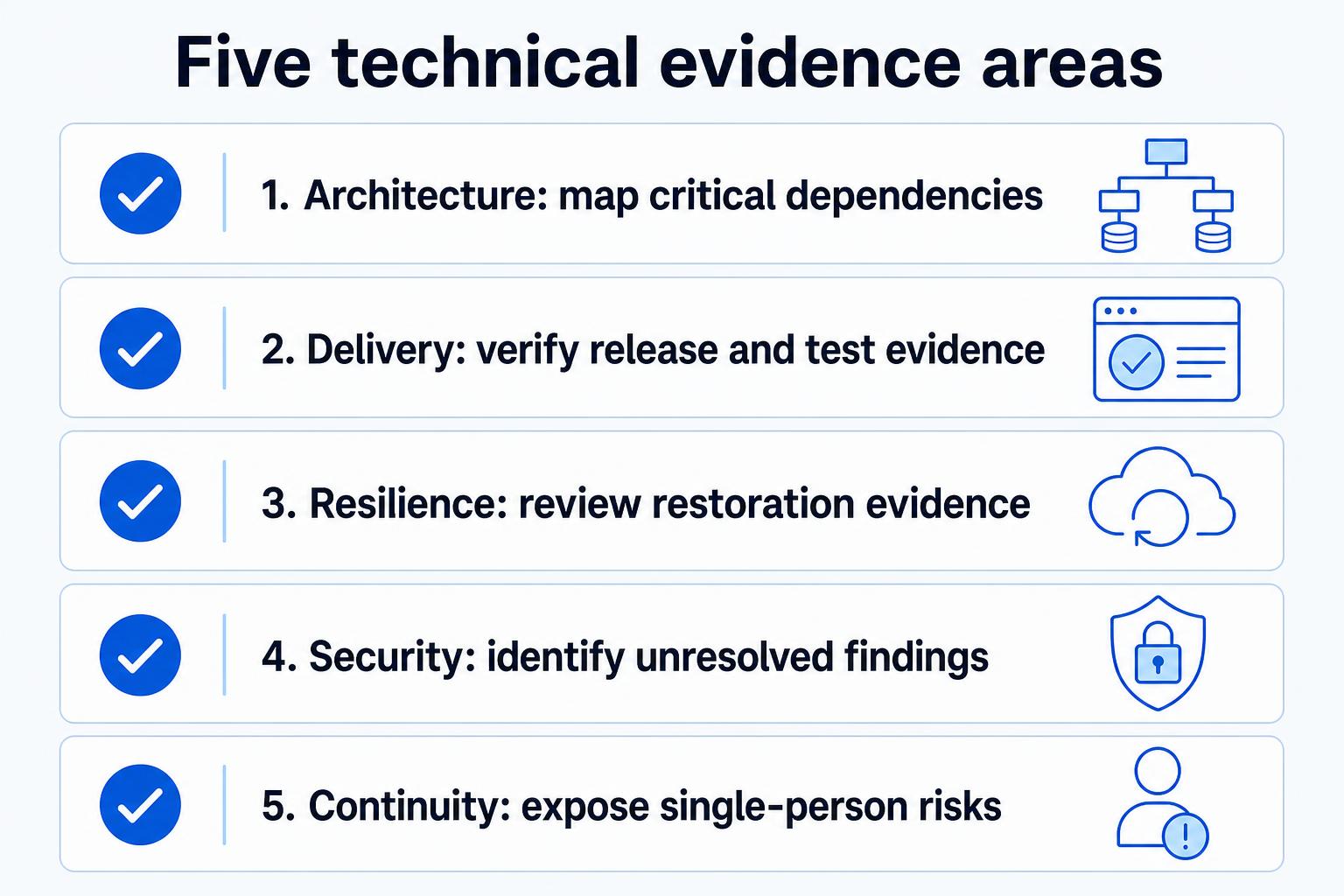
- Architecture and dependencies: Map the major services, hosting arrangements, integrations, critical third-party providers and known single points of failure. Identify where diagrams no longer match production.
- Codebase and delivery: Establish who maintains each repository, how changes are reviewed and released, what test evidence exists and which components are difficult to modify. Review technical debt by business impact, not by the length of a backlog.
- Operations and resilience: Gather incident records, monitoring responsibilities, backup arrangements, restoration evidence and the escalation path for outages. Separate documented procedures from procedures that have been exercised.
- Security and data: Summarise access controls, privileged accounts, vulnerability handling, data flows and relevant supplier arrangements. Identify unresolved findings and who owns them.
- People and continuity: Show who makes architecture decisions, who can deploy and restore the service, and which systems depend on one person or an external supplier.
If an agency built a substantial part of the product, check that your team can explain and operate what was delivered. Our guide to taking over after a build agency exits covers the handover question in more detail. Where an enterprise rollout is also under way, the enterprise rollout checklist can help you distinguish launch-readiness issues from sale-specific evidence.
Verify IP, data rights and supplier dependencies
A buyer needs to understand whether the company can continue to use and develop the technology it is selling. Ask counsel to review the chain of rights for software, designs, datasets and other material assets, especially where founders, employees, agencies or other providers contributed work. The technology lead should identify the relevant assets and contributors; the CFO should locate agreements and flag missing documents. Do not treat a repository access list as proof of ownership.
- IP records: Locate relevant development agreements, assignments and licence terms, and identify gaps for legal review.
- Third-party components: Inventory material commercial software, open-source components, APIs and hosted services, including restrictions or renewal dependencies that may affect the product.
- Customer and personal data: Map what data is held, where it flows and which agreements govern its use or disclosure during diligence. Share only through an approved process.
- Transfer dependencies: Identify accounts, domains, credentials and provider contracts that are critical to operation, without assuming they can be transferred or disclosed as requested.
Note: IP ownership, contract transfer and data-disclosure obligations depend on the relevant agreements and circumstances. Seek qualified legal or tax advice; this does not replace legal or tax advice.
Classify findings before the buyer finds them
Not every issue needs to be fixed before diligence, but every material finding needs an honest status. Use one register for technical risks, evidence gaps and proposed actions. Prioritise according to likely effect on service continuity, customer obligations, the buyer’s ability to assess the product and the time needed to resolve the issue. Have the technology lead validate severity and the CFO or transaction lead agree what must be escalated.
- Resolve now: Address a material exposure or operational weakness where a credible fix and verification are feasible before diligence.
- Document and mitigate: For work that cannot responsibly be completed in time, state the impact, interim control, owner and proposed next step.
- Investigate: Where the evidence is inconclusive, define the question, reviewer and decision date; do not present an assumption as a finding.
- Escalate: Bring potential ownership, contractual or disclosure issues to counsel and transaction leadership before responding to the buyer.
For example, an architecture diagram that omits a critical integration may be corrected and reviewed quickly. An untested restoration process needs evidence from a test or a clearly stated limitation, not a reassuring sentence. A missing agreement with a past development provider belongs with counsel as well as the technical owner.
Run a controlled readiness review
Set a short internal review cycle before formal diligence: collect evidence, test important claims, decide how to handle findings and approve what can be shared. Keep a versioned response register so the buyer receives consistent answers and the leadership team knows which statements remain provisional.
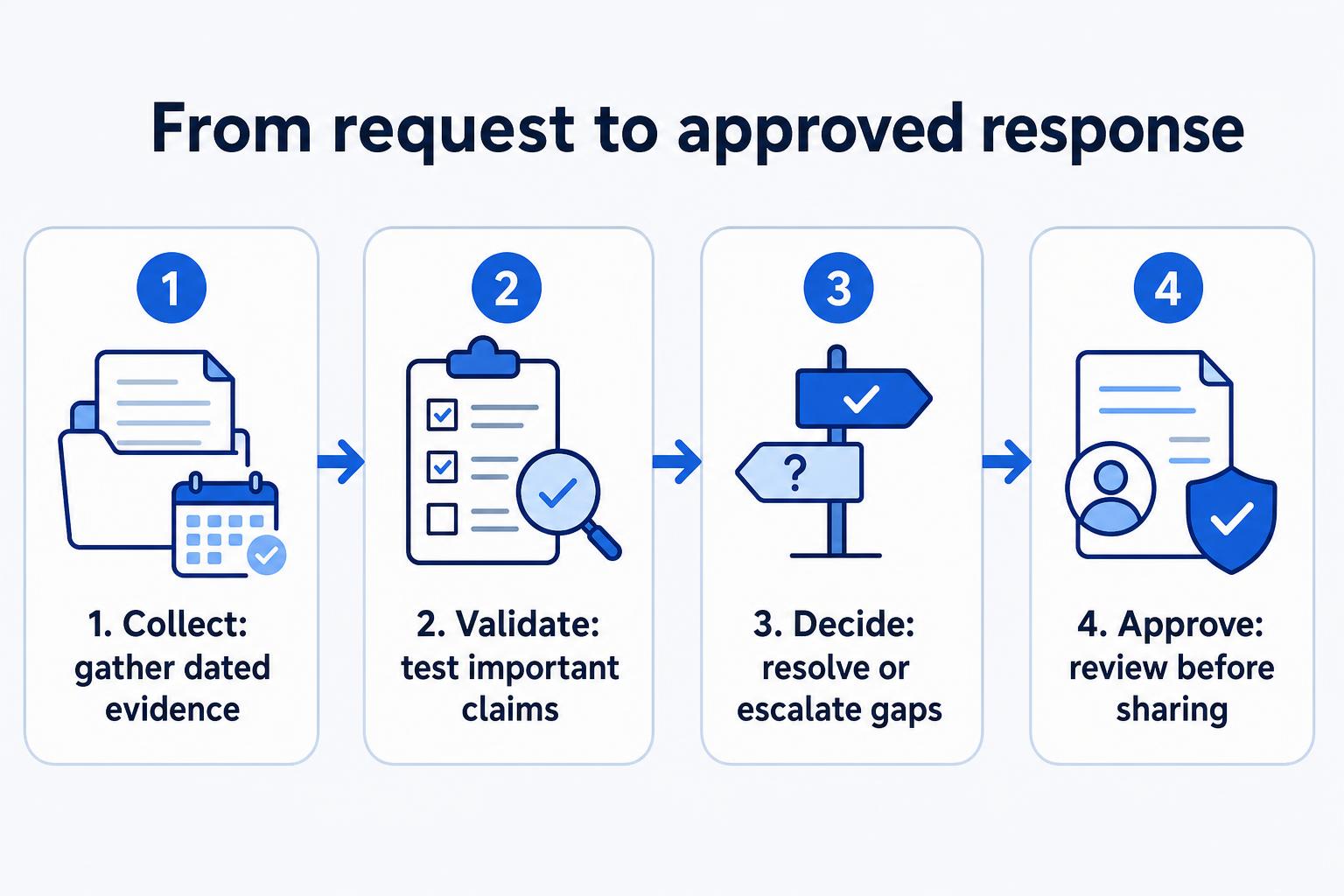
- Collect: Gather current documents and identify their owners and dates.
- Validate: Check important claims against the product, operating records and relevant agreements.
- Decide: Resolve, mitigate or escalate each material gap and agree the disclosure approach.
- Approve: Have the appropriate technical, financial and legal owners review the response before release.
If you lack a senior technology leader who can challenge the evidence and represent the findings to your board, a fractional CTO can take responsibility for the technical review and leadership discussion at a reduced commitment. Agree the mandate, decision rights and deliverables before work starts; the engagement models overview explains how to discuss scope. If a leadership vacancy calls for more immediate continuity, compare that option with an interim CTO mandate. External leadership should strengthen your company’s accountability, not replace counsel or the board’s transaction decisions.
Frequently asked questions
Should you commission a code audit before the buyer asks for one?
Only if it will answer a material question. First map product risks, ownership and existing evidence; then scope a targeted independent review if your internal team cannot credibly assess a critical codebase or dependency. A broad audit without a decision to inform can consume time without improving readiness.
What if a key technical document does not exist?
Identify who can reconstruct it, verify the result against current systems and label its date and limitations. Do not backdate or imply that a newly prepared document was an established operating record.
Should you give a strategic buyer repository or production access?
Not as an automatic response to an initial request. Agree the purpose and stage of access with your transaction and legal advisers, consider less sensitive evidence first, and apply approved access controls if direct inspection is necessary.
Conclusion
A credible sale-readiness review gives you a verified evidence register, clear owners, a ranked list of unresolved issues and an approved way to answer the buyer. If senior technology ownership is missing, explore CTO as a Service and book a technical briefing to discuss the scope of the review before diligence begins.