Fractional CTO Switzerland: What to Check Before Your First Enterprise Rollout

Imagine you lead a Basel-based B2B SaaS company founded by a non-technical team. Your first enterprise rollout is approaching, and decisions about the roadmap, engineering priorities and customer commitments can no longer sit with the founders alone. This is an illustrative scenario, not a client case. A search for fractional CTO Switzerland may surface both ongoing leadership services and one-off advice, but those solve different problems.
The central question is whether you need someone to assess a defined issue or someone who will remain accountable for technology decisions alongside your leadership team. This article shows how to make that distinction, define a workable mandate and check a provider before you commit.
When do you need a fractional CTO rather than an IT consultant?
Start with the decisions that will recur after rollout. An IT consultant can be a good choice for a bounded assignment, such as an independent architecture review or assessment of a proposed vendor. You agree the question, receive findings and decide who will act on them. If nobody in your organisation can turn those findings into priorities, guide the engineers and explain trade-offs to leadership, the gap is ongoing.
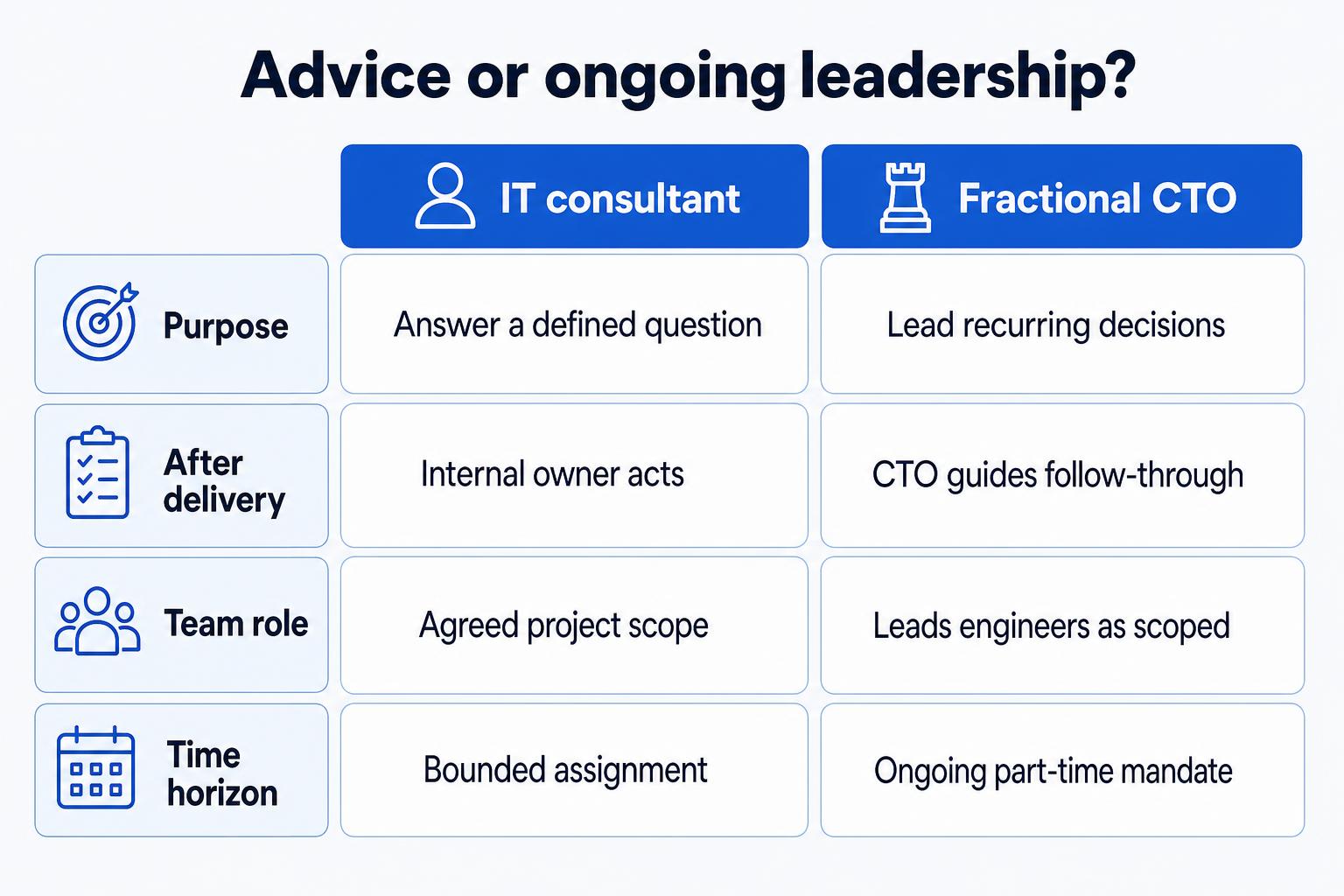
A fractional CTO takes responsibility at reduced commitment: shaping technology strategy, leading engineers and representing technology to leadership, the board or investors. This is most relevant when software is business-critical but a full-time CTO would not yet be fully utilised. For a closer comparison with a permanent leadership role, see fractional CTO versus a full-time CTO.
- Choose discrete consulting: You can name a specific deliverable, an internal owner will implement the recommendations, and the need ends with that assignment.
- Consider a fractional CTO: Technology choices and team priorities need an accountable leader over successive months, but not necessarily every working day.
- Consider interim leadership: You need a more intensive temporary mandate, for example to cover a leadership gap; an interim CTO may be a better fit.
What should the mandate cover before the rollout?
Do not buy a title without defining what the person will decide and what remains with you. Begin with the commitments you expect to make to an enterprise customer, then identify the technology decisions and evidence needed to support them. A fractional CTO can own the technology assessment and recommendations; founders and commercial leaders still own customer promises, budgets and business priorities.
Set outcomes and decision rights
- Roadmap: Agree which rollout dependencies, product commitments and longer-term improvements the CTO will prioritise with leadership.
- Architecture and risk: Ask for a review of important technical assumptions and a clear account of risks, options and recommended decisions. An audit is useful only if someone owns the follow-through.
- Team leadership: Specify who directs the engineers, resolves competing requests and handles escalation when delivery is at risk.
- External choices: Define the CTO’s role in assessing providers, tools and cloud vendors, including who approves a contract or expenditure.
- Reporting: Decide what leadership or the board needs to know, how often, and who can speak for technology in customer or investor discussions.
For each outcome, ask what you will be able to review: a prioritised roadmap, a documented recommendation, an owner for a risk or a decision recorded for the leadership team. If a funding process is also approaching, preparing architecture for tech due diligence is a related but distinct piece of work.
How much time and access will make the role effective?
A reduced commitment does not mean occasional attendance at meetings. Remoteplatz’s fractional CTO service is typically scoped at one to two days a week, with a retainer of at least three months. Whether that suits you depends on the number of decisions, the maturity of your engineering team and the intensity of the rollout—not on the job title alone.
Before requesting proposals, list the meetings and decisions that require the CTO’s presence. You may need regular time with founders to settle priorities, direct access to the engineering lead or team, and a route for urgent escalations between scheduled days. Agree when the CTO will be available, what response expectations are realistic and who acts when they are not working on your account. Do not assume a part-time mandate provides continuous cover.
Make the relationship with your existing team explicit. Engineers need to know which decisions they can make independently, which go to the fractional CTO and when the founder decides a commercial trade-off. If the rollout demands substantially more hands-on leadership for a period, discuss whether a different scope or an interim mandate is more appropriate; a fractional retainer can become an interim mandate and vice versa.
What should you check when choosing a provider?
Use your first conversation to test how a proposed CTO would work with your company, not just whether their background sounds impressive. Give each provider the same brief: your team structure, rollout timing, known uncertainties, customer-facing commitments and decisions you cannot currently resolve. Ask who would actually serve as CTO and how the provider would establish confidence in their fit.

Questions to take into the scoping call
- Ownership: Which decisions will the CTO own or recommend, and which remain with founders, the board or an existing technical lead?
- Working relationship: How will the CTO learn from engineers, handle disagreement and report decisions in language non-technical leaders can use?
- Rollout priorities: What would they examine first, and how would they distinguish a launch blocker from a longer-term improvement?
- Continuity: What happens if the nominated person is unavailable, the workload rises or the mandate needs to change?
- Contractual boundaries: How are confidentiality, access, work results and rights to code and intellectual property documented?
Remoteplatz’s CTO as a Service is a direct B2B service, not permanent placement or an employment contract with your company. Its stated terms provide for contractual assignment of work results and rights to code and intellectual property to the client; you can request an NDA before the first call. Ask how access and information handling will be organised for your systems and customer data. Collaboration should address applicable Swiss FADP and, where relevant, EU GDPR obligations.
Note: Confirm the contractual, data-protection and any tax implications of your specific arrangement with qualified advisers; this does not replace legal or tax advice.
Evidence should match the mandate you are buying. Public Remoteplatz client references concern senior engineers from its network; do not treat them as proof that a proposed individual has led an equivalent enterprise rollout. Ask for relevant experience, a clear account of the proposed CTO’s responsibilities and a discussion with that person before deciding.
How do you compare offers and plan the first steps?
Compare the scope of responsibility before comparing commercial terms. Two part-time CTO services can differ markedly if one includes team leadership and board reporting while another offers advisory calls only. The principal cost drivers to clarify are time commitment, mandate length, the breadth of leadership and assessment work, the support expected around rollout milestones, and any change in scope. Remoteplatz does not publish a price or day rate; terms are set out in an individual offer after scoping. Its engagement models provide further context for the discussion.
Ask for an offer that names the proposed person, expected availability, initial priorities, reporting rhythm, responsibilities, exclusions and how changes will be agreed. Remoteplatz clients receive one monthly invoice from Remoteplatz GmbH rather than administering payroll for the service; currency and VAT are clarified in the offer. There is no placement fee. These commercial points matter, but they cannot substitute for a workable decision-making relationship.
For planning purposes, Remoteplatz states that a shortlist follows a scoping call within 48–72 hours and work usually starts after 5–10 working days. Treat those as planning expectations to confirm for your case, not as a reason to postpone identifying rollout decisions. Before work starts, give the CTO access to the right people and documents, agree the first decisions to be made and put a review point in the diary to check whether the mandate is working.
Frequently asked questions
Can we use a consultant for the rollout and decide on a CTO later?
Yes, if the work is genuinely bounded and someone inside your company can own the resulting decisions. If leadership and engineers will need continuing direction after the consultant delivers, define that ownership before the rollout.
Does a fractional CTO replace our engineering lead?
Not necessarily. Define how the CTO will lead, support and delegate to your existing lead. The important test is whether engineers and founders know who decides priorities and resolves conflicts.
What should we bring to a first provider conversation?
Bring your rollout timetable, team structure, main customer commitments, unresolved technology decisions and an honest view of the time your leaders can give the CTO. That is enough to begin scoping; you do not need to prepare a technical solution yourself.
Conclusion
Choose a fractional CTO when your first enterprise rollout calls for continuing technology decisions and team leadership, not just a report. Define the decisions, access and commitment you need, then test the proposed person and terms against that mandate. If this fits your situation, review Remoteplatz’s fractional CTO service and book a technical briefing to scope the work.
Discuss the rollout decisions, team responsibilities and level of ongoing CTO support you need. Book a technical briefing