Pre-vetted IT professionals: choosing an engineer for a Swiss hospital pilot
Technically reviewed by Karl Zakhary, Software Engineer at RaiseNow

Assume your Basel-based medtech scale-up is preparing for a hospital pilot. Your product team needs another senior engineer, but the question is not simply how quickly someone can join. You need to know whether that person can make sound decisions in an unfamiliar product, work within your controls and leave your team ready to support what goes into the pilot.
Pre-vetted IT professionals can shorten the path to a technical interview; provider screening cannot establish suitability for your particular product or hospital environment. You still own the interview, access decision and pilot release gates. This article shows what evidence to request, how to test engineering judgement and what to agree before work begins.
What should the provider’s vetting evidence cover?
Ask for a concise account of how the proposed engineer was assessed, not just a profile labelled ‘senior’. Remoteplatz states that engineers in its network have at least seven years of proven production experience and have passed technical selection; around 1–2% of applicants are accepted. Those network-level facts are a starting point, not evidence that this individual understands your product or pilot constraints. Its senior software engineering service includes a client-team technical interview before onboarding.

- Relevant production work: Ask which systems the engineer has worked on, what they personally owned, and how their decisions were reviewed. Request examples that bear on your architecture and release process, without expecting disclosure of another client’s confidential material.
- Selection method: Ask what the technical selection tested, who assessed it and how concerns were resolved. Distinguish evidence of testing, review and CI/CD practice from a list of technologies on a CV.
- Collaboration: Confirm English communication, overlap with your team’s working hours and experience working through reviews and incident discussions. Agree how the engineer will raise a concern rather than silently work around a constraint.
- Limits: Ask what the provider has not assessed. A general senior engineer vetting process does not certify knowledge of your quality processes, clinical context or hospital-specific requirements.
Write these answers against your actual pilot work. If the immediate need is product-team capacity, assess one engineer. If several workstreams need coordinated ownership, discuss whether a dedicated squad or another engagement model would fit better. Do not use a broad shortlist as a substitute for a defined scope.
How do you test engineering judgement in the interview?
Give the engineer a short, sanitised description of a real decision your team faces: for example, a proposed change to the pilot data flow when the integration boundary is not fully documented. Do not share patient records, credentials or hospital-confidential documents to make the exercise realistic. Your tech lead should assess the candidate’s reasoning alongside a product or quality owner who understands the pilot’s operating constraints.
Ask for a decision, not a performance
Present the current behaviour, the requested change and the next review milestone. Ask what the engineer would establish before changing the system, what could fail, which options they would reject and what evidence would let the team proceed. A strong discussion should expose assumptions and trade-offs rather than jump straight to a preferred implementation.
- Boundaries: Do they identify where data enters and leaves the product, and who owns the hospital-facing interface?
- Failure modes: Do they consider incomplete data, retries, monitoring and what the pilot team would see when something goes wrong?
- Verification: Can they describe the tests, review evidence and release checks needed for the proposed change without claiming that ordinary code review replaces your formal quality process?
- Escalation: Will they stop and seek a decision when requirements, access authority or acceptance criteria are unclear?
Use the same scenario and scorecard for each shortlisted engineer. Record the answer, the evidence behind it and any question you must resolve during onboarding. Red flags include confident claims made without clarifying the product boundary, a request for production access before the task is scoped, or a proposed release path that bypasses your existing reviewers. For a different assessment context, see the legacy-migration interview checklist; its migration risks should not be mistaken for your pilot risks.
Which access controls must be agreed before the start?
Turn access into a task-by-task decision. Name an internal owner who approves the engineer’s access, an owner who can remove it and the person who confirms what the hospital permits your team to share. Start with documentation and a development environment using synthetic or appropriately prepared test data wherever that supports the work. Grant broader access only when a named task requires it and your internal approval is recorded.
- Identity: Use an individual account under your organisation’s controls, with the authentication and logging you require. Avoid shared credentials.
- Scope: List the repositories, environments, tools and data categories required for the first tasks. Keep production and hospital-system access outside the initial grant unless specifically justified and approved.
- Handling: Agree where work, discussions and evidence are stored, who may export material and how an access or data incident is reported.
- Exit: Define when access is reviewed and revoked, and who checks that work products and outstanding decisions have been handed over.
The customer-data access checklist offers a useful companion for access discussions, but your hospital’s arrangements and your own product controls take precedence. Confirm the applicable confidentiality, data-processing and intellectual-property terms before access is granted. Remoteplatz states that work results and rights to code and intellectual property are contractually assigned to the client, and that it collaborates in line with the Swiss FADP and EU GDPR; verify the terms against your specific data flow.
Note: Have the relevant legal or data-protection advisers review applicable confidentiality, data-processing and access arrangements for your pilot; this does not replace legal or tax advice.
How should onboarding and review gates work?
Before the first day, agree a small initial scope that lets the engineer learn the product without becoming the sole owner of a pilot-critical change. Remoteplatz’s stated process is requirements under NDA, a shortlist within 48–72 hours, a client technical interview and onboarding into tools and rituals; work usually starts after 5–10 working days. Treat that sequence as planning input, not permission to compress your internal approvals.
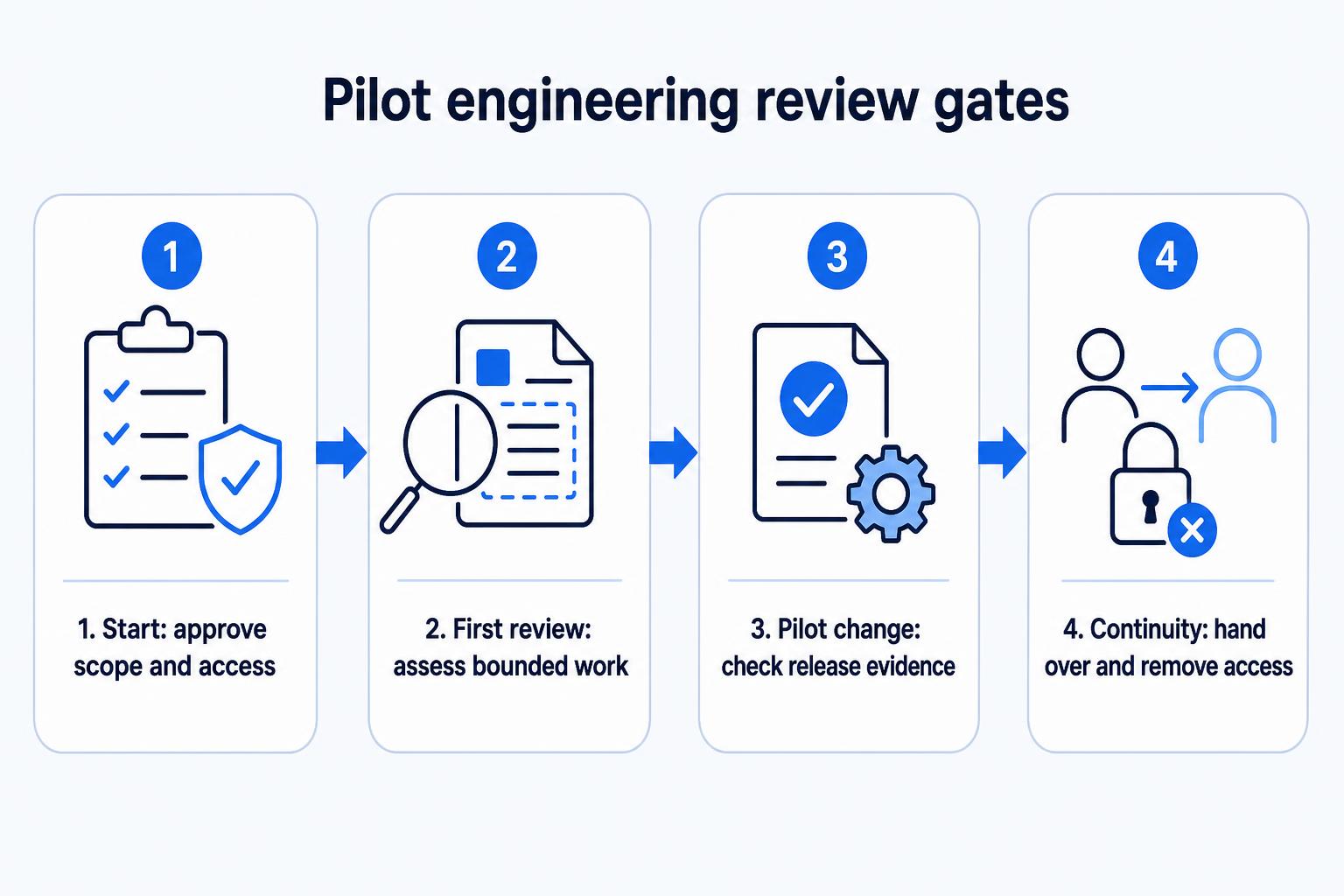
Set gates with an owner and a decision
- Start gate: The tech lead confirms scope, reviewers, approved access and the first tasks; the product or quality owner confirms any required pilot constraints.
- First review: After an initial bounded contribution, review the engineer’s written assumptions, test evidence, communication and response to feedback. Decide whether to continue, narrow the scope or address a fit concern.
- Pilot-change gate: Before a pilot-affecting change advances, your designated owners check the agreed acceptance evidence and decide whether it can enter your existing release process.
- Continuity gate: Before handover or offboarding, confirm documentation, unresolved risks, access removal and who maintains the work.
Put the engineer in your planning, code review and issue-escalation rituals, with a named internal counterpart. An external engineer can strengthen delivery without becoming the accountable owner of your product or hospital relationship. If that ownership is missing, resolve it before buying extra capacity; fractional technology leadership is a different service from adding an engineer.
What should you settle in the buying decision?
Compare proposals against the work and controls you need, not a headline promise to ‘hire vetted developers’. Ask who supplies the engineer, who manages the working relationship, what happens if the fit is wrong and which tasks might require a larger team. Remoteplatz provides a direct B2B service rather than permanent placement, offers a replacement profile if the fit is not right and does not charge a placement fee. Confirm the proposed scope, terms and invoicing details in the individual offer.
Your main effort drivers will be the complexity of the pilot boundary, the quality of existing documentation, the access approvals and the amount of review your internal team can provide. A remote developer vetting service cannot remove those responsibilities. If you cannot name an internal reviewer or provide a safe first task, delay the start rather than treating rapid availability as readiness.
Frequently asked questions
Does ‘pre-vetted’ mean the engineer is ready for hospital-system access?
No. Provider vetting and your technical interview help establish fit; your team must separately approve the task, data and environment access under the pilot’s arrangements.
Who should attend the technical interview?
Include the tech lead who will review the work and someone who can explain the pilot’s product or quality constraints. Agree a scorecard before meeting the shortlisted engineers.
What if the first contribution shows a poor fit?
Use the agreed first-review gate to document the concern and decide whether to adjust scope or request a replacement profile. Keep ownership of unfinished work and access changes explicit.
Conclusion
For a hospital pilot, buy evidence of sound judgement and a workable operating arrangement, not the ‘pre-vetted’ label alone. Define the first task, interview against its real constraints and agree access and review gates before work starts. If you are considering Remoteplatz’s senior software engineers for your product team, book a technical briefing to discuss the scope and the approvals your pilot requires.