Interim product manager in Switzerland: covering a planned absence

Assume your Swiss industrial SME has an engineering team and a digital product launch approaching. Your only product lead will be unavailable for part of the launch. Engineering can keep building, but someone must decide which requests take priority, settle scope disputes and keep commercial and technical stakeholders aligned.
For an interim product manager in Switzerland, the question is not simply whether you need another person. It is whether the decisions that cannot wait have a capable owner, with a mandate that ends in a usable handover. This article shows how to decide on interim cover, define its authority and deliverables, and return ownership to your product lead.
When is interim product cover the right choice?
Start with the decisions due during the absence, not a job title. List the launch milestones, unresolved customer or commercial questions, changes likely to reach engineering, and decisions your product lead would normally make. Then identify who could make each decision if you did nothing.
Internal cover may be sufficient if a named leader has the time, product context and authority to prioritise work, and the launch scope is reasonably stable. Consider an interim lead when priorities are still contested, discovery or specification must continue, or engineering is waiting for decisions that no available colleague can own. If the main gap is delivery capacity rather than product decisions, senior engineering support addresses a different need; the industrial SME launch checklist examines that distinction in a launch setting.
Do not use an interim appointment to conceal a governance problem. If nobody can approve a material change to launch commitments, name that executive owner first. An interim product lead can prepare a recommendation and coordinate its execution, but cannot replace decisions you have reserved for your leadership team.
Which decisions should the interim lead own?
Write a short mandate before comparing providers. It should distinguish decisions the interim lead can make, recommendations requiring approval, and decisions that stay with an executive or technical owner. Use the same document to brief engineering, design, sales and customer-facing teams.
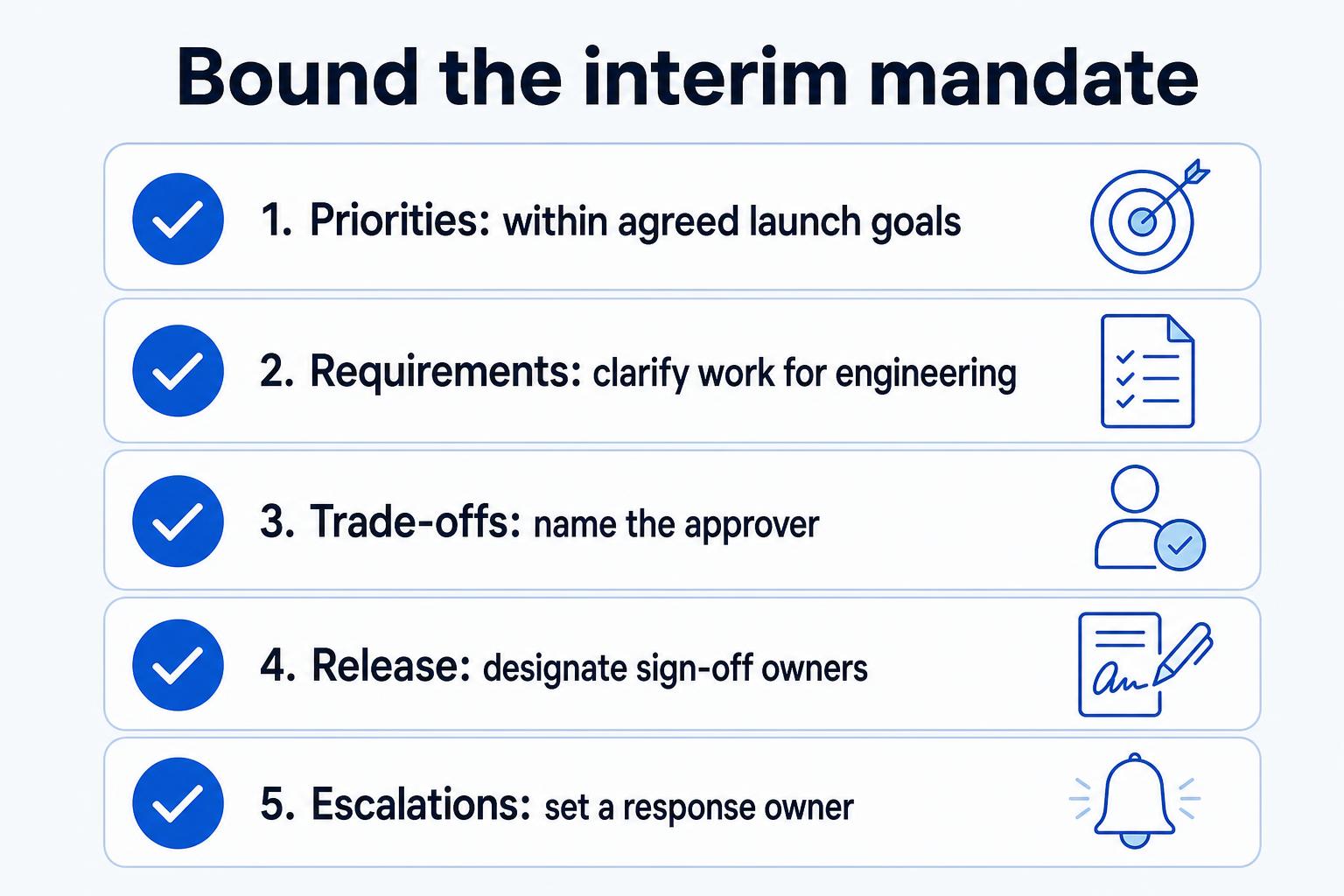
- Prioritisation: Allow the interim lead to order work within agreed launch goals and capacity; require approval for changes to committed scope or dates.
- Requirements: Make the interim lead responsible for clarifying user needs, acceptance criteria and open questions with the existing team.
- Trade-offs: Name who decides when customer requests, engineering constraints and commercial commitments conflict.
- Release decision: Specify who approves launch readiness. The product lead should bring a clear recommendation and outstanding risks; technical and business sign-off should remain with the people you designate.
- Escalation: Set a route and response owner for decisions that exceed the interim lead’s authority.
The interim lead should work directly with your existing engineering, design and business colleagues, rather than create a parallel reporting line. If architecture or technical delivery leadership is also missing, assess that gap separately; interim CTO support has a different remit from product ownership.
What should the mandate deliver before the launch?
Ask for outputs that make decisions visible, not a promise to produce a perfect roadmap. At the outset, give the interim lead access to the current roadmap, customer evidence, launch commitments, known risks and the returning lead’s existing rationale. Where time permits, the lead can test important assumptions through customer interviews or focused discovery, then prioritise by impact and effort.
- Decision log: Record significant scope and priority decisions, their reasons, approvers and any assumptions that could change them.
- Working roadmap: Show what is committed for launch, what is conditional and what has been deferred, with an owner for each unresolved question.
- Engineering-ready work: Provide precise requirements and acceptance criteria for agreed work, alongside dependencies the team still needs to resolve.
- Launch review: Bring together progress, customer implications, delivery risks and proposed trade-offs for the designated decision-makers.
Agree which artefacts already exist so you do not pay to recreate them. Match review frequency to the pace of launch decisions, and make one executive sponsor accountable for clearing escalations. A provider conversation should test how a candidate would work with your actual team and constraints, not just how they would describe an ideal product process.
How should you buy and scope interim cover?
Compare options against the period and intensity of the decision gap. An internal deputy may need protected time and executive backing. A contract product manager or product management consultant may be appropriate if you can define the scope and give them direct access to the team. If you need continuing ownership across discovery, roadmap, specification and delivery, assess whether the proposed interim lead has handled comparable cross-functional decisions.
Ask candidates to walk through a plausible launch conflict: a commercial request arrives after scope has been agreed, while engineering identifies a dependency. Listen for how they would establish the facts, present options, obtain the right approval and document the decision. Check availability during your critical milestones, time needed to understand the product, stakeholder access and the overlap needed at both ends of the mandate.
Cost depends on the required commitment, duration, seniority, overlap and breadth of responsibility. Compare offers on those terms and the expected deliverables rather than treating an undefined day rate as a complete budget. Remoteplatz provides an individual offer after scoping; its engagement models give you a starting point for that discussion. It provides an ongoing B2B service, not permanent placement or an employment contract with your company. For a broader buying checklist aimed at scale-ups without established product leadership, see the scale-up interim product manager checklist.
Note: Have your advisers review contractual rights, data access and any applicable legal or tax obligations for your arrangement; this does not replace legal or tax advice.
How do you hand ownership back to your product lead?
Plan the return before the interim lead starts. Ask your product lead, where possible, to explain existing commitments, stakeholder sensitivities and decisions they expect to retain. Agree who will update them during the absence, without making them the fallback approver while they are unavailable.

Keep the roadmap, decision log and open questions current throughout the mandate. Before the return, prepare a concise account of what changed, why it changed, which customer or commercial commitments remain, and what the engineering team needs next. Include rejected options and unresolved risks: these are often harder to reconstruct than completed work.
Use an overlap meeting with the returning lead, interim lead and executive sponsor to transfer live decisions. Confirm who now owns the roadmap and stakeholder communications, then tell the team when the interim lead’s authority ends. If a launch issue remains open, assign it explicitly rather than letting both leads assume the other owns it. A clean handover is complete when the returning lead can explain and act on the current priorities without relying on the interim lead’s memory.
Frequently asked questions
Can our engineering lead cover product decisions instead?
Possibly, if you give them the time, customer context and authority to make product trade-offs. Keep technical sign-off and commercial approvals explicit; do not assume engineering capacity alone resolves contested priorities.
Should the interim lead change the existing roadmap?
They should be able to recommend changes as evidence or launch constraints change. Define which reprioritisation they can approve and which changes to commitments need your executive decision.
What if our product lead cannot provide a departure handover?
Gather the current commitments, customer evidence and decisions from the team and name an executive sponsor to resolve gaps. Make reconstruction of the decision history an initial deliverable, and leave room to validate assumptions when the product lead returns.
Conclusion
Choose interim cover when launch-critical product decisions need an owner your existing team cannot provide for the absence. Give that person bounded authority, visible deliverables and a return plan from day one. If you want to assess the fit of interim product management for your launch, book a technical briefing to discuss the decision gap and mandate scope.
Discuss the launch decisions, interim remit and handover your team needs. Book a technical briefing