Interim product manager in Switzerland: a scale-up buying checklist

Your engineering team can deliver, but every new sales commitment seems to change what it is meant to deliver next. Without a product lead, the CEO may become the default arbiter of customer requests, commercial promises and engineering capacity. The immediate question is not whether you need a better roadmap document; it is who can make defensible product decisions while you establish lasting ownership.
An interim product manager in Switzerland can be a bridge if you have a real decision gap, not merely a temporary backlog overflow. This article shows how to test that distinction, set a bounded mandate, compare the buying options and prepare a handover that your next product leader can use.
Is an interim product manager in Switzerland the right bridge?
Start with the decisions that are currently failing. If sales can commit delivery dates or features without a shared review, engineers repeatedly pause planned work, and no one owns the trade-off between a customer exception and the broader product, you may have a leadership gap. Check whether those decisions can instead be made reliably by someone already on the team.
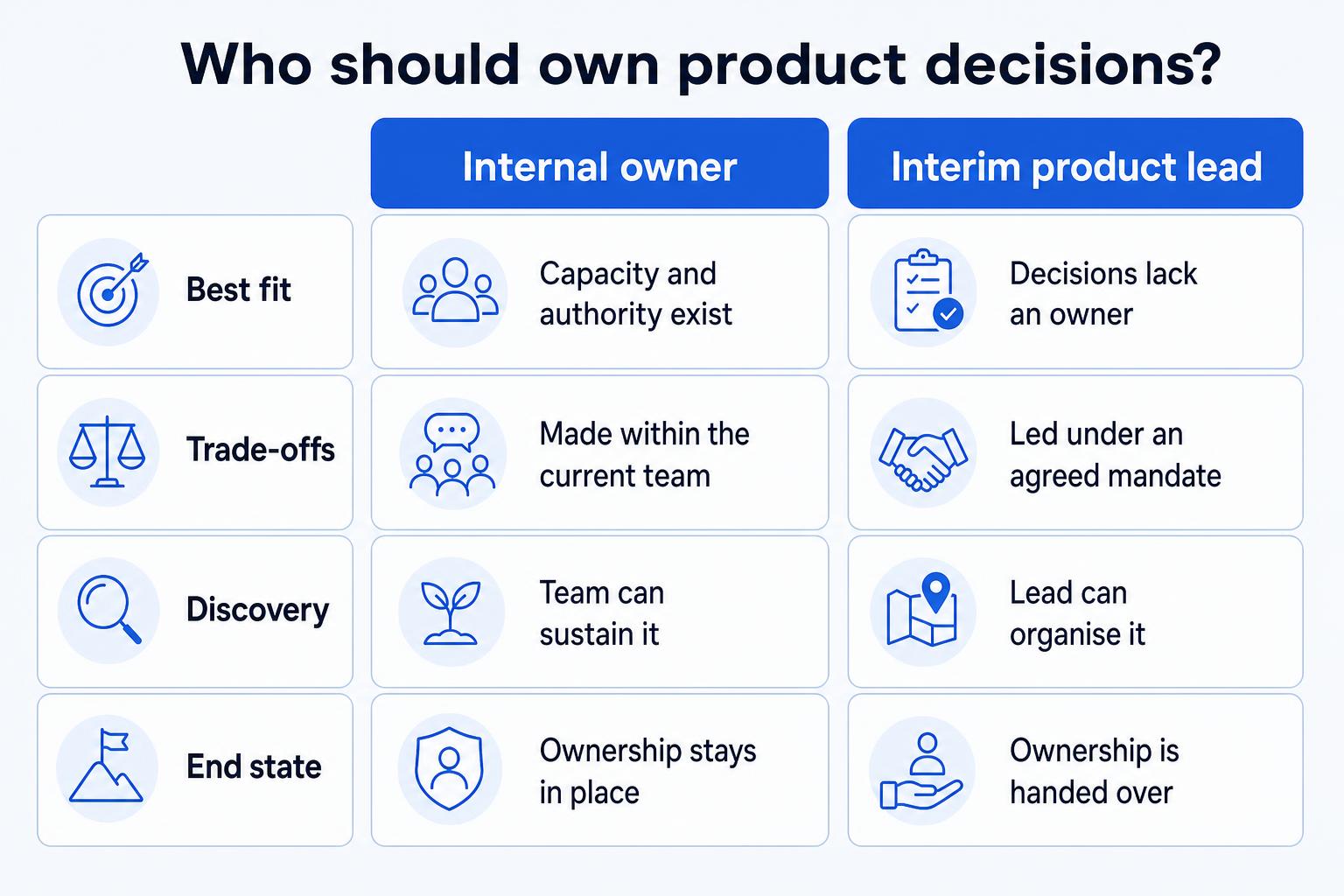
An internal owner may be enough when the volume of contested decisions is manageable and that person has the time, customer access and authority to say no. An interim lead is more plausible when you need someone to run discovery, turn evidence into priorities and align business, design and engineering while you decide on a longer-term structure. For a Series A or B scale-up before a permanent C-level hire, a fractional CPO arrangement may suit a bounded, ongoing leadership need; a more hands-on interim mandate may suit a period requiring closer operational ownership. Agree the actual time commitment rather than relying on the label.
| Decision point | Internal owner | Interim product lead |
|---|---|---|
| Best fit | Capacity and authority exist | Product decisions lack an owner |
| Roadmap trade-offs | Made within the current team | Led under an agreed mandate |
| Customer discovery | Team can sustain it | Lead can organise it |
| End state | Ownership stays in place | Ownership is handed over |
If the disputed decisions are chiefly about architecture, engineering capacity or technical risk, distinguish product leadership from a fractional CTO mandate. You may need both perspectives, but a product lead should not be expected to settle engineering matters alone.
What should the mandate own, and what remains with you?
Give the interim lead a written charter before work starts. It should name the product area, the decision sponsor, the teams involved, the time horizon and the outcomes you will review. A useful scope is concrete enough for sales and engineering to know which decisions the lead can make without asking the CEO each time.
- Discovery: Specify which customer interviews, hypotheses and experiments matter to the immediate roadmap decisions.
- Prioritisation: Ask for an explicit impact-and-effort assessment, including the work displaced when a new commitment is accepted.
- Requirements: Define the level of precision engineering needs before it can assess or deliver an item.
- Alignment: Put design, engineering, sales and business stakeholders in the same decision process, with a named route for escalation.
Retain executive control over commercial commitments, material budget changes and strategic changes to the product. Give the interim lead authority to recommend and maintain priorities within those boundaries, but state who approves exceptions. If your board needs to approve the mandate, use a decision-rights brief rather than a vague role description; the distinction between temporary authority and permanent accountability also matters in an interim leadership board mandate.
Agree an initial review point and an exit condition. Examples include a usable prioritisation process, a roadmap whose assumptions are visible, and a future owner able to take over decisions. These are acceptance criteria to define together, not guaranteed results of the engagement.
How do you stop sales exceptions from resetting the roadmap?
Do not solve the problem by banning sales input. Make the cost of an exception visible before anyone promises it. Route significant requests through one intake, capture the customer need and commercial context, and ask engineering for an effort and delivery-risk view. The product lead then recommends whether to accept, defer, test or decline the request, showing which existing priority would move.
Set a regular decision meeting with the executive sponsor, sales and engineering. Reserve escalation for commitments that exceed the agreed mandate, rather than using the CEO to reorder every item. Record decisions and the reasoning in a shared log; when circumstances change, the team can revisit an assumption rather than restart the whole argument. A roadmap should distinguish committed work from options still under discovery so that a sales conversation does not silently become a delivery obligation.
This operating rhythm matters more than a polished roadmap presentation. If leadership continues to reward unreviewed promises, an external product lead will inherit the same conflict without the authority to resolve it.
How should you compare providers and scope costs?
Ask candidates to walk through a plausible conflict between a strategic customer request and work already in progress. Listen for how they obtain customer evidence, involve engineering, explain trade-offs and handle a sponsor who disagrees. Ask who will do the work, how much access they need to customers and stakeholders, and what they would leave behind. Review Remoteplatz’s company information alongside the proposed individual’s relevant experience; a service description alone cannot establish fit for your product.
Scope cost around the required involvement and duration, not just a role title. The main drivers are the breadth of discovery, the number of product areas and stakeholders, the intensity of roadmap and delivery support, and the effort needed for handover. Compare offers on decision authority, working cadence, deliverables and exit terms as well as commercial terms. The engagement models and costs overview provides context, but concrete terms require an individual offer after scoping. Remoteplatz does not publish day rates or prices.
Under Remoteplatz’s B2B service model, the client receives one monthly invoice from Remoteplatz GmbH, with no placement fee or client-side payroll administration. Fractional retainers run for at least three months and can become interim mandates, or vice versa. After a scoping call, Remoteplatz provides a shortlist within 48–72 hours; work usually starts after 5–10 working days. Confirm the proposed schedule, currency and VAT treatment in the offer. Also check the agreement for confidentiality, access and assignment of work results and intellectual-property rights; Remoteplatz states that these rights are contractually assigned to the client and offers an NDA on request before the first call.
Note: Review contractual rights, data handling, invoicing, VAT and any employment or social-security implications for your specific arrangement with qualified advisers; this does not replace legal or tax advice.
How do you plan the handover from day one?
Name the receiving owner even if you have not yet decided who will hold the permanent product role. It may initially be the CEO or another executive. Then require the interim lead to keep decision records, customer evidence, roadmap assumptions and engineering-ready requirements accessible as the work progresses, rather than assembling them in the final week.

- Decision history: Record accepted and rejected requests, the evidence used and the person who approved exceptions.
- Roadmap status: Separate commitments, active discovery and open options, including dependencies and unresolved risks.
- Working relationships: Transfer the stakeholder cadence and introduce the receiving owner to key internal decision-makers.
- Acceptance review: Have the receiving owner run a prioritisation discussion before the interim lead exits, then list any decisions still awaiting sponsorship.
Specify who maintains the process after the mandate and when the interim lead’s decision rights end. Remoteplatz’s Interim Product Management and CPO as a Service is temporary B2B product leadership, not permanent placement. If you later appoint a permanent product leader, plan that appointment separately and make the handover part of the temporary mandate.
Frequently asked questions
Should we buy an interim product lead if our CEO already owns the roadmap?
Only if the CEO lacks the capacity to make evidence-based trade-offs consistently, or if decisions need a clearer cross-functional owner. First identify which decisions can be delegated and which remain executive responsibilities.
Is a fractional CPO the same as an interim product manager?
Not necessarily. Both can provide temporary leadership, but the appropriate involvement depends on whether you need periodic strategic direction or closer ownership of discovery, priorities and delivery coordination. Define the work and decision rights in the mandate.
When should we start preparing the handover?
Before the mandate starts. Name a receiving owner and agree which decision records, roadmap assumptions, requirements and stakeholder relationships must transfer before the interim lead exits.
Conclusion
Buy interim product leadership when the missing capability is accountable product decision-making, not simply another person to maintain a backlog. Define authority over priorities, keep commercial and technical approvals explicit, and test the handover before the mandate ends. If that describes your gap, review Remoteplatz’s interim product leadership service and book a technical briefing to scope the work.