Interim product manager in Switzerland: a flat-adoption checklist

Assume you lead a Zurich SaaS scale-up with an established engineering team. Features ship regularly, yet customer adoption is below your expectations. Sales brings requests, engineering has a backlog, and nobody has clear authority to decide which customer problem the next release should solve.
An interim product manager in Switzerland may help if the problem is missing product leadership, not simply delivery capacity. First check what users do after release, who currently makes prioritisation decisions and whether your team can act on what it learns. This article shows how to make that decision, scope a practical mandate and transfer ownership back to your team.
Is flat adoption a product leadership problem?
Do not treat a busy release calendar as evidence that you are solving the right problem. Review a recent feature with your engineering, design, commercial and customer-facing leads. Ask who requested it, what customer behaviour it was meant to change and what happened after launch. If those answers differ across the room, the gap may be in discovery and prioritisation rather than execution.
- Unclear customer problem: Feature requests reach engineering without customer interviews or a testable hypothesis.
- Competing priorities: The founder, sales team and engineering lead each have a different reason for placing work at the top of the backlog.
- Weak feedback loop: Teams record that a feature shipped, but do not agree how to assess uptake or decide whether to improve it.
- Missing decision owner: Nobody can resolve trade-offs between customer value, business goals and delivery effort.
Before engaging anyone, establish a baseline you can trust: which customers the feature was intended for, what you mean by adoption and what evidence you already have. If users want a feature but release quality or system constraints prevent them from using it, address that delivery or technical constraint first. A fractional CTO is a different form of leadership support when the principal decisions concern technical direction rather than product priorities.
When does an interim product manager in Switzerland make sense?
Use an interim lead when you have people who can build and collaborate, but need someone accountable for turning customer evidence into product choices. For a Series A or B scale-up not yet ready to appoint a permanent product executive, this can create a defined period of product leadership while you decide what the enduring role should be.
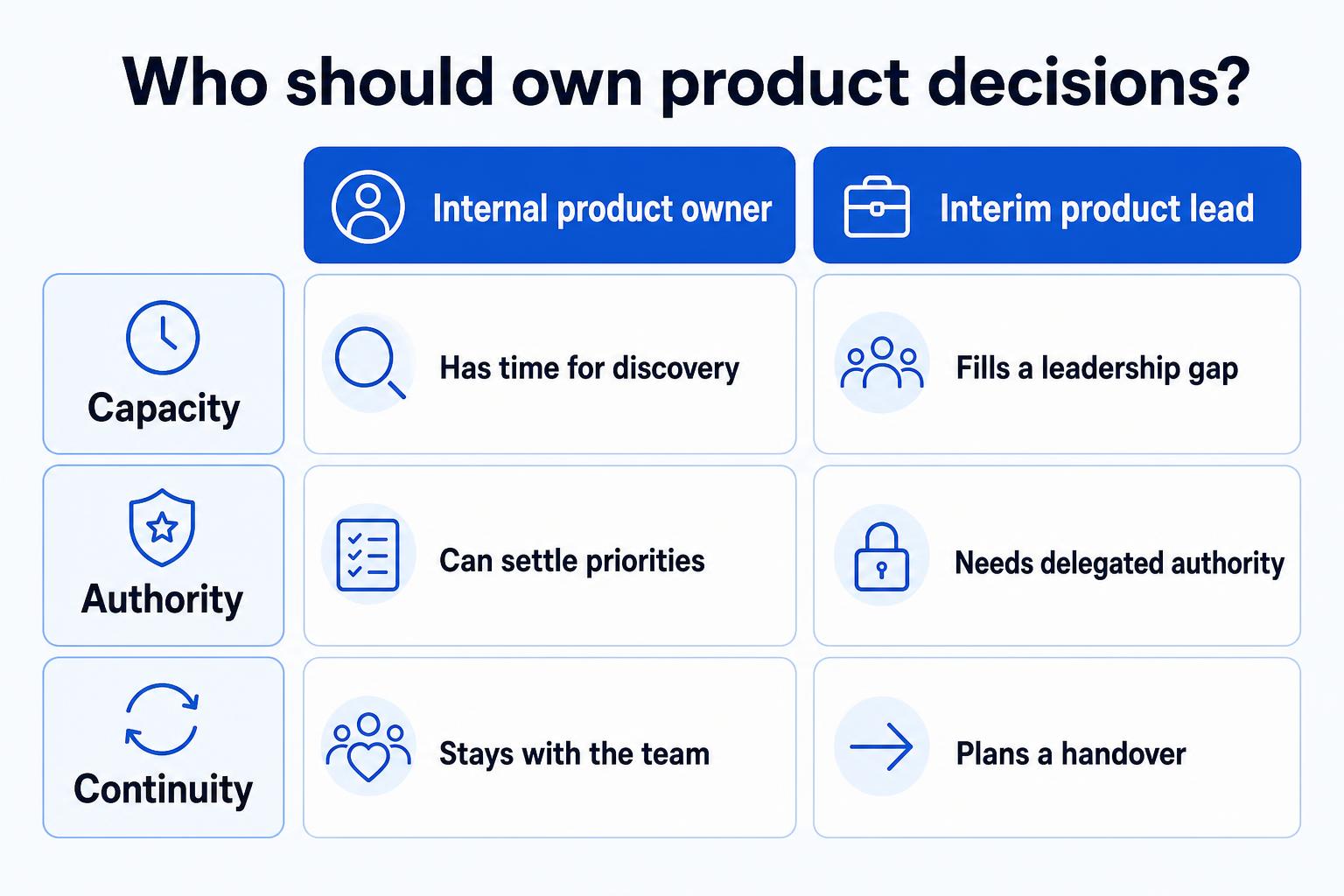
An internal owner may be the better choice if a founder or existing product lead has the time, authority and skills to run discovery and make trade-offs. Extra delivery capacity alone will not settle a disputed roadmap: compare that need with the question of adding a team to a SaaS release backlog. If you already know you need external leadership, use the separate scale-up buying checklist to assess the provider and engagement; the test here is whether flat adoption calls for a product mandate at all.
| Decision | Internal product owner | Interim product lead |
|---|---|---|
| Capacity | Has time for discovery | Fills a leadership gap |
| Authority | Can settle priorities | Needs delegated authority |
| Continuity | Stays with the team | Plans a handover |
Whether you call the external role an interim product manager, a fractional chief product officer in Zurich or CPO as a service, agree on the work and decision rights rather than relying on the title. A fractional retainer has a minimum term of three months; it can change into an interim mandate, or the reverse. Confirm the proposed scope and commercial terms in an individual offer, using the engagement models as a starting point for discussion.
What should the mandate authorise the lead to do?
Give the interim lead a narrow business problem and real access to the existing engineering, design and business team. For the assumed Zurich scale-up, the brief might be: establish why a selected customer segment is not adopting recently released capabilities, then recommend what to continue, change or stop. It should not simply ask for a larger roadmap.
- Outcome and baseline: Name the customer segment, the behaviour you want to understand and the evidence available today. Agree how you will review progress without promising an adoption result.
- Discovery access: Allow customer interviews and review of relevant feedback. Identify who can invite customers and who will resolve conflicting accounts.
- Decision rights: State who approves priorities, who can pause a planned feature and which trade-offs go to the founder or executive team.
- Engineering interface: Require clear hypotheses and sufficiently precise requirements before delivery work is committed; involve engineering in impact-and-effort discussions.
- Handover owner: Name the person or role that will receive the roadmap, evidence and decision process when the mandate ends.
Set review points with your founder or CEO, CTO or engineering lead, and commercial lead. The interim lead can facilitate and recommend, but your leadership team remains responsible for the business choices it approves. If the immediate problem is covering an established product owner’s absence, the planned-absence guide addresses that different handover.
How should the roadmap change while adoption is flat?
Start with a limited set of decisions, not a wholesale rewrite of the backlog. The interim lead should work with your team to turn customer observations into hypotheses, test the most consequential uncertainty and then prioritise by expected impact and effort. A test may show that a feature needs better onboarding, a different specification or no further investment; the point is to make the next decision explicit.
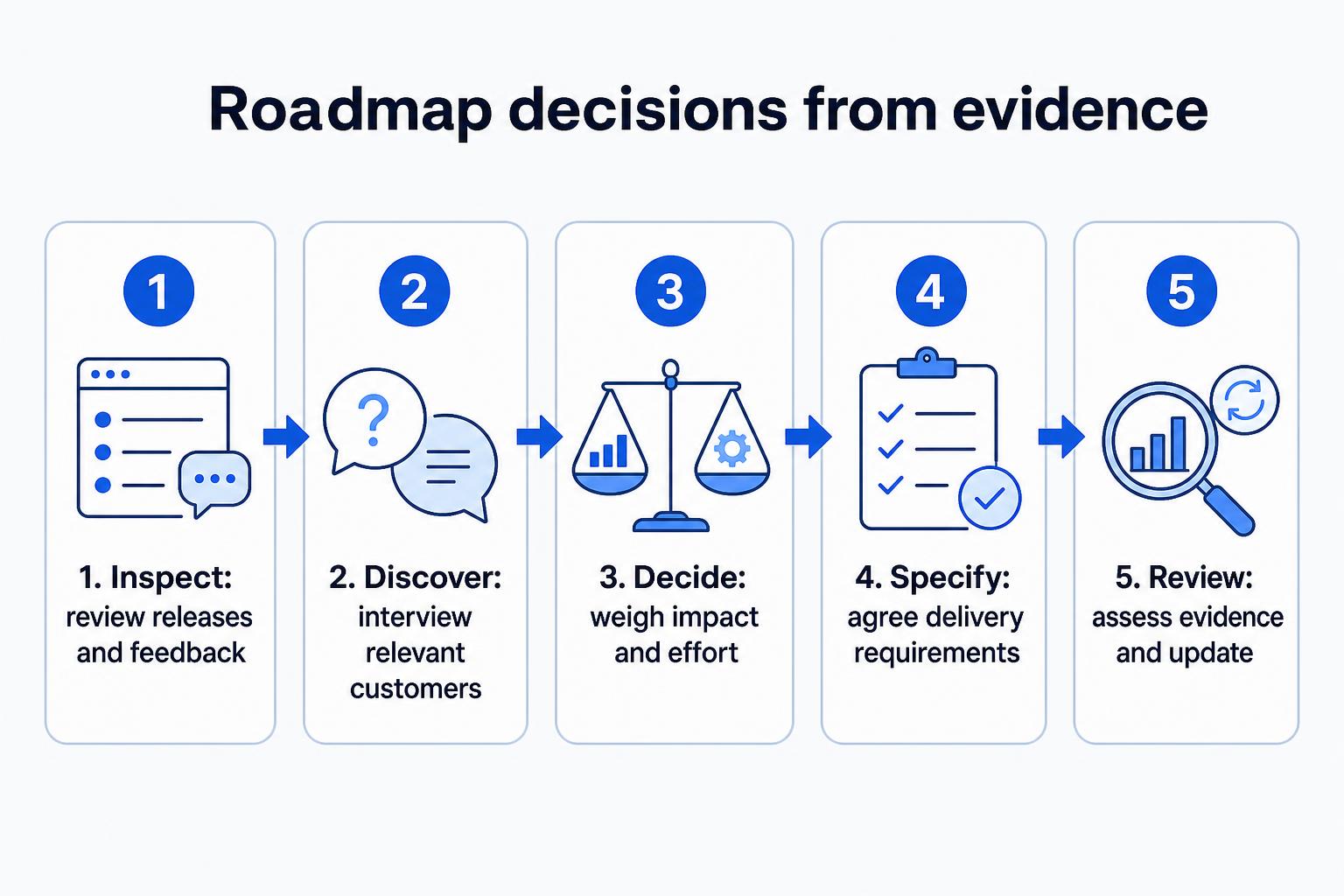
- Inspect: Review recent releases, usage evidence, customer feedback and the reasons work was prioritised.
- Discover: Interview relevant customers with the existing team and record what supports or challenges each hypothesis.
- Decide: Compare options by impact and effort, including the option to stop or defer work.
- Specify: Write requirements and success checks that engineering and design can question before delivery.
- Review: After release or an earlier experiment, assess the evidence and update the roadmap.
Keep a short decision record for each significant change: the customer problem, evidence, alternatives considered, decision maker and next review point. That record makes the roadmap understandable to people who were not in the meeting and gives the eventual product owner a basis for revisiting assumptions.
How do you return product ownership to your team?
Plan the exit at the start. A useful interim mandate leaves more than a prioritised backlog: it leaves a repeatable way for your team to hear customers, challenge proposals and make decisions. Choose the receiving owner early, whether that is an existing team member or a future product leader; do not leave ownership assigned indefinitely to a temporary external role.
- Transfer the evidence: Give the receiving owner access to interview findings, hypotheses, experiment outcomes and the limits of the available data.
- Transfer the decisions: Walk through the roadmap, deferred work, open trade-offs and who has authority to change priorities.
- Transfer the routine: Have the receiving owner chair prioritisation and review meetings while the interim lead is still available to challenge and support them.
- Confirm the boundary: Agree which decisions the internal owner will take after handover and what, if anything, still needs external support.
Check the commercial scope against this exit plan. The main cost drivers are the level of seniority, time commitment, depth of discovery, number of teams involved and length of support; Remoteplatz provides terms in an individual offer rather than publishing a day rate. If you need to compare an interim mandate with a longer fractional arrangement, make the handover deliverables and review points part of that discussion.
Frequently asked questions
Should we hire contract product managers or product management consultants?
Choose the responsibilities before the label. If you need someone to make and coordinate product decisions with your existing team for a defined period, ask for an interim lead with explicit authority and handover duties. If you only need an independent assessment, scope that narrower piece of work.
Can an interim product lead fix adoption without changing our engineering team?
Possibly, if the main gap is understanding customer needs and choosing work. They should work directly with your existing engineering, design and business team; first check whether technical constraints or delivery quality are the actual barrier.
When should we start the handover?
At the start of the mandate. Name the receiving owner, record decisions as they happen and let that person lead product reviews before the interim lead leaves.
Conclusion
If your Zurich scale-up ships consistently but cannot explain which customer behaviour its roadmap is meant to change, test the ownership gap before buying more delivery capacity. Define the evidence, decision rights and handover owner first; then assess whether Remoteplatz’s interim product management service fits that mandate and book a technical briefing to discuss the scope.
Discuss your adoption challenge, proposed product mandate and handover plan. Book a technical briefing