CTO as a Service Cost for Swiss SaaS Security Remediation

Suppose your Swiss B2B SaaS scale-up has agreed a time-bound customer security remediation plan. Your CFO needs to fund it, but the engineering lead is already managing releases. The immediate question is whether the gap is senior decision-making, delivery capacity or both. That distinction matters more to CTO as a service cost than the headline day rate.
A fractional CTO retainer is usually the better fit when your team can deliver but needs accountable technical leadership. An interim mandate fits a sustained leadership gap requiring several days a week. A delivery squad adds capacity to execute defined work, but does not by itself settle who owns technical decisions and customer-facing evidence. This article shows how to compare those options, budget their different cost drivers and scope a mandate you can review.
CTO as a service cost: define the gap before pricing it
Start with the remediation plan, not a provider rate card. Ask your technology lead to separate decisions that require senior authority from work that needs engineering time. For example, someone may need to approve priorities and trade-offs, coordinate the existing team, challenge an external provider and report progress to leadership. Separately, engineers may need protected time to make and verify changes. These are different purchases.
- Leadership gap: Name who can approve technical priorities, resolve dependencies and represent progress to your leadership team.
- Capacity gap: Identify which deliverables the current engineers cannot complete alongside committed product work.
- Evidence gap: Specify who will assemble the agreed proof of completion and who will approve it before it is shared with the customer.
A fractional CTO can take responsibility for technology decisions and engineering leadership at reduced commitment. If your existing CTO or lead already owns those decisions, adding a senior engineering delivery team may be more useful than adding another executive. If no one can direct that team, buying capacity alone leaves an ownership gap.
Compare the retainer, interim mandate and delivery squad
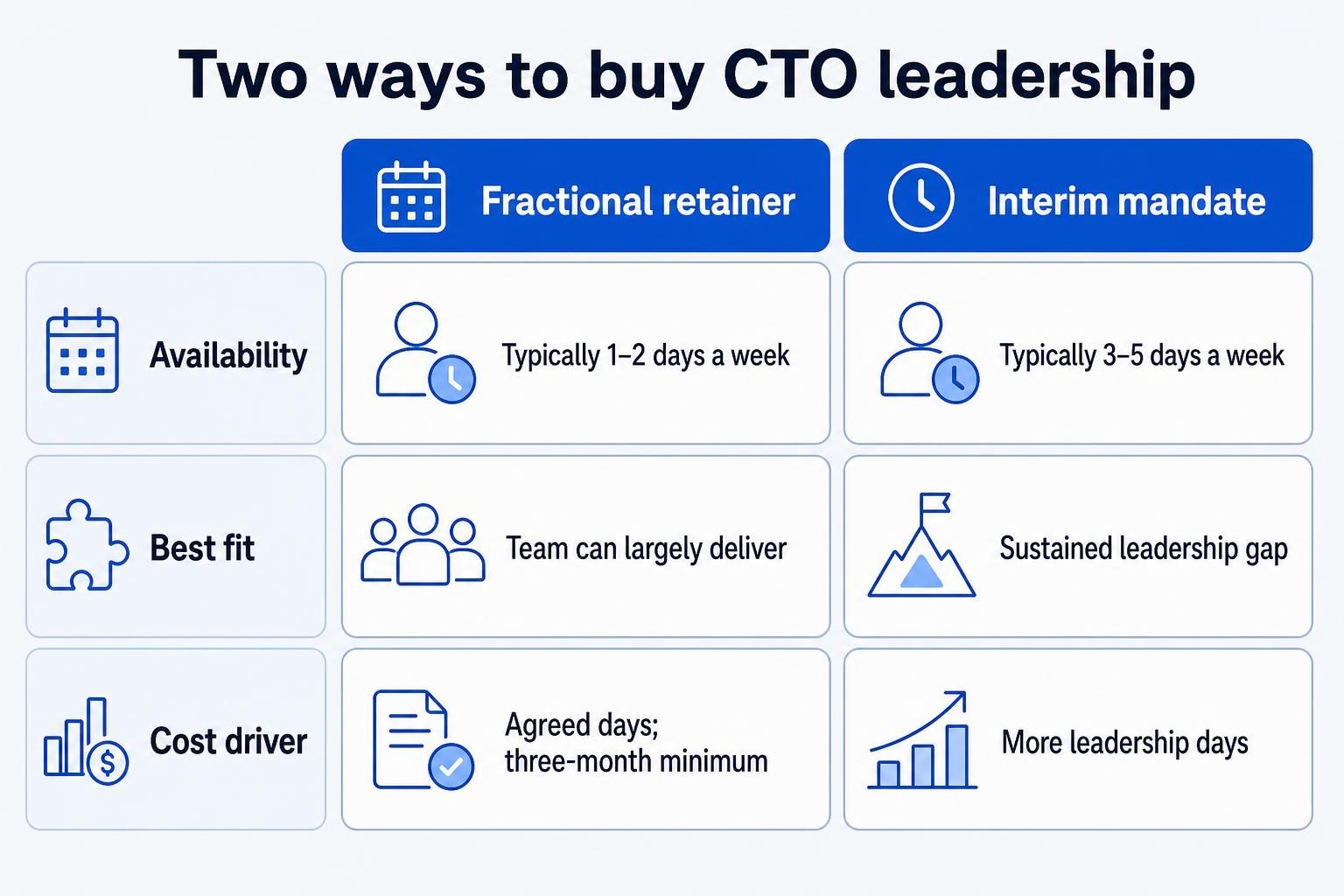
The three models have different cost drivers. A retainer buys a defined share of senior leadership time over a longer period. An interim mandate buys greater leadership availability for a concentrated period. A squad buys delivery capacity; its size and composition depend on the work, so you should request a scoped proposal rather than infer its price from CTO rates.
Fractional CTO retainer
Remoteplatz’s fractional CTO guide price starts at CHF 1,100 per day net. One day a week starts at CHF 4,400 per month; two days a week are around CHF 8,800 per month. Retainers run for at least three months. The model suits a remediation plan your engineers can largely execute if they have senior prioritisation, architecture review and a clear escalation route. Its risk is insufficient availability if urgent decisions repeatedly fall outside the agreed days.
Interim CTO mandate
Remoteplatz’s interim CTO guide price starts at CHF 1,000 per day net. At three days a week, the guide price starts at CHF 12,000 per month; interim mandates generally cover three to five days a week. Consider this when the existing leadership gap is substantial or the remediation needs frequent coordination across engineering and leadership. The lower starting day rate does not imply a lower monthly commitment: you are buying more days. See the interim CTO service for the leadership remit, or the interim CTO cost guide for a broader budgeting discussion.
Delivery squad
A squad is appropriate when work packages and decision ownership are already clear but your team lacks execution capacity. Senior engineer pricing is on request; do not treat a CTO day rate as a proxy. If product ownership also needs dedicated capacity, Remoteplatz’s guide prices start at CHF 950 per day net for an interim CPO or head of product and CHF 650 per day net for a product owner. Those roles should be included only if the remit requires them, not as default squad components.
All stated Remoteplatz amounts are net CHF, from guide prices, plus VAT where applicable. There is no placement fee; a binding offer follows a scoping call, with currency and VAT clarified in the offer. For context, the supplied market comparison puts experienced fractional executives in Switzerland typically at CHF 1,200–2,000 per day. Compare scope and availability as well as rates; see the engagement models and cost overview.
Which model gives you accountable progress?
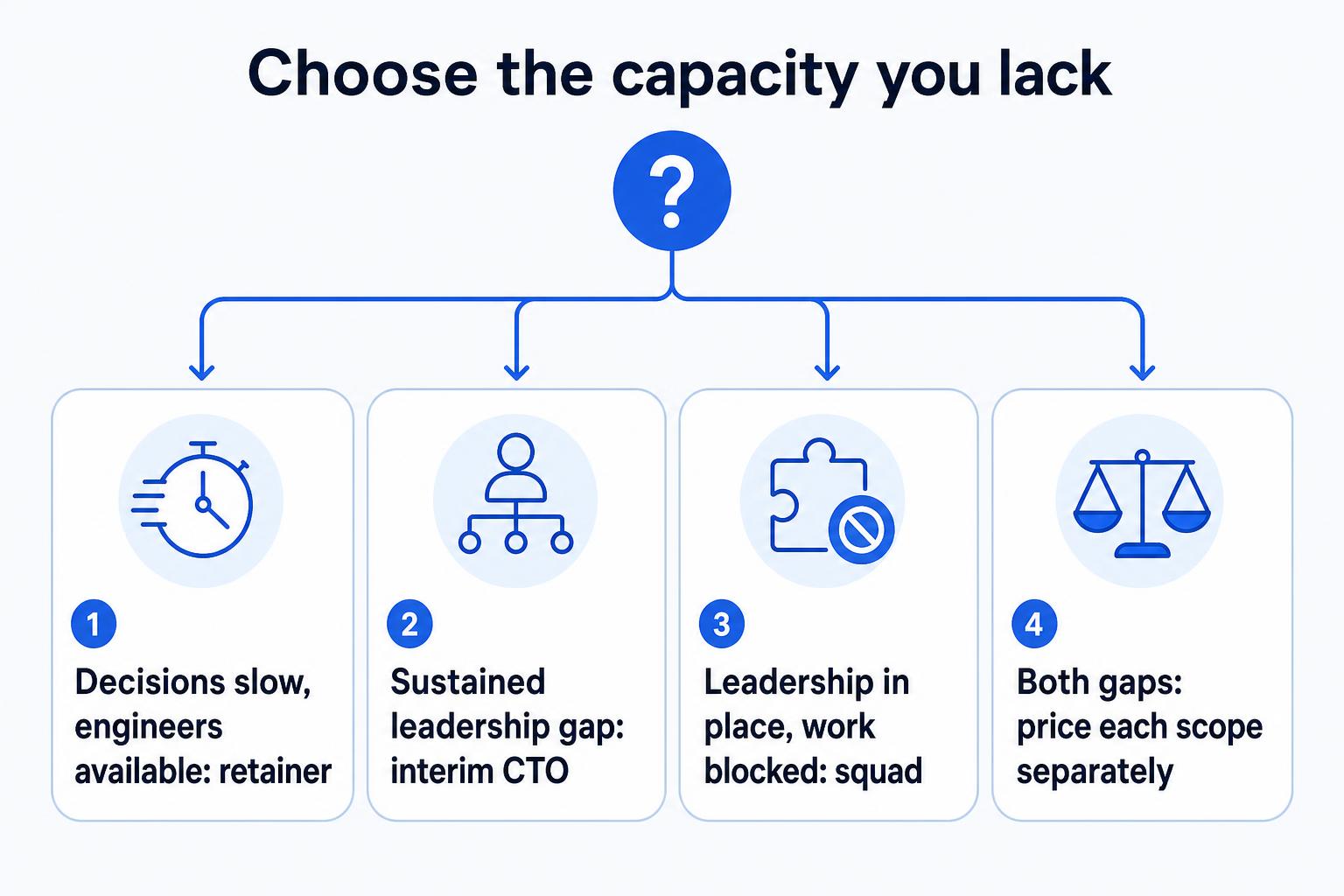
Make the selection against the constraint most likely to delay the plan, not the cheapest single day. If decisions are slow but engineers have time, start with fractional leadership. If decisions and coordination require sustained daily attention, scope an interim CTO. If leadership is available but delivery is constrained, scope engineering capacity. Where both gaps exist, price leadership and delivery separately, then establish one decision owner.
- Retainer test: Can your team keep moving between scheduled CTO days, with a defined route for urgent decisions?
- Interim test: Does the work require frequent leadership presence and authority across several teams or providers?
- Squad test: Are deliverables sufficiently defined, and does an internal or external lead have authority to accept the work?
- Combined model test: If you need both, who directs the squad, who approves changes to scope and which costs are reported separately?
Permanent hiring or executive search may make sense for a lasting, full-time leadership requirement. For a time-bound remediation, compare the time and ongoing commitment of building a permanent role with an external mandate; Remoteplatz supplies ongoing B2B services, not permanent placement. If you anticipate shifting demand after remediation, the retainer-versus-day-rate discussion addresses that separate question. A Remoteplatz retainer can also become an interim mandate, or vice versa, subject to the agreed scope.
What should the CFO ask providers to price?
Give each provider the same brief so that proposals can be compared on responsibility rather than labels. Include the customer-agreed outcomes, target dates, current team availability, known dependencies and the person authorised to accept completion. Ask for the proposed days or team composition, deliverables, reporting rhythm, assumptions and exclusions. Where the scope is uncertain, ask how changes will be approved before more capacity is committed.
- Decision rights: State who sets remediation priorities, approves architecture trade-offs and can escalate blocked work.
- Delivery boundary: Separate leadership tasks from engineering tasks, verification and preparation of customer evidence.
- Commercial basis: Compare the minimum commitment, expected days, any proposed squad composition and how additional work would be authorised.
- Exit conditions: Define what must be handed to your permanent team, including outstanding risks, decisions and the status of each deliverable.
Remoteplatz works directly B2B and issues one monthly invoice from Remoteplatz GmbH; clients do not administer payroll or Swiss social security contributions for its service personnel. Work results and rights to code and intellectual property are contractually assigned to the client, and an NDA can be requested before the first call. Collaboration is intended to comply with the Swiss FADP and EU GDPR. Check the proposed terms and access arrangements against your circumstances before signing.
Note: VAT treatment, data protection duties, contractual rights and the classification of an engagement depend on its circumstances; seek appropriate professional advice, as this does not replace legal or tax advice.
Set a review point before work starts
A time-bound plan still needs an operating rhythm. Agree an initial baseline of open items, named owners, the next decision points and the evidence your customer expects under your specific agreement. Set a regular review at which your CFO or sponsor can see work completed, remaining risks, capacity used and any forecast change. This makes it possible to increase leadership time, add delivery capacity or reduce either as the work changes.
After a scoping call, Remoteplatz provides a shortlist within 48–72 hours; work usually starts after 5–10 working days. Treat those as planning inputs, not a substitute for checking availability against your deadline. For a related handover question, see the fractional CTO guide to taking over from a build agency. Before the mandate ends, require an accepted handover of decisions, unresolved risks and evidence so your own team can continue without depending on informal knowledge.
Frequently asked questions
Is a fractional CTO retainer automatically cheaper than an interim mandate?
No. Its monthly starting commitment is lower because it covers fewer days, but compare the availability your plan needs, the minimum term and who handles decisions between scheduled days.
Can a delivery squad replace a CTO during remediation?
Only if someone else has clear authority to prioritise, resolve technical trade-offs and accept the squad’s work. Otherwise, scope leadership and delivery as separate needs.
Should we commit to both leadership and a squad immediately?
Not necessarily. First identify which work is blocked by decisions and which is blocked by capacity. If both gaps are real, agree their separate scopes and a review point before expanding the commitment.
Conclusion
For a Swiss SaaS security remediation, buy the smallest model that gives you both accountable decisions and sufficient delivery capacity, then review it against agreed outcomes. Use the CTO as a Service remit to frame leadership responsibilities and book a technical briefing to scope the right combination for your plan.