CTO as a Service Cost for Swiss Scale-Ups: Retainer or Day Rate?

Assume you are budgeting the next operating period for a Swiss B2B scale-up. Some months call for roadmap decisions and board reporting; others bring a major delivery push or a difficult provider decision. Your CFO needs to fund senior technology leadership without treating every busy month as a permanent level of demand.
The useful question behind CTO as a service cost is not simply which commercial model has the lowest quoted rate. It is which model covers the decisions you cannot defer, gives you enough capacity when demand rises and leaves clear ownership when it falls. This article shows how to compare a retainer, a day-rate interim mandate and a squad, then test external leadership against a permanent hire.
CTO as a service cost: what drives the budget?
Start with the work, not a rate card. Separate recurring leadership from temporary peaks and delivery work. That prevents you from paying for a squad when the missing capability is decision-making, or buying leadership capacity when the immediate constraint is execution.
- Recurring responsibility: Identify who owns technology strategy, architecture decisions, engineering leadership and reporting to management or the board. These duties may persist even in quieter delivery months.
- Peak intensity: Mark periods when due diligence, a major release, provider selection or an organisational change requires more senior attention. Specify the decisions and deadlines rather than calling the whole period ‘busy’.
- Execution capacity: Distinguish the person accountable for technical direction from the engineers needed to deliver a defined body of work. A squad adds delivery capacity; it does not automatically take the place of your technology leader.
- Continuity: Budget for handovers, decision records and access to key meetings. An apparently flexible arrangement can become costly to manage if context must be rebuilt each month.
- Commercial boundaries: Ask what capacity, responsibilities, changes in scope and notice terms the offer covers. Concrete rates are provided through an individual offer after scoping, rather than published as a standard price.
Remoteplatz works directly B2B and issues one monthly invoice from Remoteplatz GmbH; currency and VAT are clarified in the offer. Check the applicable contractual and accounting treatment for your organisation rather than assuming an invoice resolves every question.
Note: Contractual, VAT and social-security treatment depend on your circumstances; confirm them with qualified Swiss advisers. This does not replace legal or tax advice.
Retainer, interim day rate or squad: which problem are you buying for?
A fractional retainer is the starting point when you need continuing ownership but not a full-time CTO. Remoteplatz describes its fractional CTO service as typically one to two days a week, with retainers running for at least three months. Scope the recurring decisions, meetings and team leadership it must cover; do not assume unused capacity transfers between months unless the agreement says so. The engagement models and costs overview is a useful starting point for framing that discussion.
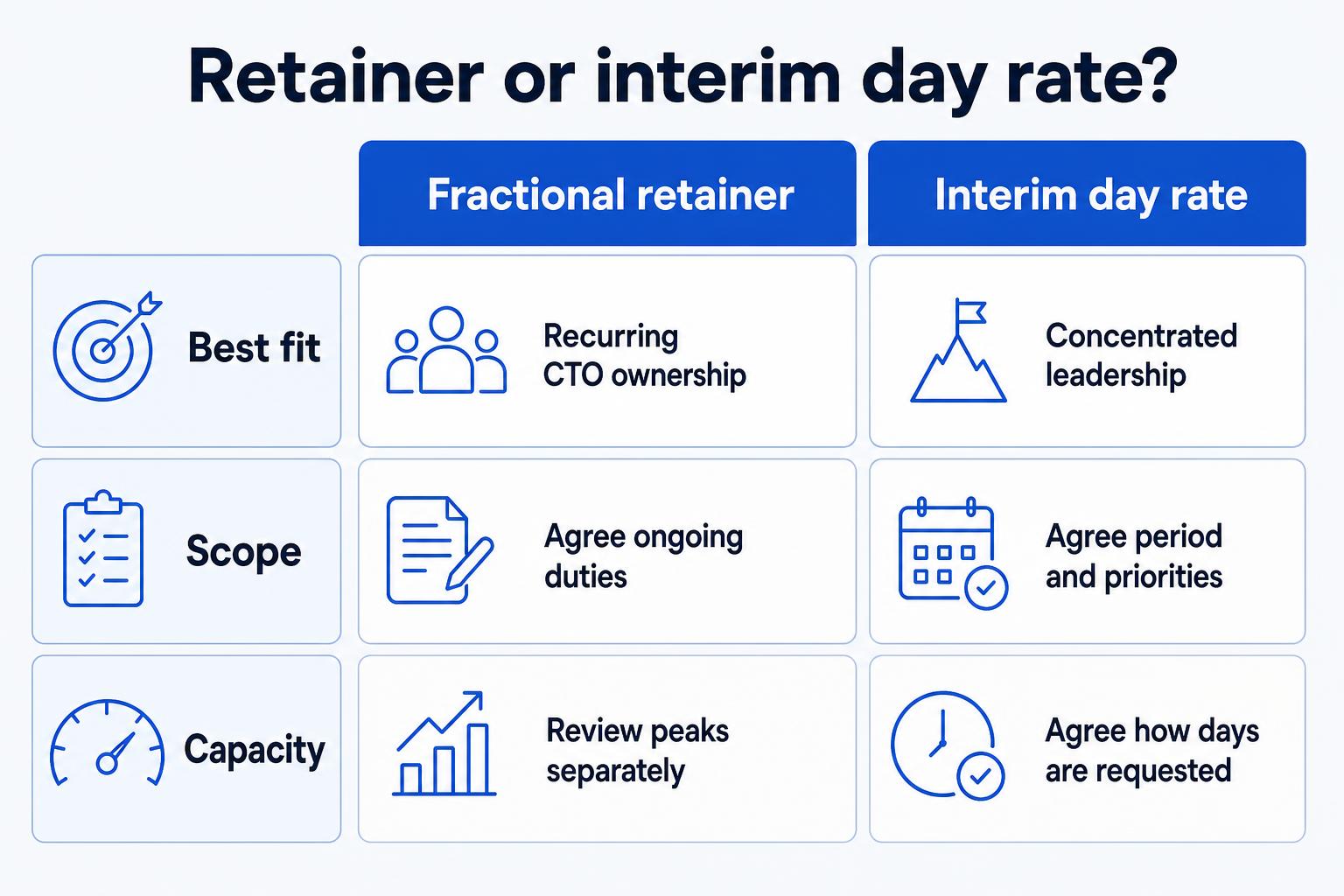
A day-rate interim CTO mandate fits a defined period of concentrated leadership or a temporary vacancy. It can also cover a surge beyond a fractional baseline. Agree how days are requested, which meetings and decisions take priority, and what happens if demand exceeds the agreed capacity. A day rate alone does not tell your CFO the total cost or guarantee availability at short notice. For the related scoping questions, see the guide to interim CTO cost in Switzerland.
Use a squad when the bottleneck is coordinated delivery, with a clear backlog, interfaces and an accountable lead on your side. Budget its work separately from the person who approves architecture trade-offs and represents technology to the board. If leadership is missing too, scope both responsibilities explicitly; adding engineers does not silently create CTO accountability. The distinction also applies when considering senior engineering capacity rather than a full squad.
A retainer can become an interim mandate, and vice versa, as the required commitment changes. Treat that as a planned review point, not an automatic change in commercial terms.
When is external leadership preferable to a permanent hire?
External leadership is a stronger fit when software is business-critical but a full-time CTO would not yet be fully utilised, or when you need accountable cover while the long-term shape of the role becomes clear. You can ask a fractional CTO to lead engineers, make technology decisions and represent technology to leadership, the board and investors at a reduced commitment. That is different from asking an adviser for occasional opinions.
A permanent hire becomes easier to justify when senior leadership is needed across the working week on an enduring basis, decisions are tightly coupled to daily operations and the scope is stable enough to define a lasting executive role. Compare the options on expected utilisation, continuity, management attention and time to establish ownership—not just on an external fee versus one employment cost. Executive search may be relevant to your own hiring plan, but Remoteplatz does not provide permanent placement or employment contracts with clients. Its B2B service has no placement fee; clients pay for the ongoing service.
Put a decision date in the plan. For example, review whether recurring CTO duties are expanding, whether an interim peak has ended and whether your internal team can take over any responsibilities. If a permanent role is becoming necessary, define who owns decisions during your hiring process and how knowledge will be handed over. The fractional versus full-time CTO comparison provides a closer look at that boundary.
A CFO checklist for an uneven operating period
Build one forecast with separate lines for leadership and delivery. Use your own demand assumptions and the terms of the individual offer; do not extrapolate from an unapproved market rate. A simple decision process keeps the comparison auditable:
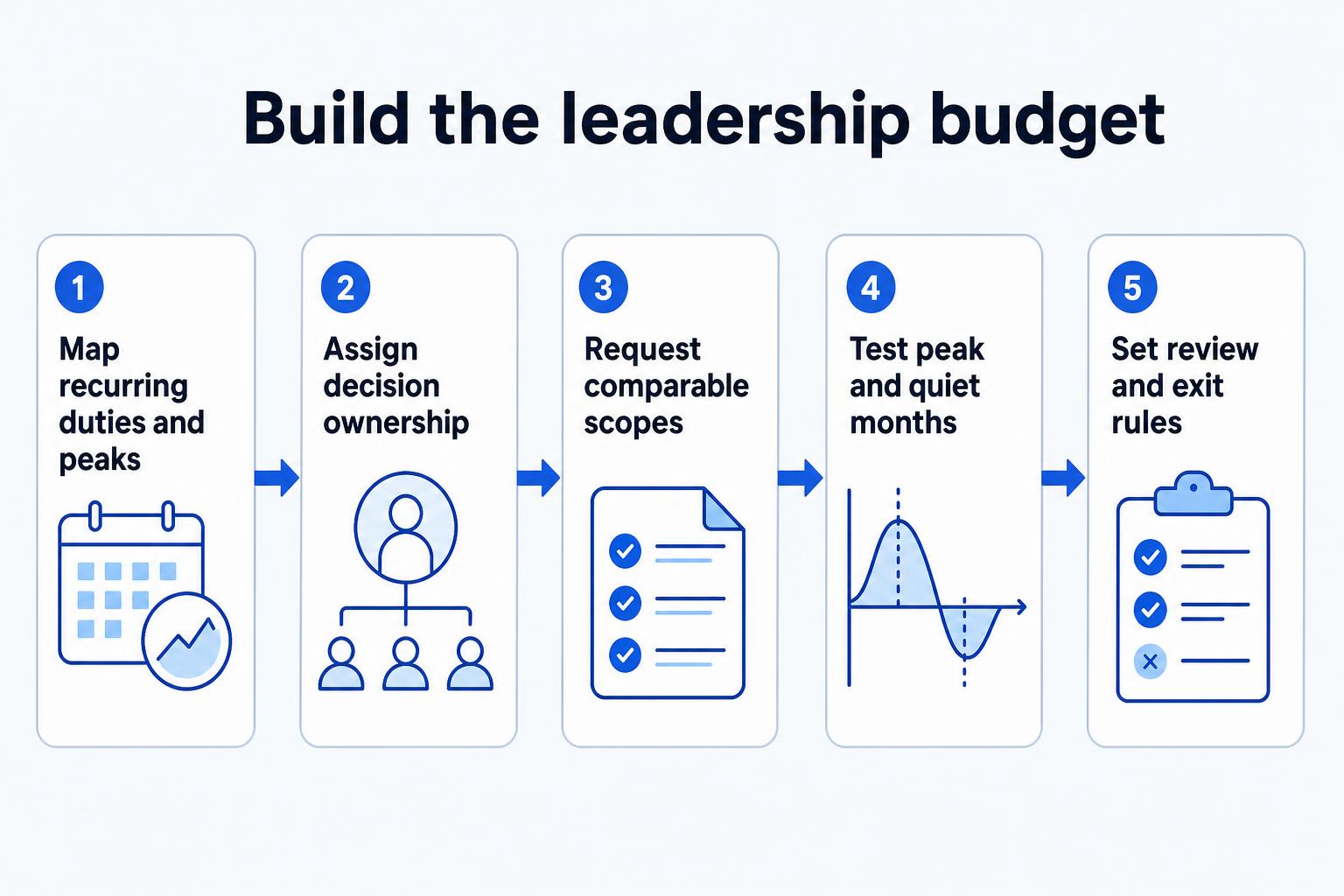
- Map the months: List recurring decisions, board commitments and expected delivery peaks. Mark uncertain events separately so they are not mistaken for committed work.
- Assign accountability: Name the person who will make technology decisions, lead the engineers and accept delivery outcomes in each option. Record what remains with your CEO or existing tech lead.
- Request comparable scopes: For a retainer, specify the recurring commitment and review points; for an interim mandate, the expected period and rules for requesting days; for a squad, the delivery objective and leadership interface.
- Test a peak and a quiet month: Ask what each model covers, what needs a scope change and what happens if a key decision falls outside planned availability. Compare total commitments and management effort, not just quoted units.
- Set change and exit rules: Agree how you will review capacity, document decisions, transfer access and hand work back to your team or a future hire.
After a scoping call, Remoteplatz provides a shortlist within 48–72 hours; work usually starts after 5–10 working days. Treat those as planning inputs, not a substitute for confirming a start date and scope in your offer. If the pressure comes from a departing supplier rather than fluctuating leadership demand, the agency-exit planning guide addresses that different handover problem.
Frequently asked questions
Should we use a retainer if demand changes every month?
Use one if a core set of leadership decisions remains yours to cover every month. Define that baseline and review how additional peak work would be scoped; a retainer is not a promise of unlimited availability.
Can a squad replace a fractional CTO?
Not by default. A squad can deliver work, but you still need to assign ownership of architecture trade-offs, engineering leadership and reporting to management. Ask for those responsibilities explicitly if both are required.
When should we revisit the permanent-hire decision?
Set a review date when you approve the external scope, then reassess sustained leadership utilisation and whether a stable full-time role has emerged. Keep decision ownership clear while you evaluate the change.
Conclusion
Budget for the leadership decisions that persist, then add capacity for genuine peaks and delivery work separately. A retainer supports a recurring baseline, an interim mandate addresses concentrated leadership demand, and a squad addresses execution; a permanent hire deserves consideration when the leadership need is sustained and full-time. To scope the baseline through CTO as a Service and test it against your forecast, book a technical briefing.