Technical due diligence in Switzerland: a SaaS buyer’s board checklist
Technically reviewed by Karl Zakhary, Software Engineer at RaiseNow
Your board is considering the acquisition of a small SaaS business. The product has customers and a roadmap, but you do not yet know whether the software can be operated, maintained and developed without relying on its founder. Before making an offer, you need enough evidence to distinguish manageable work from a risk that could change the deal.
For a Swiss SME, technical due diligence in Switzerland should begin with a buyer-defined question, not an unrestricted code audit. Access may be limited before an offer, so the board should agree what it needs to know now, what can wait for a deeper review and who will own each decision. This article shows how to scope the review, select an independent reviewer and turn findings into a board decision.
How to scope technical due diligence in Switzerland
Start with the acquisition thesis. If you are buying a product to serve existing customers, continuity, security and the ability to release changes may matter most. If the value depends on integrating the product with your systems, examine interfaces, data dependencies and the work needed after completion. Ask the reviewer to test those assumptions rather than produce a generic score.
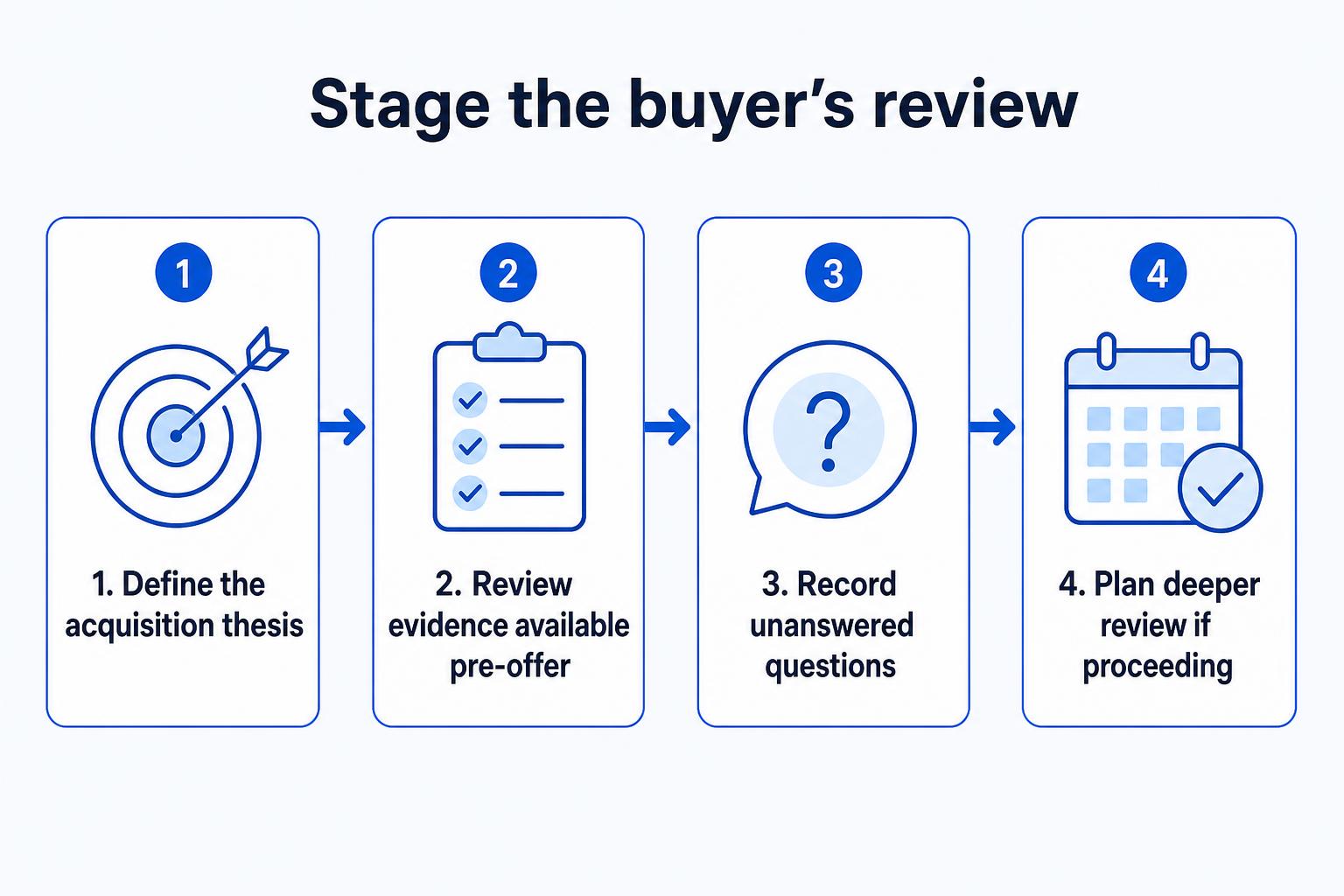
Set two stages of access. Before an offer, request a focused review of available materials and management answers. Record what cannot be verified. If the transaction proceeds, arrange a deeper review under agreed access and confidentiality terms, including repository and operational evidence where appropriate. A favourable first-stage assessment is not a substitute for the second stage.
Give the reviewer a written brief covering the product’s intended role, your proposed integration, material customer commitments, the decision date and the access the seller will permit. Request a short findings report that separates observed evidence, management statements and unanswered questions. If your board also wants to understand how a technology assessment is prepared from the company’s perspective, the Series A architecture due diligence guide covers that distinct, seller-side context.
What belongs on the SaaS buyer’s technical due diligence checklist?
Product, operations and dependencies
- Product fit: Map the features you expect to buy against what is live, contracted or still on the roadmap. Ask for demonstrations of workflows that matter to your acquisition thesis.
- Architecture and maintainability: Ask how the main components fit together, where changes are difficult and whether the team can explain the major design decisions. A repository review, when access is available, should test those explanations rather than rely on a code-quality label.
- Operations and security: Review access ownership, deployment and recovery procedures, incident records and known vulnerabilities. Establish who can restore service if a key person is unavailable.
- External dependencies: Identify cloud services, vendors and integrations essential to delivery, along with contracts or accounts that may need attention after a change of ownership.
Intellectual property and documentation
Ask the seller to identify who contributed to the software, which components are third-party or open source, and what records support the claimed rights. The technical reviewer can flag gaps and dependencies; your legal adviser should assess ownership, licences, assignments and transaction implications. Do not treat access to a repository as proof that the seller owns everything in it.
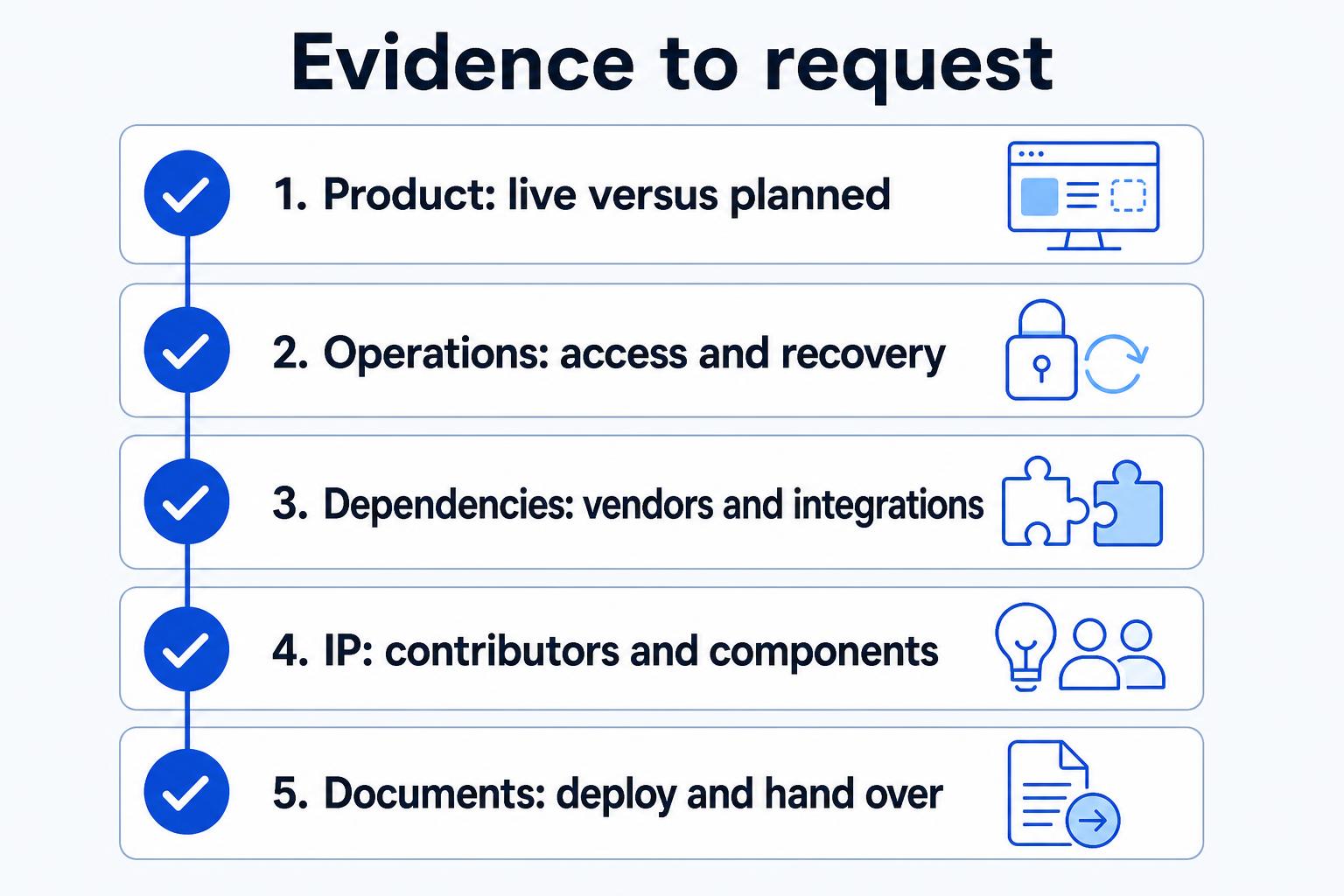
Documentation is an operating-risk question, not a request for a large document library. Look for enough current material to explain the architecture, run the service, deploy and recover it, and hand work to another engineer. Compare documents with a walkthrough by the people who operate the product. The guide to taking over after a build agency exits explores the related handover problem.
Note: Intellectual property, licensing, data protection and transaction terms require advice appropriate to your circumstances; this does not replace legal or tax advice.
How should you choose an external reviewer?
Choose for the decision you face, not for the length of a standard audit template. Ask prospective reviewers how they would narrow the scope before an offer, which evidence they would request, how they would handle restricted access and who would do the work. Relevant SaaS architecture and operational experience matters, but so does the ability to explain a technical finding to a board without overstating certainty.
Test independence explicitly. Ask about existing relationships with the seller, its investors and prospective implementation providers. Agree whether the reviewer will only assess risks or may also help plan remediation after the transaction; if both are possible, make that distinction visible in the report. Require each material finding to state its evidence, business consequence, confidence level and proposed follow-up.
A fractional CTO can provide external technology leadership, including architecture reviews and technical audits, when you need someone to frame the board’s questions as well as review evidence. For a defined acquisition review, agree the deliverables and decision dates separately from any later leadership mandate. Compare the available engagement models against the access period and the support you may need after completion; there is no useful fee comparison without a defined scope.
How should the board use the findings before an offer?
Ask for a decision paper, not simply a list of defects. Group findings by their effect on the acquisition thesis: issues you can accept and plan for, issues requiring more evidence, and issues that may change whether or how you proceed. For each, identify a responsible decision-maker, the evidence still needed and the likely operational work. Avoid presenting a rough remediation estimate as a verified cost.
Common warning signs include an essential service controlled by one person, unclear rights to a significant component, an inability to demonstrate recovery, customer commitments that the product cannot currently meet, and architecture that conflicts with your planned integration. None is automatically a reason to abandon a deal. The question is whether you can verify the position, address it under acceptable conditions and resource the work.
Possible board responses are to seek evidence before offering, make any offer conditional on further review, revise your integration or operating plan, or stop. Have transaction advisers address any contractual response. If the acquisition would leave you without continuing technical leadership, compare a temporary mandate with the longer-term choices in the fractional CTO versus full-time CTO guide.
What should happen after the first review?
Keep a register of unresolved questions and agree which require seller access before an offer and which require deeper access afterwards. Assign someone on your side to coordinate the seller, reviewer and advisers so that answers are assessed against the same acquisition thesis. If access is denied, record the limitation as a finding rather than assuming the missing evidence is favourable or unfavourable.
Before completion, turn accepted risks into an ownership and handover plan: who will control essential accounts, operate the service, maintain documentation and decide the first product changes? This is separate from the purchase decision, but it tests whether the board can realistically carry the risks it proposes to accept.
Frequently asked questions
Can we get a useful review before the seller grants repository access?
Yes, if you limit its purpose. A reviewer can test product demonstrations, architecture explanations, operational records and management answers, then specify what remains unverified. Do not call that a full code audit.
Should our lawyer or technical reviewer assess intellectual property?
Both have distinct roles. The technical reviewer identifies components, contributors and evidence gaps; a qualified legal adviser assesses rights, licence obligations and transaction terms.
Do we need a continuing CTO after the acquisition?
Not necessarily. Decide who will own technology decisions, the engineering team and board reporting once the seller’s involvement changes. The answer depends on the product’s importance, your existing team and the risks found.
Conclusion
Before making an offer, give your board a staged review brief, an independent reviewer and a clear record of what has and has not been verified. If you need external leadership to scope the assessment and interpret its findings, explore CTO as a Service and book a technical briefing to discuss your decision and access constraints.