Pre-vetted IT professionals for a Swiss payments integration
Technically reviewed by Karl Zakhary, Software Engineer at RaiseNow

Assume you are the CTO of a Zug-based fintech preparing a payments integration. An external senior engineer has already passed a provider’s technical selection, but your risk lead still needs to know whether that person can work safely within your systems, controls and release process. With pre-vetted IT professionals, the decision is not whether a profile looks senior; it is whether the evidence supports this particular assignment and the access it requires.
You can separate that decision into three parts: establish the integration’s boundaries, test the engineer’s judgement against realistic failure scenarios, and release access in stages. This article shows how to make those checks jointly, and when to stop or narrow the assignment.
Define the payments assignment before you interview
Write a short brief that the CTO, integration owner and risk lead can all use. State which payment flows or interfaces are in scope, what the engineer may change, who owns the relationship with the payment provider, and what must remain with your internal team. Identify the systems, data categories and environments the work may touch. If those boundaries are unsettled, interview answers will be hard to assess and an early start may create avoidable access risk.
- Delivery outcome: Define the first reviewable result, such as an integration design decision or a change ready for your normal review process, rather than assigning the entire integration at once.
- Control ownership: Name the internal owners for architecture approval, risk sign-off, credential management, release approval and incident escalation. An external engineer can contribute to each activity without becoming its unacknowledged owner.
- Dependencies: List the provider documentation, internal service owners, test environment and decisions that must be available before work begins.
- Engagement scope: Decide whether one engineer can deliver within these boundaries or whether you need broader capacity or technical leadership. The available engagement models provide context for scoping an individual engineer or a dedicated squad.
If the design owner or decision-maker is missing, resolve that gap first. Where you need an accountable technology lead rather than delivery capacity, assess the leadership role separately; CTO as a Service addresses a different need from assigning an engineer to an integration.
What pre-vetted IT professionals must still prove
Provider vetting is a useful starting filter, not your approval to give someone payments-system access. Remoteplatz’s network criteria include at least seven years of proven production experience, experience with microservices and distributed systems, and modern CI/CD, testing and review practice. Only around 1–2% of applicants are accepted into its network. Those criteria do not, by themselves, establish that a particular engineer understands your payment flows or can operate within your controls.

Ask for evidence tied to the brief, with confidential material removed where necessary. Do not require another organisation’s source code, credentials or incident records. Assess what the engineer personally decided and delivered, not just the reputation of a project or team.
- Comparable responsibility: Ask for an account of a production integration, the engineer’s role, the decisions they owned and who approved releases or exceptions. Payment-domain experience may be valuable, but verify its relevance to your specific scope.
- Failure handling: Request an example of how they identified a failed or ambiguous transaction, made it observable and worked with others to resolve it. Look for clear boundaries between engineering judgement and business or risk decisions.
- Delivery discipline: Ask how changes were reviewed, tested, released and rolled back in their previous production work. Seek specific responsibilities and outcomes rather than a list of tools.
- Communication: Confirm that the engineer can explain uncertainty, raise a blocker promptly and participate in your team’s working hours. Remoteplatz profiles are fluent in English and have working hours overlapping with CET; agree the actual meetings and escalation expectations for this assignment.
Remoteplatz’s published client references can provide service context, but they are not evidence that an individual shortlisted engineer has completed an equivalent payments integration. If the proposed work instead centres on untangling an older platform, the checks in the legacy-system migration assessment address that distinct risk.
Run an interview around failure and control
Use the client-team technical interview to test judgement, not recall. Give the engineer a concise, non-sensitive version of your integration brief and ask them to talk through decisions with your CTO or tech lead and risk lead present. Agree beforehand what each interviewer will score, so a strong architectural discussion cannot mask weak control awareness.
Three checks for the technical interview
- Trace the boundary: Ask what the engineer would need to learn before changing a payment flow, which assumptions they would validate with the provider, and which decisions they would bring back to your internal owners. A strong answer distinguishes known facts from questions.
- Introduce an ambiguous outcome: Describe a payment request for which the upstream result is unclear. Ask how they would reason about duplicate effects, reconciliation, visibility and escalation. You are assessing their approach to risk and collaboration, not asking for a coding solution.
- Challenge the release: Ask what evidence they would want before a production change, how they would monitor its impact and when they would pause or reverse it. Listen for respect for your review and approval path.
A short, bounded discussion of an anonymised system diagram can reveal more than an open-ended technology quiz. If you use a work sample, specify its purpose, time boundary and evaluation criteria in advance; keep it free of live credentials and customer data. Your architecture due-diligence preparation may also help identify system boundaries to clarify before the interview, without turning the assessment into a general architecture audit.
Red flags include confident claims without a clear account of personal responsibility, treating retries or duplicate outcomes as trivial, proposing production access before understanding the environment, or bypassing reviewers to move faster. A candidate need not know every answer immediately; they should know which questions must be answered before a change is safe.
Put access and delivery behind onboarding gates
A positive interview is permission to begin controlled onboarding, not permission to deploy. Set the gates before the start date and record who can approve each one. Remoteplatz’s process moves from requirements under NDA to a shortlist within 48–72 hours, a technical interview with your team, and onboarding into your tools and rituals. Work usually starts after 5–10 working days; your access and control checks still determine what the engineer may do at that point.
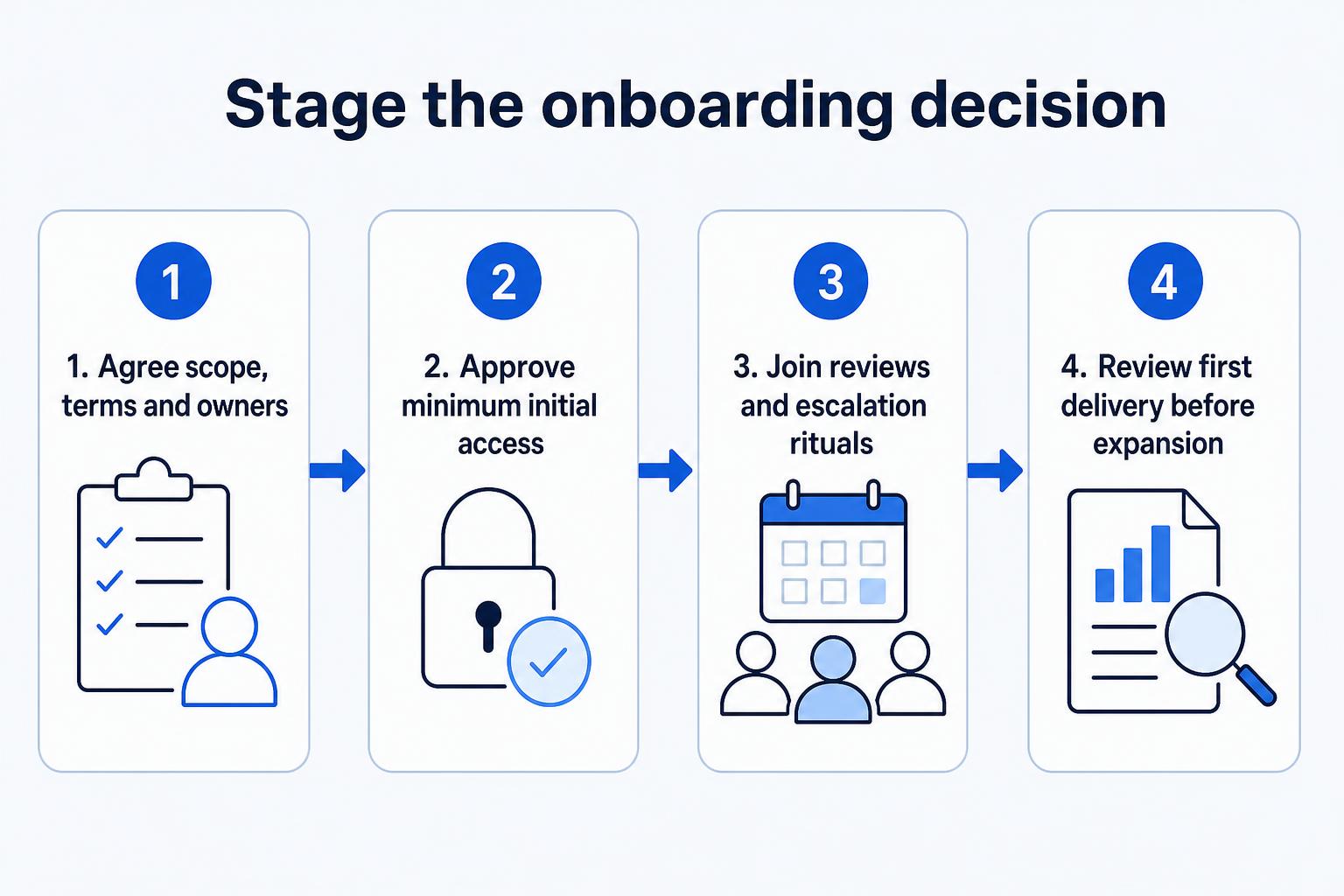
- Gate 1 — scope and terms: Confirm the named engineer’s responsibilities, confidentiality arrangements, handling of work results and rights to code, and the internal people who will accept the work. Remoteplatz states that work results and intellectual property rights are contractually assigned to the client; check the actual agreement against your needs.
- Gate 2 — controlled access: Approve the minimum tools, environments and data needed for the first task. Use your existing identity, logging and access-review procedures, and keep production credentials and sensitive data outside the initial access set unless separately justified and approved.
- Gate 3 — team rituals: Introduce the engineer to the integration owner, risk contact and relevant service owners. Include them in planning, design review, change review and incident-escalation routines, with a clear route for raising a blocked or unsafe change.
- Gate 4 — first delivery review: Inspect a small, reviewable piece of work and the engineer’s documentation, tests and communication before expanding scope or access. Require the normal internal approval path for any production release.
For personal data or payment-related information, have your risk and legal advisers confirm which safeguards, provider obligations and contractual terms apply to the actual data flow. Remoteplatz describes its collaboration as compliant with the Swiss FADP and EU GDPR, but that statement does not replace your assessment of this integration.
Note: Data-protection, contractual, tax and social-security implications depend on your arrangement and should be checked with qualified advisers; this does not replace legal or tax advice.
Make the go/no-go decision and scope the engagement
After the interview, record a decision against the brief: evidence of relevant production responsibility, quality of failure reasoning, willingness to work within your controls, communication fit and the access the first deliverable requires. The CTO should own technical acceptance; the risk lead should identify unresolved control conditions; the integration owner should confirm that the proposed work can be reviewed and accepted.
Choose one of three outcomes. Proceed if the evidence is sufficient and the onboarding gates are ready. Narrow the scope if the engineer appears capable but lacks context for sensitive work: begin with design or a low-access task and reassess. Do not proceed if critical evidence is missing, risk concerns cannot be resolved or the person will not follow your approval path. If the fit is wrong, Remoteplatz can propose a replacement profile; that is an option to reassess, not a reason to relax the gates.
The commercial decision should follow the same scope. Clarify whether you need an individual senior engineer or a dedicated squad, the expected duration, internal review capacity and any access dependencies that could delay productive work. Remoteplatz provides this as a direct B2B service rather than permanent placement; terms are set out in an individual offer after scoping. You should not treat shortlist timing as a guarantee that your internal approvals or external provider dependencies are complete.
Frequently asked questions
Does a pre-vetted engineer still need our technical interview?
Yes. Provider selection filters for senior engineering capability; your interview tests the person against your payment flow, failure scenarios, team practices and control boundaries. Remoteplatz’s process includes a technical interview with the client team.
When should we grant production access?
Only when a defined task requires it and your authorised owners have completed the relevant access and change approvals. Start with the minimum access needed for a reviewable first deliverable; do not make production access a default onboarding step.
What if the engineer is technically strong but has limited payments experience?
Judge the gap against the assignment. You may begin with a bounded, lower-access task under an internal payments owner and reassess the evidence, or decline if the work immediately requires domain judgement the engineer cannot demonstrate.
Conclusion
For a payments integration, make the hiring decision and the access decision separately: test the engineer against a defined scope, observe how they reason about failure and controls, then expand responsibility only after reviewable work meets your gates. If you are considering Remoteplatz senior software engineers, book a technical briefing to discuss the role, evidence and onboarding conditions your team will require.