Staff augmentation or a dedicated team for your distributor portal?

Your industrial SME wants distributors to place orders, see account-specific information and resolve routine queries through a portal. Your CTO must protect the existing systems; your CFO needs a controllable commitment. Before you buy IT staff augmentation in Switzerland, decide whether your team can direct individual engineers or whether the portal needs a dedicated delivery group.
The distinction affects more than headcount. It determines who defines work, coordinates dependencies, accepts results and retains knowledge when the engagement ends. This article shows how to choose the model and what to check before signing.
When does IT staff augmentation in Switzerland fit?
Choose an individual senior engineer when you already have a product owner, a technical lead and a prioritised backlog. Your team can then assign work, review decisions and integrate the engineer into its existing delivery rhythm. This is team extension, not a substitute for internal ownership.
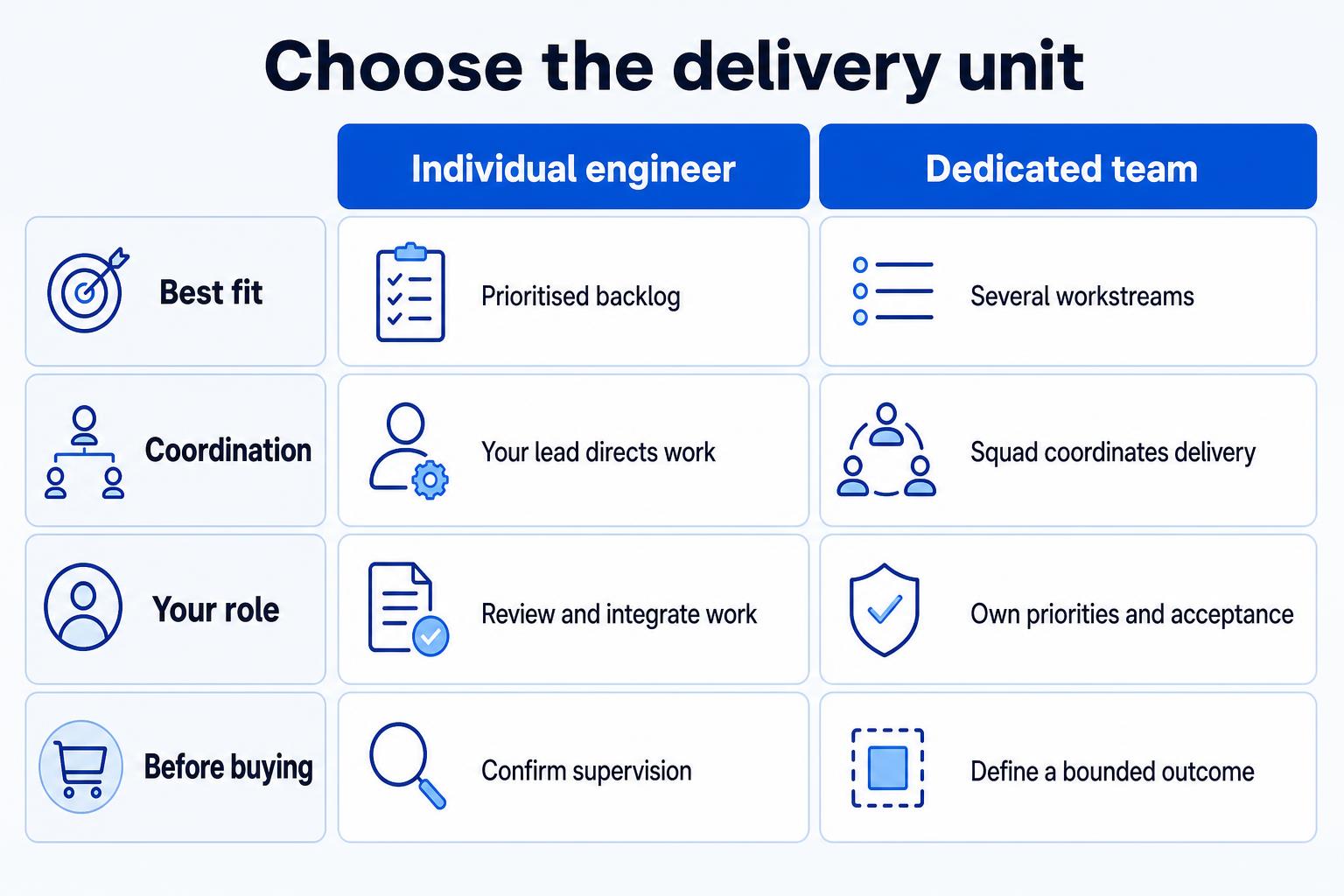
Consider a nearshore dedicated development team when the portal has several connected workstreams and your internal team cannot coordinate all of them alongside its current workload. A squad, optionally with a tech lead, can provide a more coherent delivery unit. You still need someone on your side to set commercial priorities, approve access and accept outcomes. Remoteplatz offers both individual engineers and dedicated squads through its senior engineering service.
- Individual engineer: A better fit if your CTO can specify tasks, supervise integration and make timely decisions on architecture and dependencies.
- Dedicated team: A better fit if multiple disciplines must work together and you can define a bounded outcome, decision owner and review cadence.
- Neither yet: If ownership, requirements or system access are unresolved, complete a short scoping phase before committing to delivery capacity.
Do not confuse either service with hiring developers in Switzerland for employment or using a staffing agency. A B2B engineering service buys ongoing delivery capacity; it does not, by itself, fill a permanent position. If you need a person under an employment arrangement, assess that route separately. For a different example of squad use, see the SaaS release-backlog decision; a distributor portal needs its own scope and governance.
What must you define before requesting a proposal?
Start with the portal’s first usable outcome, not a list of people. In this illustrative scenario, you might prioritise distributor sign-in, account-specific product information and an order request. Whether those functions are appropriate depends on your existing systems and commercial process. State what is outside the first release as clearly as what is inside it.
- Business owner: Name the person who decides distributor priorities and accepts the release on behalf of sales or operations.
- Technical boundaries: Identify the systems the portal may read or change, the integration owners and the review process for architectural decisions.
- Access and dependencies: List environments, documentation, test data and internal approvals needed before work can start.
- Acceptance: Specify how you will assess each milestone, including operational handover and outstanding defects.
If your CTO cannot spare time for technical decisions, adding engineers will not remove that bottleneck. Assess whether interim CTO support is needed to establish ownership first. If a legacy integration is the main uncertainty, use the criteria in the senior-engineer assessment for legacy work to probe relevant experience rather than buying capacity on a generic CV.
How should your CFO and CTO compare providers and costs?
Ask each provider to respond to the same scope and responsibility split. Your CTO should interview the proposed people about production decisions, integration risk, testing and how they escalate blockers. Your CFO should compare the total commitment required to reach a defined decision point, not an isolated rate: team composition, expected duration, onboarding effort, internal supervision, scope changes and the notice or replacement arrangements all matter.
Remoteplatz states that its engineers have at least seven years of proven production experience and that its selection process accepts around 1–2% of applicants. Its process moves from requirements shared under NDA to a shortlist within 48–72 hours after scoping, a technical interview with your team and onboarding into your tools and rituals. Work usually starts after 5–10 working days. Treat those as service-process information, not as proof that a particular person or start date will suit your portal.
Ask who will act as tech lead, how capacity can change, what happens if the fit is wrong and which person will attend steering meetings. Remoteplatz offers a replacement profile if the fit is not right; agree the practical handover before work begins. You can review its published client references, while checking whether each reference is relevant to your specific integration and delivery risks.
Remoteplatz works directly B2B, without permanent placement or a placement fee. Clients receive one monthly invoice from Remoteplatz GmbH rather than administering payroll for the external engineers. Concrete prices and day rates are not published; currency, VAT and other commercial terms belong in an individual offer after scoping. Use the engagement models overview to frame questions, then request written terms for the model you are actually comparing.
Which contract, IP and data checks belong on the signing list?
Have your CFO, CTO and appropriate advisers review the agreement and its operational schedules together. A sound offer should describe not only the people supplied but also what your organisation must provide to make the work possible.
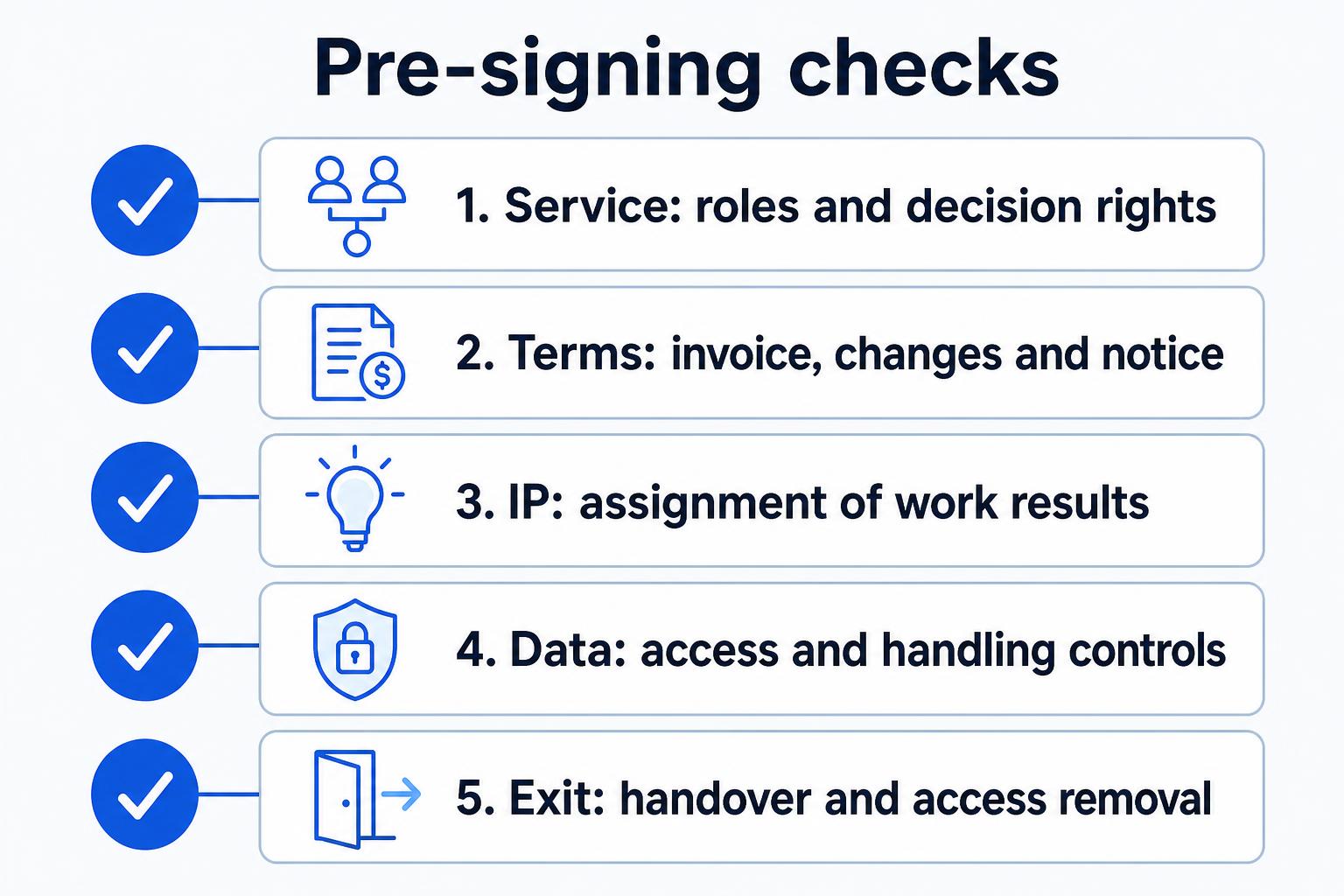
- Service and control: Identify the contracting entity, named roles, scope, service boundaries, steering responsibilities and who can authorise changes.
- Commercial terms: Check invoicing basis, currency, VAT treatment, any minimum commitment, notice, capacity changes and replacement procedure.
- Intellectual property: Ensure rights to code and other work results are assigned to your company, including work produced across the delivery chain. Remoteplatz states that work results and IP rights are contractually assigned to the client; verify that the agreement reflects this.
- Data protection: Map which distributor and business data the team can access, where it is processed, who else may handle it and which security, confidentiality, deletion and incident processes apply. Verify the documents and controls needed for your use of the service.
- Exit: Agree repository and account ownership, documentation, knowledge transfer, access removal and the treatment of incomplete work before the first sprint.
Note: B2B service labels alone do not settle questions about staffing rules, employment classification, Swiss social-security obligations, VAT or cross-border data processing. Have qualified legal and tax advisers assess the actual arrangement and applicable Swiss FADP and, where relevant, EU GDPR requirements; this does not replace legal or tax advice.
How will you steer delivery and make an exit possible?
Assign a single business decision owner and a technical counterpart before onboarding. Give the team access only after your internal approvals are complete. In the first working session, agree a prioritised backlog, an initial acceptance point, meeting cadence and the route for raising integration or security concerns. An individual engineer should join your existing rituals; a dedicated team may run its own delivery rhythm, but must still report against your priorities and acceptance criteria.
At each steering review, inspect completed and accepted work, unresolved dependencies, forecast capacity and changes to the agreed scope. If the provider controls delivery activity while your organisation controls priorities and acceptance, write down who decides when those views conflict. This matters particularly when distributor feedback changes the release plan.
Plan the final handover at the start. Keep code and decisions in repositories you control, require usable documentation, schedule knowledge-transfer sessions and define who will maintain the portal after departure. Set a point at which your CFO and CTO will decide to continue, change the team shape or stop. That makes both a small initial engagement and a larger dedicated team easier to govern.
Frequently asked questions
Is a dedicated team the safer choice if our portal scope is unclear?
No. A team can coordinate delivery, but it cannot replace your decisions about priorities, integrations and acceptance. Resolve the largest uncertainties first, then choose the capacity you can govern.
Can we start with one engineer and move to a squad?
Potentially. Define the initial engineer’s remit and the conditions for expanding capacity, such as parallel workstreams or a confirmed integration plan. Confirm availability and commercial changes in the offer rather than assuming an automatic transition.
What should we request before signing?
Request the proposed roles, interview process, responsibilities, written commercial terms, IP assignment, data-protection arrangements, steering plan and exit provisions. Have your internal owners and advisers review them against the portal’s actual data and operating model.
Conclusion
Buy an individual engineer when you can direct the work yourself; consider a dedicated team when several workstreams need coordinated delivery and you can still own priorities and acceptance. Set the scope, decision rights, commercial terms and exit checks first, then review Remoteplatz’s senior engineers and dedicated squads and book a technical briefing to test which model fits your distributor portal.