After a CTO Resigns: How to Scope an Interim CTO Mandate

Consider a hypothetical Swiss mid-market company integrating technology and teams after an acquisition. Its CTO resigns while product commitments, architecture decisions and team responsibilities are still unsettled. As CEO or board member, you need someone accountable for the next decisions, not simply someone to attend the CTO’s meetings.
Your search for interim CTO Zurich may produce potential providers, but location alone will not tell you whether an interim appointment is justified. The test is whether delivery and integration decisions require accountable technology leadership before a permanent hire can take over. This article shows how to make that decision, set the mandate and plan its handover.
Interim CTO Zurich: when is a mandate justified?
Appoint an interim CTO when the leadership gap is already affecting decisions that cannot safely wait for a permanent appointment. In an acquisition integration, that might mean unresolved ownership of systems, competing roadmaps or teams waiting for direction on shared priorities. A resignation is a trigger to assess the gap, not an automatic reason to buy a full-time mandate.
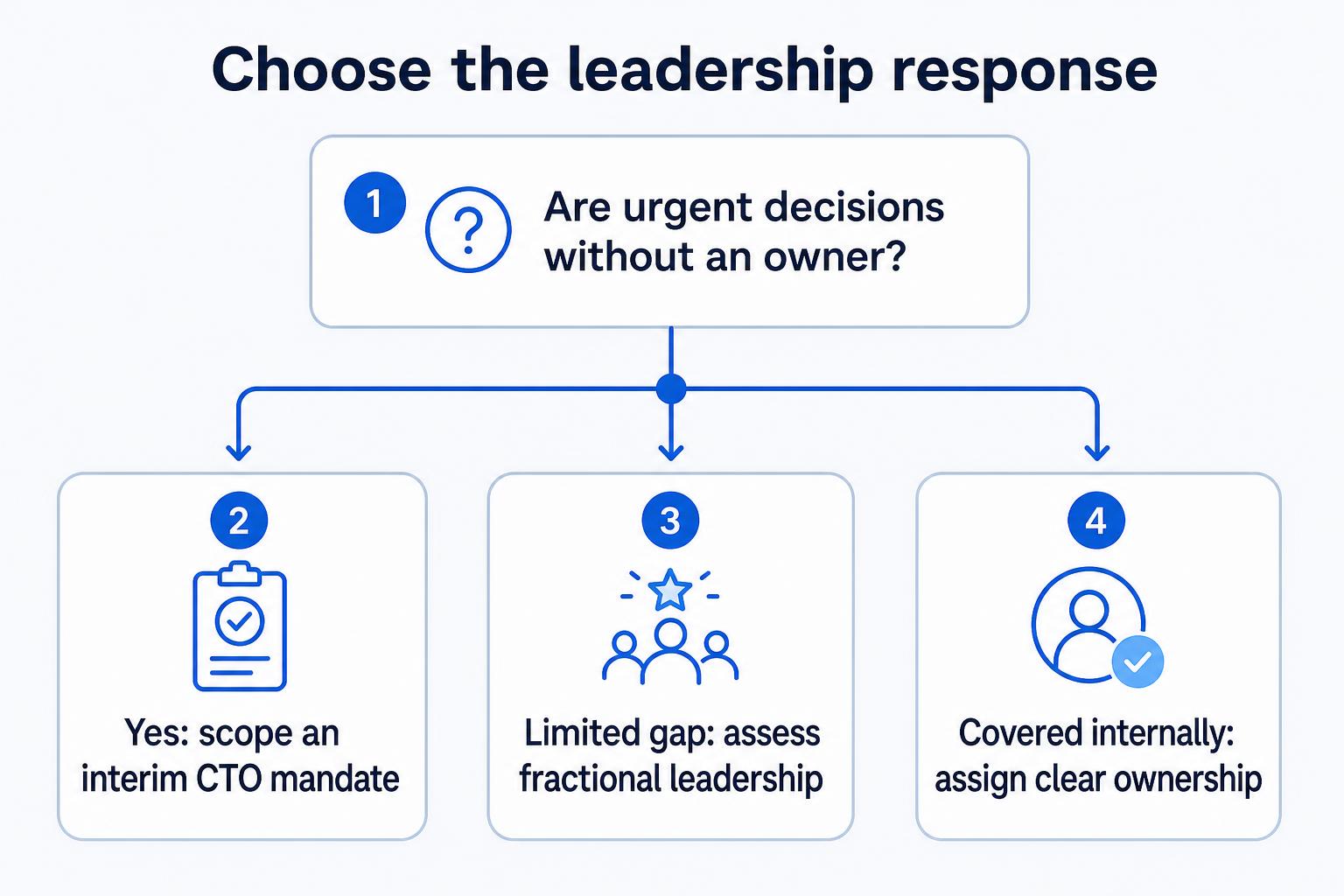
- Choose an interim mandate: Delivery or integration needs a named decision-maker who can work with leadership, set priorities and take responsibility for the transition.
- Consider fractional leadership: The organisation has dependable day-to-day technical leads, but needs senior direction and oversight for a defined set of decisions. Compare the remit with CTO as a Service rather than treating the two models as interchangeable.
- Continue with internal leadership: Existing leaders have the authority and capacity to protect delivery while you assess the permanent role. Give one person explicit ownership rather than leaving decisions to a committee.
The same test applies after funding or a transaction: has the organisation gained more technology decisions than its current leadership can own? If the answer is unclear, identify the decisions due in the next planning cycle and who can make them. A useful comparison is the distinction between fractional leadership and a full-time CTO role; an interim mandate solves an immediate leadership gap while you decide the enduring structure.
What should the CEO and board put in the mandate?
Begin with outcomes and authority, not a list of generic CTO duties. The CEO should agree the business priorities, the board should clarify what it expects to oversee, and technical and product leaders should identify the decisions currently blocked. Record where the interim CTO can decide, where they recommend, and what must return to the CEO or board.
- Delivery: Name the critical commitments and the teams responsible for them. Ask for an agreed priority plan, clear roles and a way to surface risks early; do not promise that every existing date will hold.
- Integration: Specify which systems, teams and dependencies the interim CTO must assess. Separate decisions needed for continuity from longer-term architecture choices that warrant further evaluation.
- Operating rhythm: Define who attends leadership reviews, how priorities change and which roadmap and KPIs the interim CTO is expected to maintain.
- Decision rights: Set approval boundaries for changes that affect budgets, product commitments or the acquisition integration. The board retains its oversight; the interim leader needs enough delegated authority to act within the agreed scope.
- Exit: Require a documented handover to a permanent successor or an explicit decision to move to another leadership model.
Keep product ownership distinct from technology leadership. If the central gap is product prioritisation rather than technical accountability, assess interim product management separately. Combining two unresolved roles in one vague mandate makes performance and handover harder to judge.
How should the interim mandate run?
An interim appointment should have a defined term and a sequence of decisions. Remoteplatz’s Interim CTO service starts with an assessment of architecture, code quality, team, processes and risks. Leadership and the interim CTO then agree a priority plan and immediate actions. The operating phase focuses on stable delivery, clear roles, a roadmap and KPIs, followed by preparation for a permanent successor or a move to a fractional model.

- Assess: Establish what is known, what needs investigation and which delivery or integration risks require immediate attention.
- Prioritise: Agree the first actions with the CEO and relevant leaders. Make trade-offs visible when integration work competes with customer commitments.
- Run delivery: Set a practical review rhythm for the roadmap, responsibilities and KPIs. Escalate decisions that exceed the mandate’s authority.
- Prepare transition: Maintain a decision log and a clear account of open risks so the next leader does not have to reconstruct the integration from meeting notes.
Remoteplatz interim mandates have a fixed agreed term, either full-time or three to four days a week, with a monthly management fee. Collaboration is remote-first in CET; key workshops and board meetings are arranged individually. Choose the working pattern according to the decisions and teams that need access to the interim CTO, not simply the number of meetings on the calendar.
How do you select a provider and control the buying risk?
Ask providers to respond to the actual integration problem. A credible scoping discussion should establish which decisions are urgent, what access is needed to assess risk, who holds authority internally and what a satisfactory handover would contain. If those points remain vague, a quick start alone will not reduce operating risk.
- Relevant remit: Ask who will lead the assessment, stabilise delivery and work with the CEO, board and existing technical leads. Check that the proposed experience matches your integration challenge.
- Capacity and term: Decide whether full-time coverage or three to four days a week provides enough access for decisions and team leadership. Set review points within the agreed term.
- Commercial scope: Compare what the monthly management fee covers, the expected availability, any individually arranged meetings and the conditions for changing scope. The engagement models provide a starting point; specific terms come in an individual offer after scoping.
- Continuity: Ask how priorities, decisions and unresolved risks will be recorded for the permanent hire. A mandate that only keeps meetings running can leave the successor with the same uncertainty.
Remoteplatz says it provides a shortlist within 48–72 hours after the scoping call and that work usually starts after five to ten working days. Treat these as planning inputs, not a substitute for agreeing the mandate and checking the proposed person’s fit. If you need to understand the factors behind an individual offer, read the guide to interim CTO costs in Switzerland.
How do you prepare for a permanent CTO without rushing the hire?
The interim CTO should protect today’s delivery while making tomorrow’s role easier to define. Once the assessment reveals the organisation’s actual needs, the CEO and board can distinguish capabilities needed to complete the integration from those needed to lead the technology organisation over the longer term. That distinction reduces the risk of hiring against an outdated job description or making a rushed appointment because no one else can hold the role temporarily.
Agree handover deliverables early: the current roadmap and its trade-offs, ownership of teams and systems, a record of significant decisions, open risks, relevant KPIs and the next decisions the permanent CTO will face. Schedule time for the incoming leader to test assumptions with the interim CTO and existing team, rather than treating the handover as a document transfer on the final day.
On request, Remoteplatz’s interim CTO can define the successor’s role profile, run technical interviews and onboard the new leader. The permanent appointment remains your organisation’s decision: Remoteplatz does not provide permanent placement. If the long-term need is narrower than a full-time CTO role, make that an explicit decision rather than extending an interim mandate by default.
Frequently asked questions
Should you appoint an interim CTO before defining the permanent role?
Yes, if delivery or integration decisions need accountable leadership now. Define the interim authority and immediate outcomes first, then use the assessment to inform the permanent role profile.
Can an interim CTO work three to four days a week?
Remoteplatz offers interim mandates on that basis as well as full-time. Choose the pattern only after checking whether urgent decisions, team access and integration work can be covered within it.
Who owns the handover to the permanent CTO?
The CEO should make it a required outcome of the mandate. The interim CTO prepares the roadmap, decisions and risk picture, while the incoming leader and internal team review what remains open.
Conclusion
When a CTO resigns mid-integration, decide first whether existing leaders can own the urgent decisions; if not, give an interim CTO defined authority, delivery priorities and a planned exit. To discuss how Remoteplatz’s Interim CTO service could fit that scope, book a technical briefing before committing to a mandate.