Interim CTO Zurich: A Post-Funding Checklist for Your Board

Assume your Swiss scale-up has just closed a funding round. Delivery expectations are rising, but you have not decided what permanent technology leadership should look like. You need someone accountable for the next phase without making a long-term appointment before the role is clear. If you are considering an interim CTO Zurich mandate, start with the decisions that cannot wait, not a generic job description.
An interim leader can take responsibility for technology priorities during a fixed period while your board tests its longer-term assumptions. The mandate needs boundaries: what the CTO may decide, what requires board approval, how progress will be judged and what must be handed over. This article shows how to set those boundaries, assess a provider and plan the transition.
Interim CTO Zurich: when is a mandate the right choice?
A funding round changes the operating question from what the product could become to what your organisation can deliver reliably next. An interim mandate fits when technology leadership is needed now but the permanent role is still being defined. It may also fit after a CTO departure or during a transaction that puts extra scrutiny on delivery and risk. If a resignation is the immediate trigger, use the separate CTO departure mandate guide to address continuity first.
Before seeking temporary CTO services, ask what would happen if no leader were appointed for the agreed period. If product and engineering leads can make cross-team decisions, explain trade-offs to the board and manage delivery risk, the gap may be narrower than a CTO mandate. If decisions are stalled or accountability is split, an interim leader may provide a clearer owner while you determine the permanent structure.
- Choose an interim mandate: you need defined leadership capacity and accountability for a fixed term, potentially full-time or three to four days a week.
- Consider a fractional model: you need ongoing senior guidance but not the same level of hands-on leadership. The CTO as a Service model is a separate option; its retainers run for at least three months.
- Wait to define the permanent role: use the interim period to establish which responsibilities must remain with your eventual technology leader. Remoteplatz can support role definition and technical interviews on request, but does not provide permanent placement.
Set a board-owned remit before you hire an interim CTO
Write a one-page mandate that a candidate, your CEO and your engineering leads can all interpret in the same way. Start with the outcomes you need by the end of the term, then specify the interim CTO’s decision rights and the decisions reserved for your board. Avoid making the interim leader responsible for a funding-round growth target that depends on commercial or product decisions outside the role.
Define the first decisions, not just the first activities
- Delivery: name the commitments that need credible sequencing and who may change priorities when capacity or dependencies become clear.
- Risk: require an assessment of architecture, code quality, team, processes and risks; identify which findings demand immediate action and which can enter the roadmap. If the board also needs investor-facing architecture preparation, the tech due diligence guide addresses that distinct task.
- People and roles: clarify who manages engineering leads, resolves cross-team conflicts and provides input into the permanent CTO profile.
- Board oversight: agree a reporting rhythm, a small set of delivery and risk indicators, and an escalation route for decisions outside the approved plan.
- Exit: specify the documents, decisions and relationships that must be transferable to the permanent leader or continuing team.
Ask the CEO to sponsor the mandate and nominate an internal counterpart for product and commercial trade-offs. Without that counterpart, the interim CTO may be held accountable for priorities the business has not agreed. The board should approve the initial outcomes and review changes to scope rather than manage day-to-day sprints.
Compare the leadership options and commercial terms
Do not use “temporary” to mean any arrangement short of a permanent appointment. An interim mandate is a fixed agreed term with substantial leadership capacity; a fractional retainer suits a different level of ongoing involvement. A retainer can become an interim mandate, or vice versa, if the need changes. The fractional versus full-time comparison can help you separate capacity from seniority when discussing the longer-term role.

For an interim mandate, assess the proposed term, full-time or three-to-four-day availability, decision authority, handover work and the level of change expected from the existing team. These are more useful budget questions than comparing an unspecified headline fee. Remoteplatz uses a monthly management fee for interim mandates; concrete terms are provided in an individual offer after a scoping call. Its engagement models explain the available forms of collaboration, while the interim CTO cost guide explores the cost decision in more detail.
For Remoteplatz’s direct B2B service, the client receives one monthly invoice from Remoteplatz GmbH, rather than running payroll administration for the service on its side. There is no placement fee because this is an ongoing service, not permanent placement. Confirm currency, VAT treatment and contract terms in the offer; take professional advice on legal, tax or social-security implications for your circumstances.
Note: Contract, VAT and social-security treatment depends on your circumstances; this does not replace legal or tax advice.
Assess the provider against your actual constraints
A convincing technology strategy is not enough. Ask each prospective interim leader to explain how they would establish a baseline, make the first priority decisions and work with your existing leads without bypassing them. You are assessing judgement under your constraints, not asking for a complete solution before they have access to the organisation.
Questions worth asking in the scoping conversation
- First assessment: what access to architecture, delivery information and team leads would be needed to identify the most material risks?
- Authority: which decisions should the interim CTO make, which should go to the CEO, and which need board approval?
- Delivery: how would the leader stabilise sprints and resolve competing demands without promising output before understanding capacity?
- Working pattern: which decisions require live CET collaboration, and which workshops or board meetings should be arranged individually?
- Successor readiness: what will the next leader receive besides a roadmap: decisions made, risks accepted, team responsibilities and open questions?
Request a proposal that names the person’s availability, the agreed term, initial assessment, reporting cadence and exit deliverables. Check how access and confidentiality will be handled; an NDA is available on request before a first call. For Remoteplatz, a shortlist follows the scoping call within 48–72 hours, and work usually starts after 5–10 working days. Treat those timings as planning inputs, not a substitute for confirming availability for your mandate. Public Remoteplatz client references concern senior engineers from its network; assess an interim CTO candidate on the proposed leadership mandate itself.
Run the mandate towards a decision and a handover
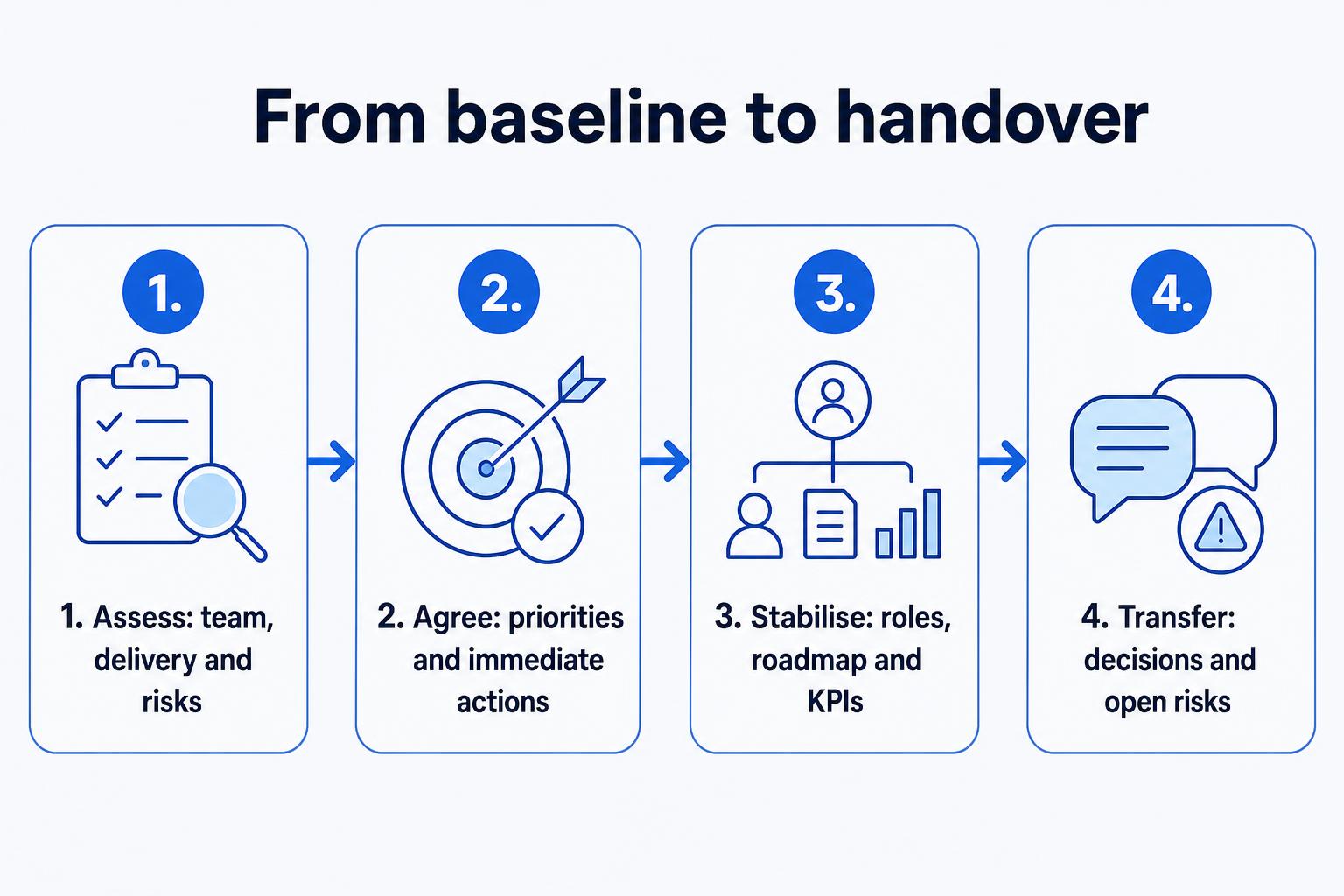
The first phase should establish the baseline: architecture, code quality, team, processes and risks. The interim CTO then agrees a priority plan and immediate actions with leadership. Once delivery is steadier, the work shifts towards clear roles, a roadmap and indicators that your board can review. Keep a decision log so the permanent leader can distinguish an agreed trade-off from an unresolved problem.
Set review points in the mandate for two separate questions: is the interim leader achieving the agreed outcomes, and what permanent leadership model does the organisation now need? A good interim outcome is not automatically a case for copying the interim role into a permanent job description. Your board may decide it needs a different balance of strategic, operational and people leadership as the next phase becomes clearer.
On request, the interim CTO can define the successor’s role profile, run technical interviews and onboard the new leader. Your organisation remains responsible for its permanent hiring decision; Remoteplatz is not a recruitment agency and does not place permanent employees. Plan an overlap or another agreed transfer mechanism so that ownership of priorities, risks and team relationships does not disappear at the mandate’s end. Work results and rights to code and intellectual property should be assigned to your organisation in the contract; check that the offer reflects the work you have scoped.
Frequently asked questions
Should we appoint an interim CTO if our engineering leads are capable?
Possibly, if the missing element is cross-team authority, board-level risk ownership or capacity to guide the next phase. First establish which decisions your leads can already make; do not add a leadership layer without a defined gap.
Can we begin before deciding on the permanent CTO role?
Yes. Give the interim leader a fixed term and clear operating remit, then use the assessment and board review points to define the longer-term role. Your board should retain the permanent hiring decision.
What should be complete at the end of the mandate?
Expect an agreed account of delivery priorities, material risks, decision ownership and the roadmap, plus a deliberate transfer to the permanent leader or continuing team. Define those deliverables in the mandate rather than relying on an informal handover.
Conclusion
After a funding round, scope temporary technology leadership around the decisions and delivery risks you face now, while leaving room to design the permanent role on evidence. If a fixed-term leader is the right fit, review the Interim CTO service and book a technical briefing to discuss your mandate, authority and handover requirements.
Discuss the scope, decision rights and handover requirements for your interim CTO mandate. Book a technical briefing