Interim CTO Zurich: the first 100 days after an acquisition

Your Swiss SME has acquired a smaller software business. Its product still needs to ship, but you do not yet know who can make technology decisions across the two organisations. The acquired company’s CTO may have left, may be staying only briefly, or may be focused on their existing product. Meanwhile, the board needs a credible view of delivery risk before approving an integration plan.
If you search for interim CTO Zurich, availability alone is not the test. You need to decide whether there is a leadership gap that cannot wait for a permanent appointment, what authority a temporary leader would hold, and when that authority should end. This article shows how to make that decision, govern the first 100 days and hand over without losing accountability.
Interim CTO Zurich: when is a temporary mandate justified?
Appoint an interim CTO when a material technology decision has no credible owner and delaying it would put delivery or integration at risk. A CTO departure is an obvious trigger. Others include a transaction that combines two technology teams, or rapid post-funding growth that has outpaced the current leadership structure. An acquisition alone is not sufficient reason: first establish whether an existing leader can take responsibility with clear authority and enough time.
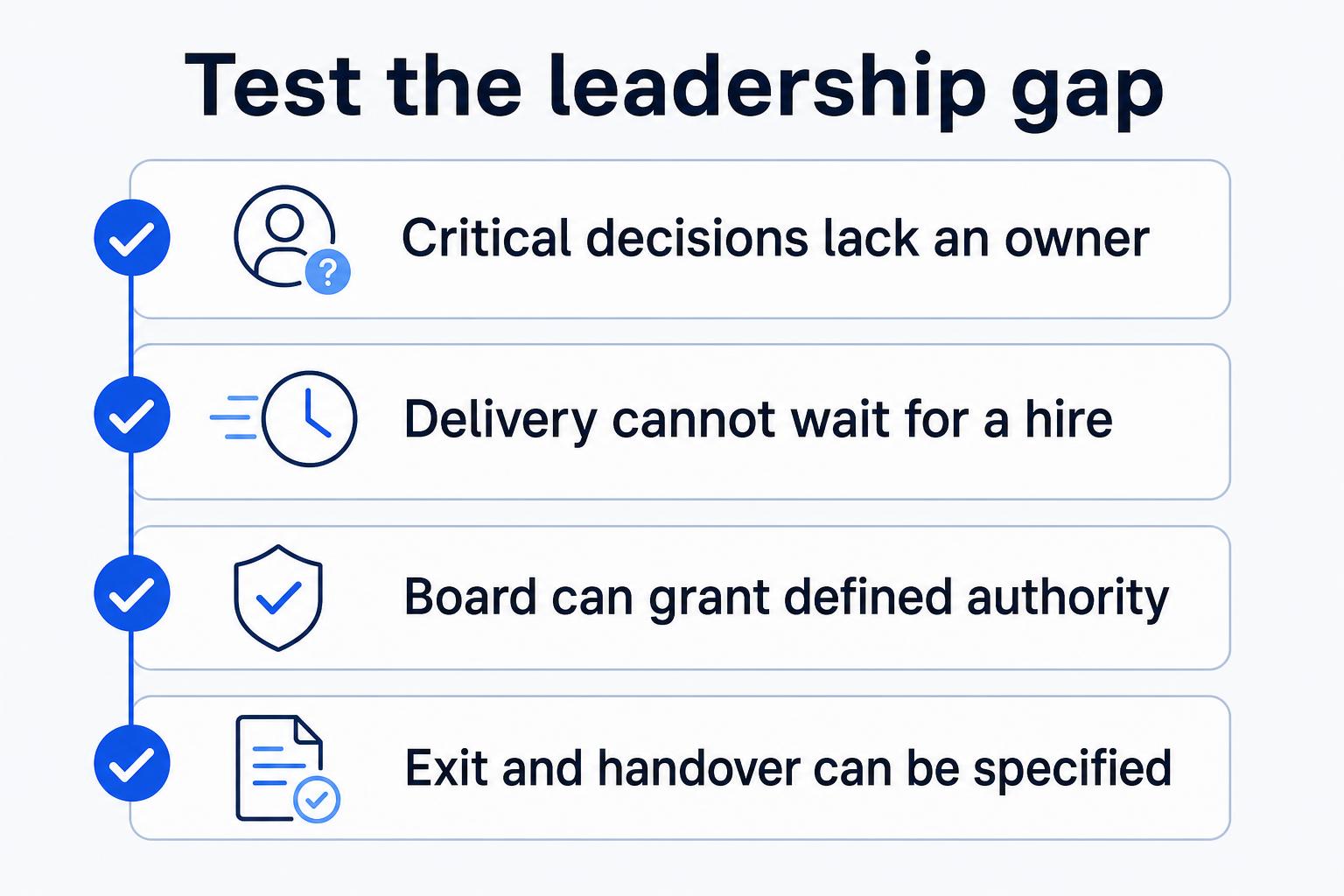
- Leadership gap: Identify who currently decides priorities, resolves disputes between teams and reports technology risk to the CEO and board. If nobody can do all three, name the gap.
- Immediate work: List the decisions that cannot wait for a permanent hire, such as protecting a release, assigning responsibility for critical systems or sequencing integration work.
- Available authority: Confirm that you can give an interim leader access to the right people and information, and a defined route for escalating decisions.
- Likely duration: Decide whether you need a fixed-term leader to run delivery and prepare a successor, or continuing part-time leadership once the immediate gap is controlled.
If your existing CTO can lead the integration while maintaining delivery, give that person an explicit mandate instead. If the need is continuing but less intensive, compare an interim appointment with fractional CTO support. For a departure without an acquisition, the separate CTO resignation mandate guide addresses a narrower succession problem.
What should the board put in the mandate?
Give the interim CTO a written decision brief, not a general instruction to ‘integrate the technology’. The board and CEO should agree the business outcomes, boundaries and reporting line before work starts. In the illustrative case here, the board wants to keep both products operating while deciding what to integrate, defer or leave separate. This is an assumption, not a Remoteplatz client example.
- Authority: State which delivery priorities the interim CTO can change, who approves material changes to the integration plan, and which decisions remain with the CEO or board.
- Assessment: Ask for a proportionate review of architecture, code quality, teams, processes and risks. Its purpose is to support decisions, not to promise a complete audit of every system.
- Early actions: Agree who owns live incidents, near-term releases and access to critical systems while the assessment is under way.
- Measures: Choose a small set of indicators you can review regularly, such as delivery commitments, unresolved critical risks and decisions awaiting an owner.
- Exit: Define what must be documented and transferred to a permanent leader, and who will accept the handover.
An Interim CTO mandate can be agreed for a fixed term, full-time or three to four days a week, with a monthly management fee. Choose the commitment around the decisions and team support required; the acquisition timetable alone should not determine it. The engagement models provide context for discussing the arrangement. Set a review point at which the board can narrow, extend or end the mandate rather than treating day 100 as an automatic finish.
How should the first 100 days run?
Use 100 days as a board planning horizon, not a promise that integration will be complete. The sequence below is an illustrative way to organise decisions; adjust it to the transaction and the state of the acquired business.
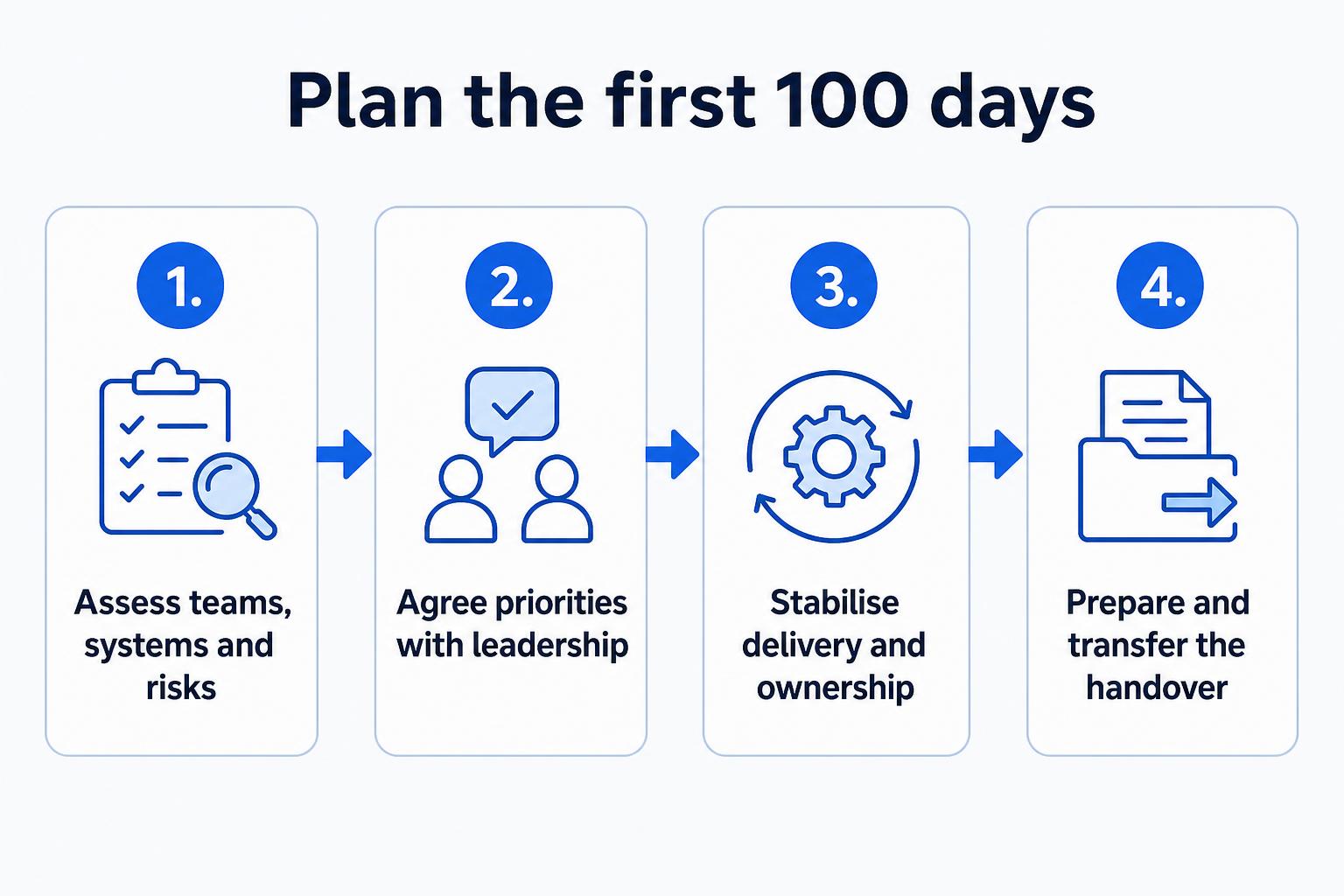
Establish control and assess
Confirm the current decision-makers, product commitments, system owners and immediate operational risks. The interim CTO should speak with leaders and engineers on both sides, review the available evidence and distinguish urgent issues from questions that need deeper investigation. Your CEO should make clear that the assessment is not permission for unapproved changes to the acquired product.
Agree priorities and stabilise delivery
Turn the assessment into a priority plan agreed with leadership. It should say which work continues, which integration decisions need board input, who owns each action and what evidence would change the plan. Establish clear roles, a realistic roadmap and a regular review of delivery and risk indicators. Where teams disagree, record the trade-off and decision owner rather than letting an unresolved issue stall both businesses.
Prepare the long-term owner
Before the end of the planning horizon, decide whether the combined organisation needs a permanent CTO, another internal owner or a continuing fractional arrangement. Start the handover while the interim leader still has direct knowledge of the teams and decisions. Avoid making the permanent leader inherit a roadmap whose assumptions and unresolved risks are invisible.
Which acquisition risks need a board-level check?
The board does not need to design the architecture. It does need to know which risks could alter its integration decision and who is authorised to act. Ask the interim CTO to separate observed facts, working assumptions and proposals in each update.
- Delivery collision: Are integration tasks competing with commitments to existing customers? Decide which commitments take precedence before asking teams to absorb both.
- Key-person dependency: Does one departing leader or engineer hold essential operational knowledge? Require named owners and a plan to capture that knowledge.
- System access: Who can access production systems and sensitive information across the two businesses? Agree the access needed for assessment and who approves changes.
- Ownership and contracts: Check that the mandate covers confidentiality, work results and rights to code and intellectual property. Remoteplatz’s work results and rights are contractually assigned to the client; confirm the transaction-specific position with your advisers.
- False certainty: Resist committing to a single merged platform before the teams have examined dependencies, delivery obligations and the cost of disruption.
Note: Have qualified advisers check transaction-specific access, intellectual-property arrangements and applicable Swiss and EU data-protection requirements; this does not replace legal or tax advice.
Ask for a short risk register with an owner, impact and next decision for each significant item. If you need a framework for questioning architecture evidence, the technology due diligence guide offers relevant prompts, although it addresses a funding context rather than post-acquisition integration.
What makes the handover credible?
A good interim appointment reduces the risk of a rushed permanent hire; it does not remove the board’s responsibility for that hire. Specify the successor’s role only after the interim assessment has shown what the combined business needs. On request, the interim CTO can define the role profile, run technical interviews and onboard the new leader. Remoteplatz provides temporary leadership, not permanent placement.
Require a handover that another leader can use: the current roadmap and its assumptions, architecture and operational concerns, team responsibilities, open decisions, risk owners and agreed measures. Arrange overlap where practical so the successor can challenge priorities and meet the people who will deliver them. The board should then confirm who owns each unresolved decision after the interim term. If the permanent appointment will take longer, consider whether the need remains a full interim mandate or could move to a fractional model; the fractional-versus-full-time guide helps frame that longer-term choice.
Frequently asked questions
Should we appoint an interim CTO if the acquired company still has a CTO?
Not automatically. First test whether that CTO has the authority, capacity and support to lead the combined technology agenda. An interim mandate is more useful when critical cross-company decisions otherwise lack an accountable owner.
Can the interim CTO select our permanent successor?
On request, the interim CTO can help define the role, conduct technical interviews and onboard the new leader. Your organisation remains responsible for the appointment; Remoteplatz does not provide permanent placement.
When should we decide whether to extend the mandate?
Set a review point in the initial mandate, before the handover becomes urgent. Assess delivery stability, unresolved integration decisions and the readiness of a permanent or fractional successor against the outcomes you agreed at the start.
Conclusion
Appoint an interim CTO after an acquisition when you need a named leader to protect delivery, establish a defensible integration plan and prepare a clear transfer of responsibility. Define authority and exit criteria before work begins, then review evidence rather than relying on a 100-day deadline alone. If that describes your gap, review the Interim CTO service and book a technical briefing to scope the mandate.
Discuss the leadership gap, decision authority and handover you need after an acquisition. Book a technical briefing