CTO as a Service Cost: Budgeting for Swiss Retail Outages

Assume you are the CFO of a Swiss online retailer. Order-processing outages keep recurring, peak season is approaching, and operations wants a budget approved now. You need to decide whether the immediate gap is technology leadership, engineering capacity or both. Comparing proposals solely by their headline fee could leave the cause of the outages—and responsibility for fixing it—unaddressed.
CTO as a service cost depends on the commitment, authority and work you ask the person to take on. A fractional CTO retainer can provide recurring senior decisions; a time-bound interim mandate can put one leader in charge of a defined recovery period; additional engineers can deliver agreed changes. This article shows how to compare those options, identify cost drivers and check a proposed budget before you approve it.
First, define the outage problem you are buying help to solve
Do not begin with a preferred title or team size. Ask your technology and operations leads for a concise account of what has failed, how often it has happened, which parts of order processing were affected and what remains uncertain. Separate known defects from suspected causes. The initial brief should make it possible for a prospective leader or delivery team to challenge the scope rather than price an undefined rescue.
- Business impact: Identify affected order steps, operational workarounds, customer commitments and the peak-season dates that constrain change.
- Current ownership: Name who decides incident priorities, approves production changes and communicates with operations today. An outage can persist even when engineers are available if no one owns these decisions.
- Evidence: Gather incident records, relevant system and provider responsibilities, the current change backlog and known capacity constraints. Record what you cannot yet verify.
- Immediate outcome: Specify what you need before peak season: an assessed risk, a prioritised stabilisation plan, completed changes, or some combination. Do not describe an assessment as if it guarantees an outage-free peak.
If the main gap is unclear technical direction, consider external leadership first. If decisions and priorities are already sound but delivery is blocked, additional engineering capacity may be the better starting point. If both gaps exist, budget for both roles and make their boundaries explicit.
CTO as a service cost: compare commitment with responsibility
A fractional retainer and an interim mandate buy different levels of availability and operational involvement. Neither is interchangeable with a delivery squad, which supplies capacity to implement work rather than automatically owning technology decisions. Ask for proposals against the same outage brief and the same required outcomes.
Fractional CTO retainer: recurring decisions
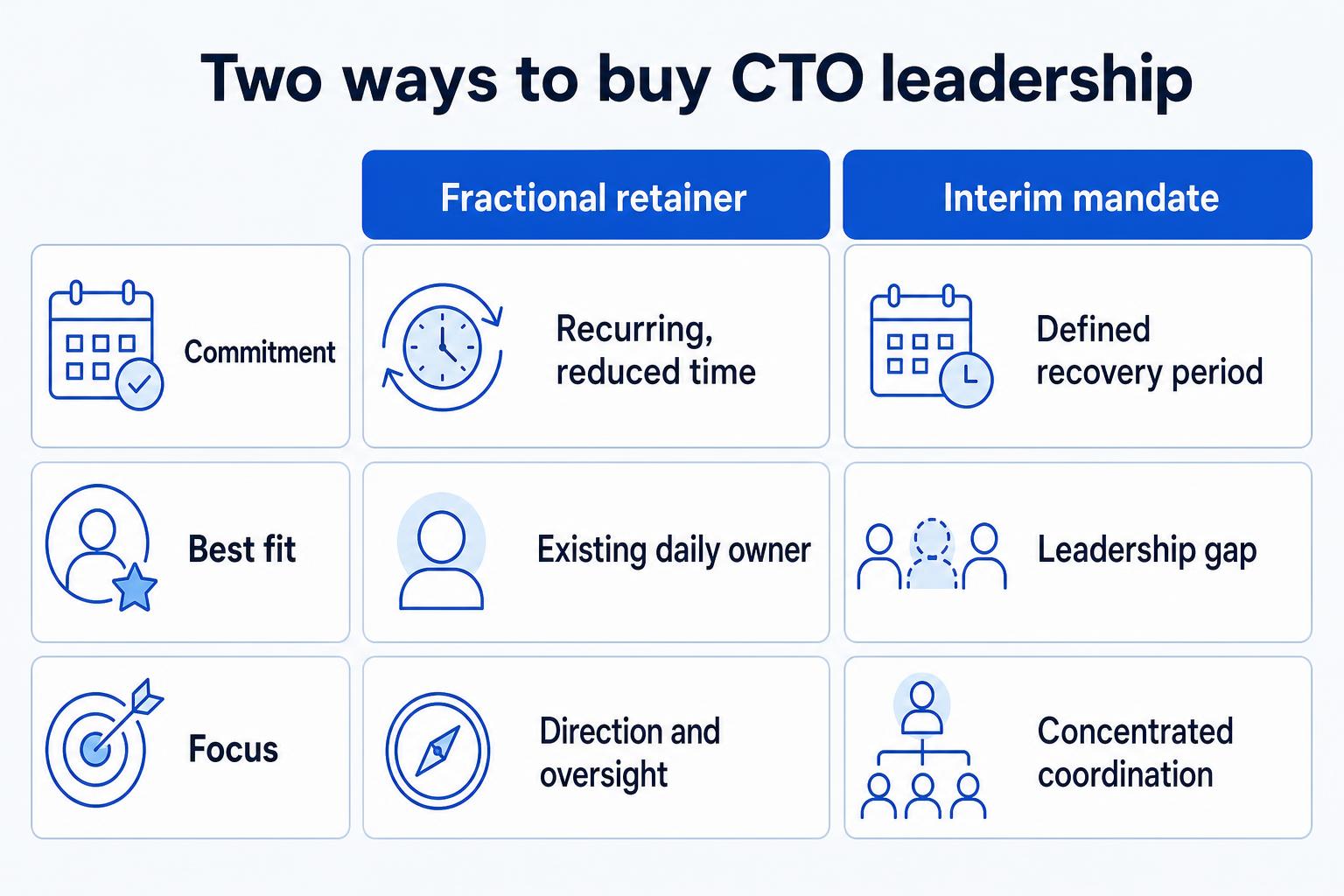
A fractional CTO can take responsibility for technology decisions, guide engineers and report to leadership at a reduced commitment, typically one or two days a week. For this retailer, the scope might cover an architecture and incident review, a prioritised stabilisation roadmap, provider decisions and regular executive reporting. This is most credible when someone in the existing team can handle day-to-day incidents and delivery between the CTO’s working days. Remoteplatz fractional retainers run for at least three months; include that minimum commitment when comparing budgets.
Time-bound interim mandate: concentrated leadership
An interim CTO mandate is a stronger candidate when the retailer has no effective technology lead, needs hands-on coordination across several teams or providers, or must establish clear decision-making through the peak period. Define the mandate’s start and end conditions, authority, expected availability and handover. A retainer can become an interim mandate, or vice versa, if the needed commitment changes. An interim leader still needs access to people who can carry out the work.
Delivery squad: implementation capacity
A proposed delivery squad should be assessed as a defined group of people with specified skills, capacity and deliverables, not as a substitute for an accountable technology leader. It may be appropriate when a capable internal lead has already prioritised the fixes and can review and accept them. If you consider external senior software engineers, ask who will direct their work, provide access, test changes and decide whether a release is safe. Confirm the composition and availability of any proposed squad during scoping rather than assuming a standard package.
Permanent hiring and executive search answer a longer-term staffing question, not necessarily the immediate peak-season gap. Compare their time to an effective decision-maker and the continuing role you actually need, without treating a temporary mandate as a permanent-placement service. Remoteplatz provides ongoing B2B services, not permanent placement.
What moves the budget beyond a headline rate?
Searches for fractional CTO rates or an interim CTO day rate Switzerland may suggest a simple price comparison. No Remoteplatz prices or day rates are published; terms follow a scoping call and an individual offer. The useful comparison is the total commitment required to achieve and verify the same defined outcome.
- Time and duration: Compare the retainer’s minimum term and scheduled access with an interim mandate’s expected duration and availability. A lower apparent rate is not a saving if critical decisions must wait.
- Authority and scope: Establish who can prioritise work, direct engineers, challenge providers, approve architectural choices and report risks to you. More responsibility usually means a different scope from occasional advice.
- Delivery effort: Separate leadership from engineering, testing and operational work. A CTO may define the recovery plan without providing all the people required to execute it.
- Uncertainty: If the root cause is not established, price an initial assessment and a decision point before authorising a broad implementation budget. Ask how the proposal handles a change in findings or priorities.
- Commercial boundaries: Compare what is included in the retainer or mandate, how additional work is agreed, and what reporting and handover you receive. The engagement models are a useful starting point, but the offer should control the comparison.
For a retainer vs day rate decision, request the expected commitment over the whole decision period, not just the unit used for billing. Remoteplatz clients receive one monthly invoice from Remoteplatz GmbH; currency and VAT are clarified in the offer. Seek appropriate professional advice on the treatment of a proposed contract or invoice.
Note: Contractual and tax treatment depends on your circumstances; this does not replace legal or tax advice.
What should you check before approving the budget?
Require a short, comparable scope from each proposed option. The approval should give you a way to stop, redirect or expand work when the initial evidence changes—not merely authorise a number.
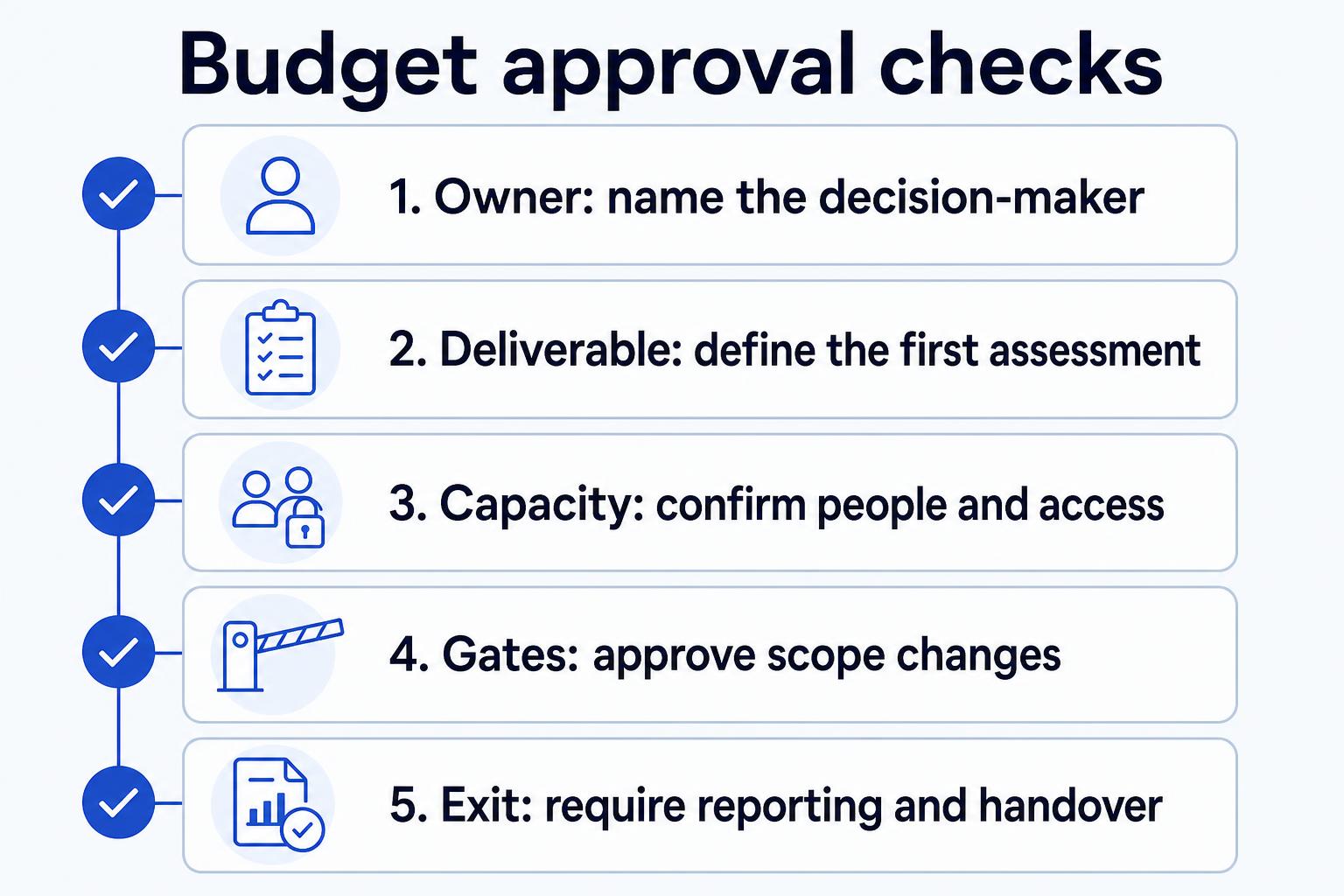
- Accountable owner: Name the person who will make technology decisions and the person in your business who will accept the work. If these are different people, define how disagreements are resolved.
- First deliverable: Ask for a time-bound assessment of outage causes, unresolved risks and a prioritised plan. Distinguish the evidence you expect from the changes that might follow it.
- Capacity and dependencies: Check the leader’s availability, the engineers available to implement fixes, access to providers and systems, and the time your operations team must contribute.
- Approval gates: Identify what can proceed immediately, what requires a fresh estimate after diagnosis and who authorises work that changes scope.
- Reporting and exit: Set a reporting rhythm, decision record and handover requirement. Specify who will own incident response and the backlog when the external commitment ends.
If you are also considering a longer-term hire, compare the interim coverage you need now with the enduring leadership role. The fractional versus full-time CTO comparison addresses that separate decision. For a different budgeting example, see the Swiss ERP modernisation cost guide; an outage before peak season calls for its own risk and timing assumptions.
Set a peak-season decision point, not an open-ended rescue
The first engagement should reduce uncertainty quickly enough for you to choose the next commitment. Agree when the leader will present the diagnosis, which stabilisation work is feasible before peak season, and which changes should wait because they introduce further risk. If the assessment shows that existing engineers can deliver the priority fixes, you may need leadership without a new squad. If the plan is clear but the team cannot deliver it, add scoped capacity. If neither ownership nor capacity exists, approve them together with distinct responsibilities.
Keep a named internal sponsor throughout. The external lead can advise and direct within the agreed mandate, but your business still needs to decide its acceptable operating risk, customer priorities and spend limits. Make the handover a budget item from the outset so that knowledge, outstanding risks and ownership do not disappear when a time-bound mandate ends.
Frequently asked questions
Is a fractional CTO enough if outages are happening now?
Possibly, if day-to-day incident ownership already exists and the gap is senior prioritisation and technical direction. If decisions or coordination are needed throughout the working week, assess an interim mandate instead.
Should we approve a delivery squad before the cause is known?
Approve only clearly scoped diagnostic or stabilisation work at first. Once a responsible lead has prioritised the changes, you can assess the skills, capacity and budget required to deliver them.
Can we switch from a retainer to an interim mandate?
Yes. Remoteplatz allows a fractional retainer to become an interim mandate, and vice versa. Agree the revised availability, scope and commercial terms before the change.
Conclusion
For recurring retail outages, compare proposals by the decisions they cover, the delivery capacity they require and the risks they leave with your team—not by a headline rate alone. If you need to scope external leadership, review CTO as a Service and book a technical briefing with your incident evidence and peak-season deadlines.
Discuss the outage brief, leadership gap and delivery capacity you need before peak season. Book a technical briefing