CTO as a Service Cost: Budgeting a Swiss ERP Modernisation

Your manufacturing business is preparing to modernise its ERP. Operations wants fewer disruptions, the technology team needs decisions on architecture and providers, and the board wants a budget it can control. Before comparing proposals, you need to know whether the gap is leadership, delivery capacity or both.
That distinction matters more than an isolated rate when assessing CTO as a service cost. In this illustrative scenario, the business and its needs are assumptions, not a Remoteplatz client case. This article shows how you can scope the three options, compare their cost drivers and put a decision-ready budget in front of leadership.
Start with the work the ERP programme cannot leave unowned
Write down who will make and approve technology decisions before requesting a retainer, mandate or team proposal. A delivery squad can add capacity, but it should not become the default owner of the ERP strategy merely because it is doing the work.
- Business ownership: Name the executive who sets operational priorities, accepts process changes and approves spending.
- Technology leadership: Identify who assesses architecture, integration dependencies, provider choices and technical risks, then explains trade-offs to leadership.
- Delivery ownership: Identify who plans, implements and tests the agreed work, and who accepts its results.
- Continuity: Decide who will retain the rationale for decisions and take responsibility after the external engagement ends.
For an ERP modernisation, the first useful output is a short decision register: open choices, their owners, the evidence required and the date each choice must be made. If no one can own the technology decisions, buying more implementation capacity first may increase rather than resolve budget uncertainty.
Which engagement should you budget for?
A fractional CTO fits when you need continuing technology leadership but not a full-time CTO. The service covers areas such as strategy, architecture review, provider selection, engineering leadership and reporting to management or the board. Remoteplatz describes the usual commitment as one to two days a week; its fractional retainers run for at least three months. Budget it against defined responsibilities and review points, not just attendance.
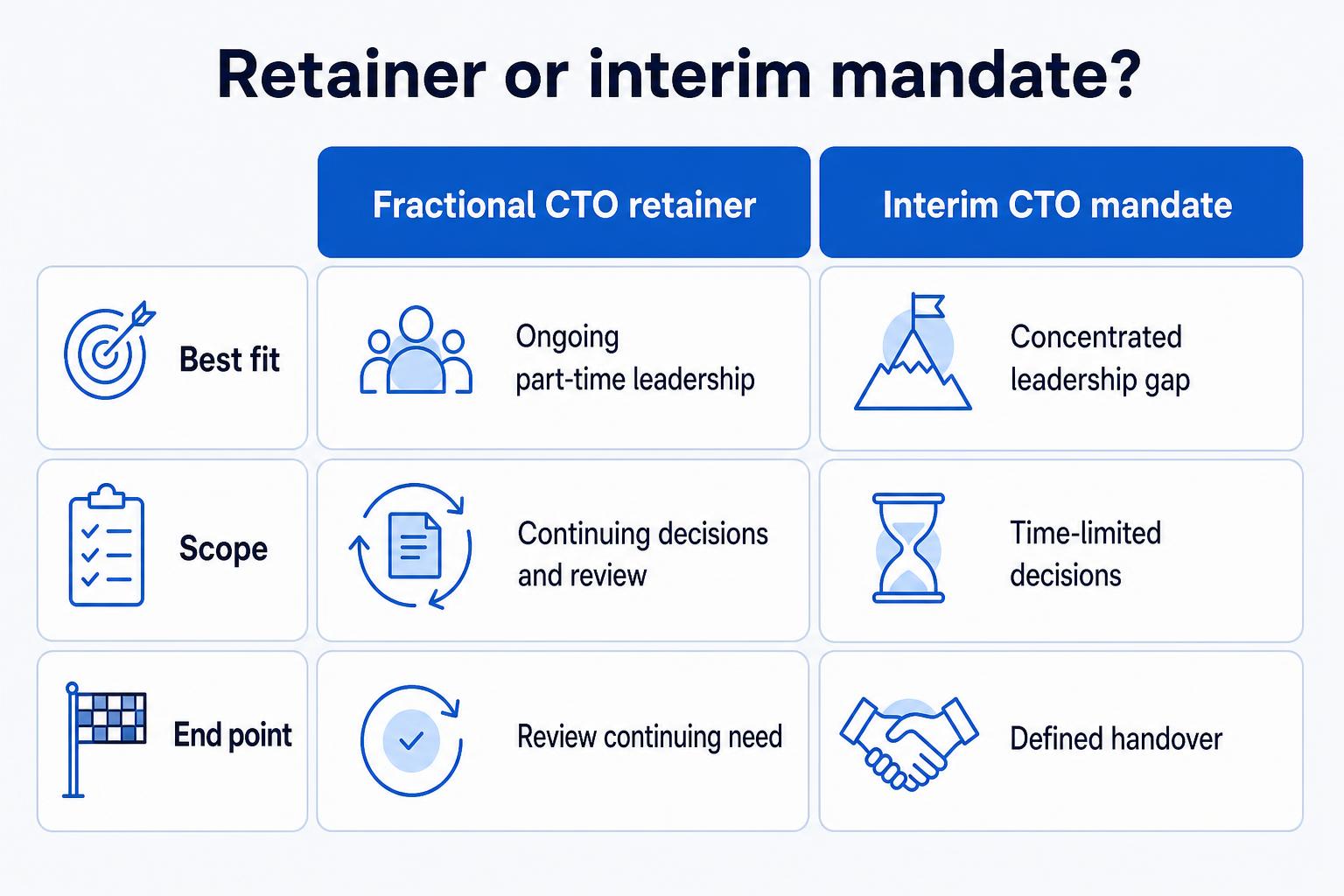
An interim CTO mandate is more appropriate when a time-limited period calls for concentrated leadership: for example, while critical ERP decisions are being made or a leadership gap must be covered. Define the mandate’s decision authority, expected availability, end condition and handover. A retainer can become an interim mandate, and vice versa, if the need changes.
A delivery squad addresses implementation capacity. It may be the right purchase when your organisation already has someone accountable for technical decisions but lacks the people to deliver the agreed scope. If you need specific engineering capacity, assess the senior software engineer service alongside any proposed team arrangement. Ask who will direct the work and integrate its output with your existing ERP programme; do not assume the squad includes CTO-level governance.
These are not necessarily exclusive choices. You might need a fractional leader to set direction and separate delivery capacity to execute it. Keep their responsibilities and budgets distinct so the same work is neither purchased twice nor left unowned.
What drives CTO as a service cost in an ERP programme?
There is no published Remoteplatz price or day rate to insert into a generic ERP budget. Terms are provided in an individual offer after scoping. If you are comparing fractional CTO rates with an interim CTO day rate in Switzerland, ask every provider for the same scope assumptions rather than treating the rate alone as the total cost.
- Decision load: Count the architecture, integration and provider decisions that need senior review, not only the meetings you expect someone to attend.
- Availability: Specify the working pattern and how urgent decisions or escalations will be handled. A retainer and a concentrated interim mandate may price different levels of access.
- Duration: Link the engagement to ERP decision gates. For a fractional Remoteplatz retainer, include the minimum three-month term in the committed budget.
- Delivery scope: Separate leadership from engineering effort, internal staff time and any provider work. An external leader’s fee is not the whole modernisation budget.
- Handover: Allow time for documenting decisions, transferring ownership and resolving open issues before the mandate ends.
To compare retainer vs day rate, request a proposal that states the included responsibilities, expected commitment, assumptions about additional work and approval route for scope changes. The engagement models and costs page provides service context, but your approval should be based on the offer for your programme.
Remoteplatz works directly B2B and issues one monthly invoice to its client; currency and VAT are clarified in the offer. The client does not administer payroll or Swiss social security contributions for the Remoteplatz engagement.
Note: Check the contractual, VAT and social-security treatment of your specific arrangement with qualified advisers; this does not replace legal or tax advice.
Build a budget the board can compare
Use one worksheet for all options. Create separate lines for external leadership, delivery capacity, internal time, other provider work and a change allowance set through your own budgeting process. Do not use an assumed day rate as a substitute for a scoped offer.
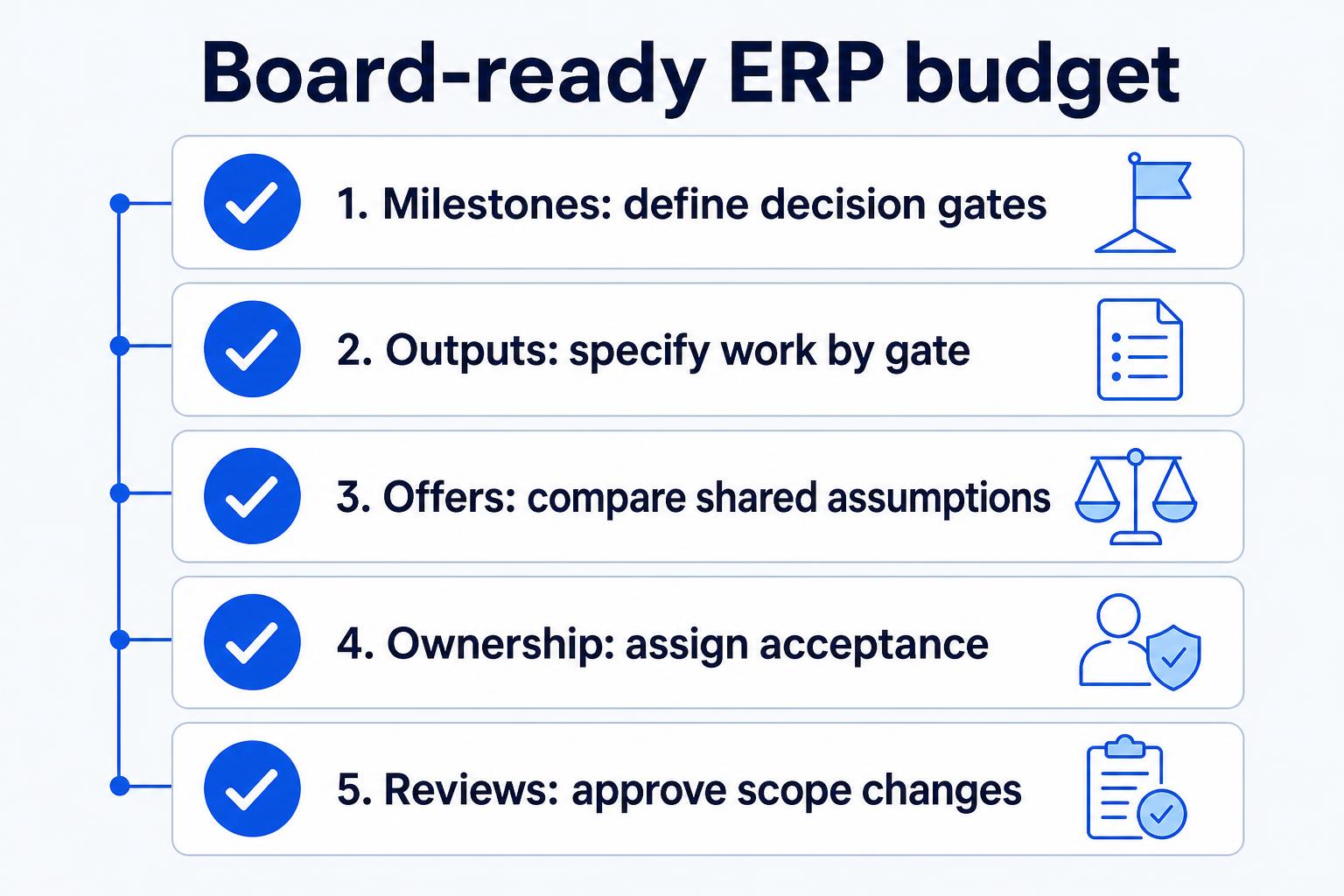
- Define the decision period: Identify the ERP milestones that need leadership, such as provider selection, architecture approval and the decision to proceed with delivery.
- Specify outputs: Ask what each option will deliver by those milestones: decision records, reviewed plans, delivery work or a handover.
- Request like-for-like offers: Give providers the same description of systems, decision rights, internal capacity and known constraints. Ask them to identify exclusions.
- Test the combined plan: If you buy both leadership and delivery, name the person who accepts work, manages dependencies and approves changes.
- Set review gates: Agree when leadership will reassess scope, spend and whether the engagement should continue, change form or end.
Compare the total commitment for the defined period, the work covered and the consequences of delayed decisions. The least expensive-looking line item is not necessarily the lowest-risk plan if it leaves architecture or provider decisions without an owner.
Compare external support with a permanent hire
A permanent CTO may make sense when technology leadership is a sustained, full-time requirement and you are prepared to build that role inside the organisation. A fractional CTO is a different choice: accountable external leadership at reduced commitment while you retain responsibility for business priorities and approvals. For a closer discussion of the trade-off, see fractional CTO versus a full-time hire.
Executive search is a route to recruiting for an internal role, not an alternative delivery model for the immediate ERP work. Compare its timing and organisational commitment qualitatively with the work you need covered now. Remoteplatz is not a recruitment agency: it does not offer permanent placement or employment contracts with clients, and it charges no placement fee. Do not put a hypothetical recruitment saving into the approval paper.
Before signing, ask how decisions, working documents and implementation results will be handed back to your organisation. Remoteplatz states that work results and rights to code and intellectual property are contractually assigned to the client; confirm the applicable scope in your agreement. This keeps the ERP programme’s continuity in view even if the engagement model later changes.
Frequently asked questions
Should we approve a delivery squad before appointing a technology lead?
Only if someone you trust already owns architecture, provider decisions and acceptance of the squad’s work. Otherwise, scope leadership first or budget the two responsibilities separately.
Is a retainer always cheaper than an interim mandate?
No general conclusion follows from the billing model. Compare the scoped period, expected availability, included decisions, exclusions and handover in individual offers; neither a rate nor a retainer figure tells you the whole programme cost.
What if our leadership need grows during the ERP programme?
Review the decision load and required availability at an agreed gate. A fractional retainer can become an interim mandate, or the reverse, but the revised scope and terms should be agreed before you rely on the change.
Conclusion
Approve the model that fills your actual gap: ongoing part-time leadership, concentrated interim leadership or delivery capacity under an existing decision-maker. For a scoped view of CTO as a Service alongside your ERP budget, book a technical briefing and bring your decision register, milestones and current ownership map.
Discuss the ERP decision points, leadership responsibilities and delivery capacity you need before requesting an offer. Book a technical briefing