Fractional CTO Switzerland: Scoping a Discontinued CRM Decision

Assume your Swiss SME relies on one CRM for sales and customer service. Its provider announces that the product will be discontinued and proposes a migration. The proposal may be sensible, but signing it before you understand your data, integrations and alternatives could commit your team to the wrong route.
A fractional CTO in Switzerland can take responsibility for the technical assessment at a reduced time commitment while you retain the business decision. The useful mandate is not ‘choose a new CRM’: it is to establish the facts, compare credible routes and give leadership a recommendation the team can execute. This article shows how to scope that mandate.
Start with the discontinuation facts, not the vendor pitch
Ask the provider for its written discontinuation notice, proposed migration scope and the dates that matter: when the current product loses support, when access or exports change, and which services continue during a transition. Treat dates in this example as questions to verify, not as assumed deadlines.
Then ask your CRM owner and team to describe what the system actually does. Include sales and service workflows, reporting, customer-data exports, connected tools, user access and any customisations. Record who can supply evidence for each dependency. If parts of the setup are managed externally, use an outsourced IT ownership checklist to identify who can answer questions and authorise changes.
Set the business constraints before requesting a recommendation: which operations cannot pause, what disruption users can tolerate, which decisions need leadership approval and when a choice must be made. Without that brief, a provider migration and a replacement can appear comparable on licence features while carrying very different transition risks.
How to scope a fractional CTO in Switzerland for this decision
Commission a bounded decision mandate with an agreed output, access to the right people and a named executive sponsor. A practical brief asks the CTO to:

- Verify the deadline: confirm what the provider is discontinuing and what the proposed migration does and does not include.
- Map dependencies: review workflows, data, integrations and the team’s capacity to support a change.
- Assess options: challenge the provider proposal against a small set of plausible replacements using the same criteria.
- Recommend a route: present assumptions, unresolved risks, decision points and an outline transition sequence to leadership.
Define the deliverables as a short options assessment, a risk and dependency register, and a decision briefing—not a promise to complete the migration. Specify whether the CTO may contact vendors, who approves that contact, and whether implementation oversight is a separate phase. The CTO as a Service offering covers technology strategy, architecture review, provider selection and team leadership; your mandate should name only the responsibilities this decision requires.
A fractional CTO owns the technical recommendation and helps lead engineers through the assessment. An IT consultant may instead be engaged for a defined specialist analysis or implementation task. ‘Part-time CTO’ generally describes the reduced time commitment; ‘virtual CTO’ emphasises remote delivery; ‘CTO on demand’ describes access when needed. These labels do not settle authority or availability. Put both in the brief. If you are weighing this against a permanent leadership role, see the fractional versus full-time CTO comparison.
Compare the provider migration with replacement options
Require the same evidence for each viable route. The provider’s migration may preserve familiar workflows, but you must verify which data, customisations and integrations transfer and what your team must rebuild. A replacement may better fit future needs, but it requires a fresh assessment of workflow fit, data transfer, integrations, user adoption and ongoing ownership. Neither route wins merely because it is familiar or new.
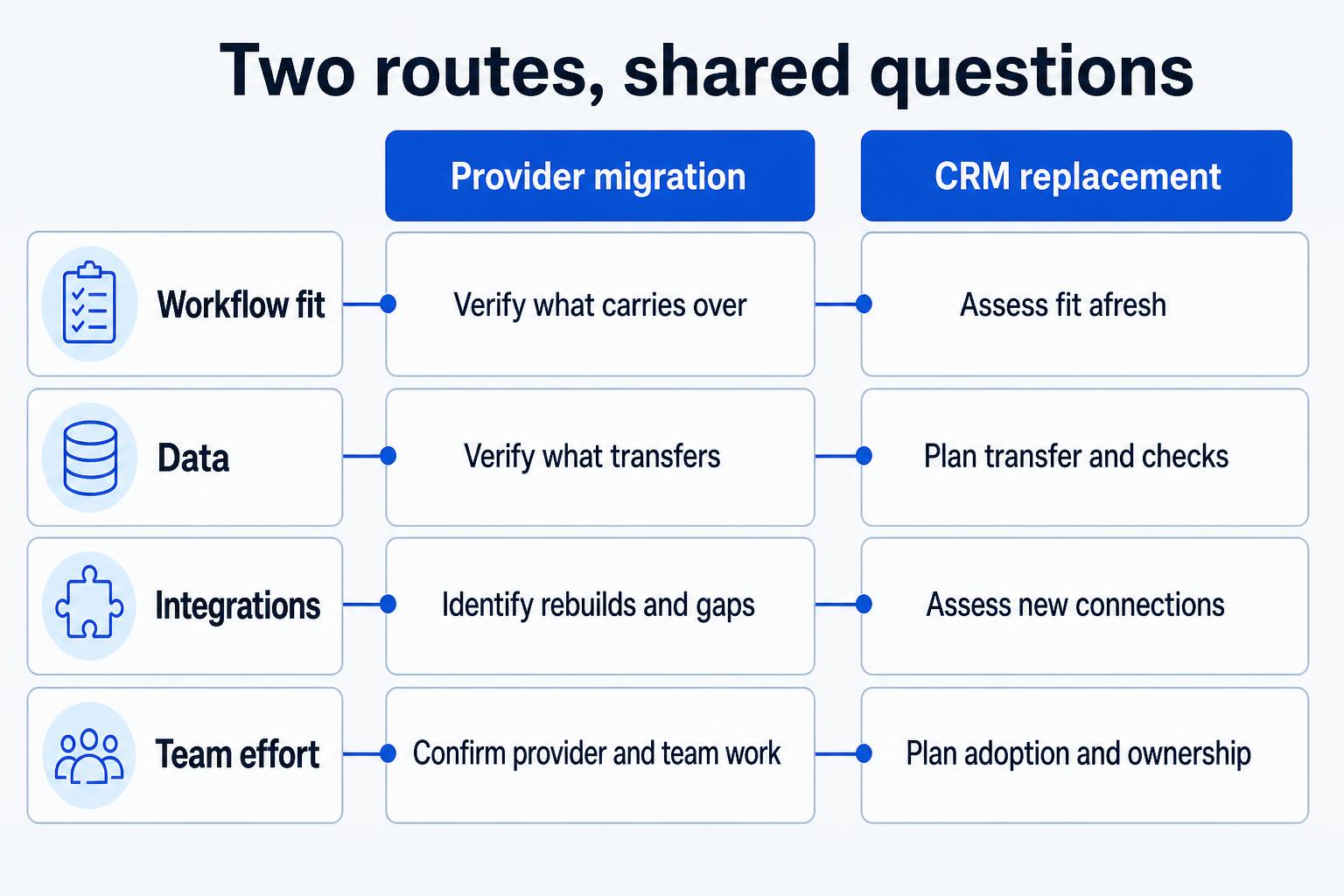
- Continuity: can sales and service operate through the transition, and what is the fallback if they cannot?
- Data and integrations: what can be exported, checked and connected, and who will resolve gaps?
- Team effort: what work falls on employees, the incumbent provider or another supplier?
- Commercial exposure: which vendor commitments, transition tasks and continuing costs require confirmation in a proposal?
- Decision confidence: which findings are evidenced, and which need a test or written vendor response before approval?
Ask the CTO to show where an option has been ruled out and why. A recommendation should name the preferred route, a viable fallback if there is one, the evidence still needed and the consequences of waiting. Leadership can then make an explicit trade-off rather than delegating the business decision to the incumbent provider.
Set ownership, cadence and exit conditions
Give the CEO or another executive sponsor ownership of the business decision and priorities. The fractional CTO owns the technical assessment and brings disagreements to leadership. Your CRM owner represents users and current workflows; engineers or external IT providers supply integration and data evidence; finance challenges commitments and the basis for comparing costs. Agree who can approve vendor spending and any change to the mandate.
Arrange an initial briefing, regular working sessions with the team and a leadership decision review. Ask for a written update before that review so the CFO and operational owners can challenge assumptions. A typical fractional commitment is one or two days a week, but the right cadence depends on the deadline, the state of your documentation and how quickly vendors and your team can respond. Remote delivery can work if system access and meetings are organised; the label ‘virtual CTO services’ should not imply that stakeholder time is optional.
Set an exit test: leadership has an evidenced decision, a named owner for the next phase, a sequenced transition outline and a list of issues that remain open. If the choice leads to substantial delivery leadership, scope that separately; an interim CTO mandate may be more appropriate when the role needs a heavier weekly commitment. Do not let an assessment retainer silently become an implementation commitment.
Budget the mandate and prepare the first briefing
Price the leadership work separately from CRM licences, vendor migration services, integration work and internal team time. The main cost drivers for the CTO mandate are the number of viable options, the quality of current documentation, the number of integrations, stakeholder availability and whether the CTO is asked to oversee delivery after the decision.
Remoteplatz’s published guide price for a fractional CTO starts at CHF 1,100 per day net; a one-day-a-week retainer starts at CHF 4,400 per month net, plus VAT where applicable. Fractional retainers run for at least three months. These are ‘from’ prices, not a quote for this CRM assessment; the binding proposal follows a scoping call. Review the engagement models and costs and use the CFO contract checklist when agreeing scope, reporting and approval terms.
For the first briefing, bring the provider notice and proposal, a list of CRM users and connected systems, known contract dates, and the leadership deadline for a decision. Say what you need to decide—not which product you want the CTO to endorse.
Frequently asked questions
Should the fractional CTO choose the replacement CRM for us?
No. Ask for a technical recommendation with evidence, risks and a fallback. Your leadership team remains responsible for the business trade-off and approval.
Can we use a virtual CTO if our team and provider are in different places?
Yes, if the mandate specifies access, meetings and decision authority. Remote delivery does not remove the need to work directly with your CRM owner and technical team.
When is one day a week unlikely to be enough?
Question that cadence if the deadline is tight, dependencies are poorly documented or you also need hands-on delivery leadership. Agree the required commitment during scoping rather than assuming an assessment retainer covers implementation.
Conclusion
Scope the role around an evidenced comparison and a clear decision handover, not an open-ended search for software. If you need external technical leadership to challenge the migration proposal and align your team, review Remoteplatz’s fractional CTO service and book a technical briefing with the provider notice and your decision deadline to hand.
Bring the provider’s discontinuation notice, migration proposal and your decision deadline to scope the assessment. Book a technical briefing