Interim product manager in Switzerland: from pilot to product

Your industrial SME has a digital pilot that works for one customer. The customer wants the next feature, engineering is ready to build it, and sales sees a wider market. But nobody owns the decision about which parts should become standard and which should remain customer-specific.
An interim product manager in Switzerland can help you make that decision without treating a successful pilot as proof of a repeatable product. This article shows how to recognise the leadership gap, choose the right temporary mandate, set a product roadmap and prepare a handover to a permanent internal owner.
Is the pilot ready to become a product?
Start by separating evidence that the pilot works from evidence that other customers will buy and use substantially the same offer. A functioning deployment proves something important, but it may also depend on bespoke integration, manual support or knowledge held by one engineer.
- Customer need: Can you describe the problem in terms that apply beyond the pilot customer, and have other prospective customers confirmed it matters to them?
- Standard offer: Which workflows, data requirements and service commitments could remain consistent across customers? Record exceptions rather than quietly adding them to the core product.
- Delivery effort: Which parts of the pilot can your team deliver again, and which required one-off work or extensive customer access?
- Decision ownership: Who can say no to a requested feature when it conflicts with the wider product direction?
If the main uncertainty is still whether a shared customer problem exists, prioritise discovery before expanding delivery. If the problem is understood but every request becomes an engineering priority, you may have a product-leadership gap. For the broader question of evaluating an external lead, see the scale-up buying checklist for interim product management; the task here is specifically to productise an industrial pilot.
When does an interim product manager in Switzerland make sense?
Engage an interim lead when you have people who can build and sell, but no one with the time and authority to test product assumptions, make trade-offs and turn them into a shared plan. The role is not a substitute for executive sponsorship or customer access: you still need a business sponsor who owns the commercial ambition and can resolve escalations.
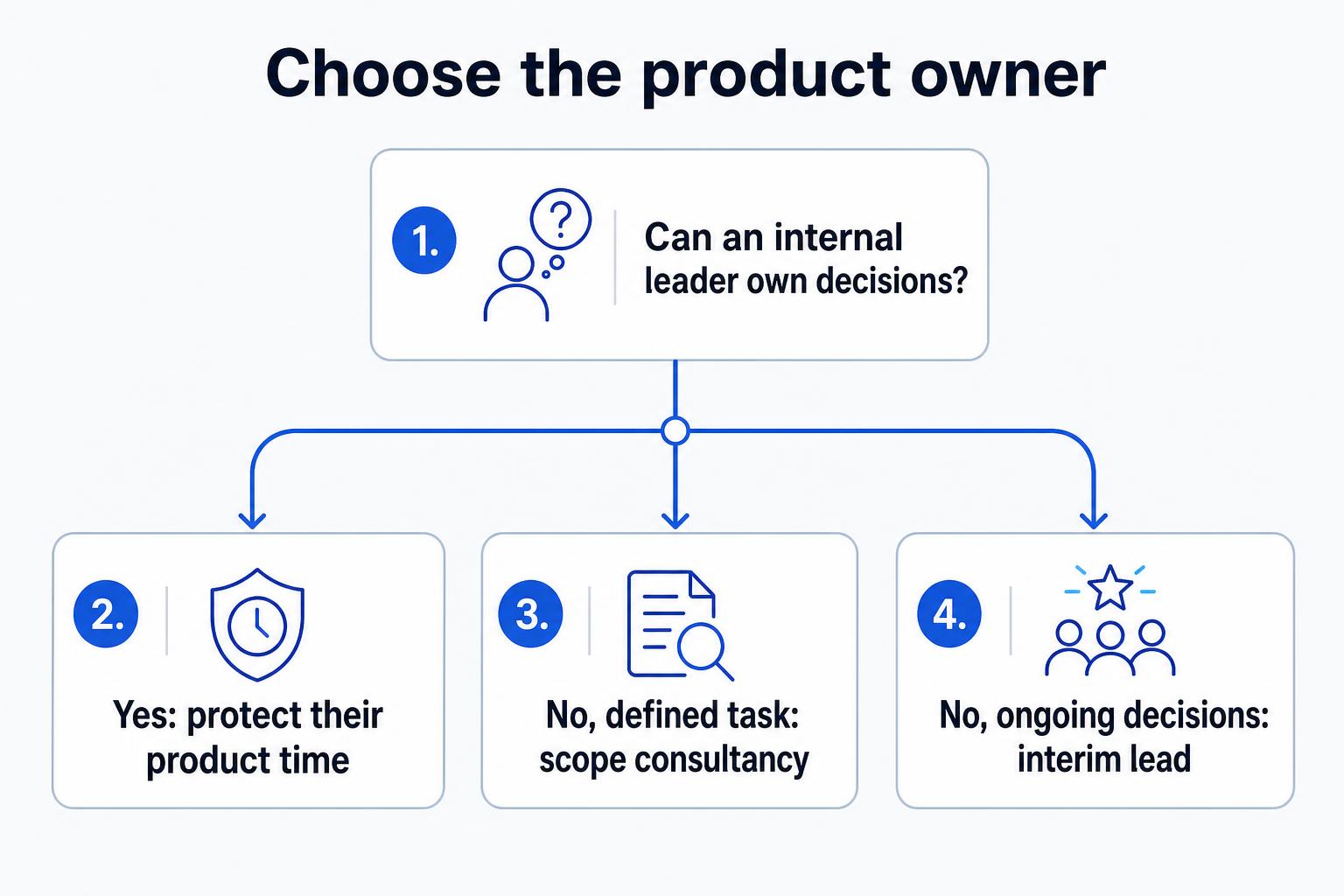
Before commissioning help, choose between three practical options. Give an internal business or engineering leader protected product time if they have the authority and capacity. Use a narrowly scoped consultant if you need a defined piece of discovery rather than ongoing ownership. Use an interim product lead if decisions must continue across customer discovery, prioritisation, specification and delivery while you establish a lasting owner. The interim product management service covers that continuing cross-functional role; a fractional or interim arrangement should reflect the work you need, not simply a preferred title.
Ask candidates how they would handle a request that benefits the pilot customer but makes every subsequent deployment harder. A useful answer should explain what evidence they would seek, who would make the commercial decision and how they would communicate the trade-off to engineering and sales. Qualitative cost drivers include the breadth of discovery, the number of stakeholders and customer environments, the depth of delivery involvement and the time needed for handover. Compare scope and responsibilities, not just the proposed time commitment; the engagement models provide a starting point for that discussion.
Give the interim lead a decision mandate, not just a backlog
Write a short mandate before asking anyone to produce a roadmap. State the product question, what the lead may decide, what needs executive approval and what evidence you expect at each review. An interim lead should work directly with your existing engineering, design and business team, rather than create a parallel decision structure.
- Outcome: Decide which parts of the pilot form a repeatable offer, for whom, and what remains a customer-specific service or exception.
- Authority: Let the lead propose priorities and requirements; name the sponsor who approves commercial commitments, major scope changes and investment.
- Access: Arrange conversations with the pilot customer, other relevant customers or prospects, and the people who delivered the pilot. Make customer access an explicit responsibility of the sponsor.
- Boundaries: Agree how product decisions connect to technical feasibility. If architecture, integration ownership or engineering leadership is also unclear, assess that separately rather than expecting a product lead to act as a CTO; fractional CTO support addresses a different leadership need.
- Review: Set a regular decision meeting where the sponsor can accept a recommendation, request more evidence or stop an assumption from becoming a delivery commitment.
The first useful output is not necessarily a feature list. It may be a clear statement that the pilot depends on exceptions that must be reduced before broader rollout. That is a product decision your team can act on.
Build a roadmap from evidence to repeatable delivery
Ask the interim lead for a roadmap that makes uncertainty visible. A sequence of promised features alone will not tell you whether the next customer can adopt the offer without recreating the pilot project.

- Map the pilot: Document the customer problem, working workflows, integrations, support burden and decisions made specifically for that customer. Mark what is known and what is assumed.
- Test transferability: Use customer interviews, hypotheses and small experiments to check whether the same problem and proposed offer apply elsewhere. Do not label an untested requirement as a market standard.
- Choose a product boundary: Define the common offer, permitted configuration and work that remains bespoke. Prioritise options by expected impact and effort, including the cost of maintaining exceptions.
- Specify and review delivery: Give engineering precise requirements and acceptance criteria for the next increment. Review what customers and the delivery team learn, then adjust priorities rather than treating the initial roadmap as a contract.
Keep a separate record of customer promises, unresolved assumptions and decisions awaiting the sponsor. If the principal obstacle is rollout feasibility rather than product direction, the enterprise rollout checklist can help you examine the technical leadership questions alongside this roadmap.
Plan the handover before the mandate begins
Decide who will own the product after the interim period: an existing leader with protected capacity, a new internal product leader or a clearly named executive sponsor while you decide. Remoteplatz provides temporary B2B product leadership, not permanent placement. If you have no credible successor, make the development of an ownership plan part of the mandate rather than leaving it to the final week.
Specify what the successor should receive: customer insights and their limitations; the product boundary and rationale for exceptions; prioritised opportunities and rejected options; requirements and delivery status; open commercial and technical decisions; and a map of the people who must be consulted. Require the interim lead and successor to review those materials together where possible. The handover is complete when the new owner can explain the next decisions and run the review meeting, not merely when the documents have been delivered.
Check that the proposed time commitment leaves room for both delivery and transfer of knowledge. A fractional retainer has a minimum term of three months, and a retainer can become an interim mandate or vice versa. The appropriate arrangement depends on the decision load and the pace at which your internal owner can take responsibility.
Frequently asked questions
Should we hire an interim lead if the first customer is still requesting changes?
Possibly, but give the lead authority to distinguish learning from bespoke commitments. If you cannot discuss the pilot customer’s needs alongside evidence from other customers, start by securing that access and agreeing who can approve exceptions.
Could our engineering lead own the roadmap instead?
Yes, if they have protected time, customer access and authority to make cross-functional trade-offs. If they must also lead delivery full-time, assign a separate product owner rather than assuming backlog management covers product strategy.
What should we ask for in the first briefing?
Bring a summary of the pilot, current customer commitments, your team structure, the decisions nobody owns and your intended long-term owner. Ask the prospective lead to propose a mandate with decision rights, initial discovery questions and handover responsibilities.
Conclusion
Turn the pilot into a product by testing what transfers to other customers, defining who can make trade-offs and giving the next owner a usable record of decisions. If you need temporary leadership to do that work with your team, review Remoteplatz’s interim product management service and book a technical briefing to scope the mandate.